
Engineering guide · Medical polymers
PEI vs PPSU: Comparing High-Temperature Medical Plastics
For high-temperature medical plastics, PPSU generally wins on repeated steam sterilization toughness; PEI (Ultem) often wins on stiffness, creep resistance, and high-heat rigidity for structural device parts.
If the part faces many autoclave cycles and impact risk, start with PPSU. If it must stay stiff at elevated temperature with tight CNC geometry, PEI is frequently the stronger engineering choice.
That combination makes them useful when ordinary plastics such as ABS, acetal, nylon, or standard polycarbonate cannot maintain their geometry or mechanical performance. In medical and laboratory equipment, the choice is rarely based on temperature alone. We also examine impact loading, disinfectants, steam exposure, transparency, tolerances, surface requirements, validation needs, and whether the component will be molded or CNC machined.
PEI at a glance
PEI is valued for high stiffness, strong tensile performance, low creep, and stable dimensions at elevated temperatures. Its amber or transparent appearance can also help engineers inspect internal features or fluid paths where the grade permits it.
PPSU at a glance
PPSU is especially attractive where repeated steam sterilization, impact resistance, and broad chemical compatibility are dominant requirements. It is often selected for reusable medical hardware exposed to aggressive cleaning cycles.
The right question is not simply “Which polymer has the highest temperature rating?” It is “Which material retains the required safety margin after heat, chemicals, loading, machining, and sterilization are combined?”
PEI vs PPSU: Core Material Properties
The following comparison describes typical unfilled material behavior. Exact results depend on resin grade, reinforcement, processing history, specimen geometry, moisture, temperature, and the test method. For a regulated device, we recommend reviewing the specific supplier datasheet and validating the finished component under its real service conditions.
| Property | PEI | PPSU | Design implication |
|---|---|---|---|
| Tensile and flexural strength | Generally higher stiffness and strength | Good strength with greater toughness | PEI suits rigid load-bearing features; PPSU suits parts that may be dropped or impacted |
| Impact resistance | Good, but more notch-sensitive than PPSU | Excellent impact and ductility | PPSU provides more forgiveness in reusable handling environments |
| Chemical compatibility | Broad resistance, with attention to strong bases and selected solvents | Very broad resistance to cleaners, disinfectants, and hydrolysis | Confirm the exact chemical, concentration, temperature, and exposure duration |
| Dimensional stability | Very good at elevated temperature and low moisture uptake | Good, with toughness prioritized over maximum stiffness | PEI can simplify tight-tolerance rigid interfaces |
| Steam sterilization | Compatible with appropriate grades and validated cycles | Particularly strong choice for repeated autoclave exposure | PPSU often offers a wider practical sterilization margin |
Temperature Resistance Comparison
Both PEI and PPSU are high-temperature thermoplastics with glass-transition temperatures well above common medical-use plastics. Typical PEI grades support continuous service around 170°C, while PPSU grades are commonly used in continuous service near 180°C. Heat-deflection values for both materials can approach or exceed 200°C under suitable test conditions, but the exact value changes with stress, specimen orientation, grade, and test standard.
PPSU is often preferred for repeated steam sterilization because its hydrolytic stability and toughness help it tolerate autoclave cycles. PEI can also be used in sterilizable medical assemblies, but we do not treat a nominal temperature rating as proof of unlimited sterilization life. Steam temperature, dwell time, pressure, cooling, residual stress, and part geometry all matter.
Validation note
For a reusable instrument or tray, test the actual machined or molded part through the intended number of sterilization cycles. Inspect for discoloration, cracking, distortion, loss of transparency, dimensional drift, and changes around holes or sharp internal corners.
Mechanical Strength and Durability
PEI generally offers the stronger and stiffer response under static load. Its tensile and flexural performance makes it useful for brackets, guides, housings, fixtures, instrument components, and other parts where deflection must be controlled. How strong PEI plastic performs in practice depends on the load direction, wall thickness, unsupported span, temperature, notch geometry, and duration of loading. For more context, see a related polymer comparison.
PPSU usually gives up some stiffness in exchange for exceptional impact tolerance and ductility. That trade-off is important for reusable surgical components, handles, protective covers, and fluid connectors that may be dropped, clamped, repeatedly assembled, or exposed to accidental impact. A part that is stronger on a tensile datasheet is not automatically more durable in a real handling environment.
Check sustained loading
Use creep data at the real operating temperature rather than relying only on short-term tensile strength.
Review stress concentrators
Add suitable radii around holes, slots, threads, and transitions to reduce cracking risk during use and sterilization.
Separate material from design limits
A rigid PEI part can still fail if a thin section, sharp corner, or poor clamping arrangement creates a local overload.
Cost Factors and Market Pricing
PEI plastic is expensive because it is a specialized high-performance resin produced in lower volumes than commodity polymers. Its polymer chemistry, high processing temperature, quality-control requirements, and limited supplier base all influence raw material cost. PPSU is also a premium engineering polymer, so the lowest purchase price is not always the decisive difference between the two.
For a custom part, the total cost includes more than resin. We consider material yield, machining time, tool wear, drying requirements, inspection, finishing, sterilization validation, scrap risk, and the cost of replacing a component that fails in service. A slightly higher material cost may be justified if it reduces breakage during repeated handling or avoids dimensional changes after autoclaving.
Material cost drivers
- Medical-grade traceability and grade availability
- Resin form, color, reinforcement, and required stock size
- Machining allowance and material yield
Total ownership questions
- Will the part survive the planned cleaning and sterilization life?
- Can it maintain the required fit after heat cycling?
- Will a more impact-resistant option reduce replacement frequency?
Medical and Healthcare Applications
PEI and PPSU are used in demanding healthcare and laboratory equipment where repeated heat, cleaning chemicals, and mechanical handling rule out conventional plastics. The selected grade must still match the device’s regulatory, biocompatibility, sterilization, and traceability requirements. We never assume that a general-purpose sheet or rod is suitable for a patient-contact application simply because the base polymer is used in healthcare.
Surgical instruments and trays
PPSU is attractive for reusable trays, instrument handles, and protective components that must tolerate impact and repeated autoclaving. PEI is useful for rigid instrument fixtures, alignment components, and high-temperature housings where stiffness and dimensional control are priorities.
Fluid handling and laboratory equipment
Both polymers can serve in manifolds, adapters, valve components, pump parts, and laboratory fixtures when the specific fluid compatibility is confirmed. PPSU is often favored for aggressive cleaning exposure, while PEI can provide a stiff, stable platform for precision interfaces. For more context, see a closer look at ppsu vs psu vs pei.
Current product development also reflects a balance between single-use and reusable systems. Single-use devices can reduce reprocessing demands, but they may require cost-sensitive components with reliable short-term performance. Reusable high-temperature components remain important where durability, sterilization, waste reduction, or repeated laboratory operation justifies the added material and validation effort.
For implantable device components, the decision is significantly more controlled. Only a specifically qualified material grade and a complete device validation program can establish suitability. We recommend treating implant-related work as a documented materials-engineering project rather than selecting PEI or PPSU from a generic comparison chart.
Processing and Manufacturing Considerations
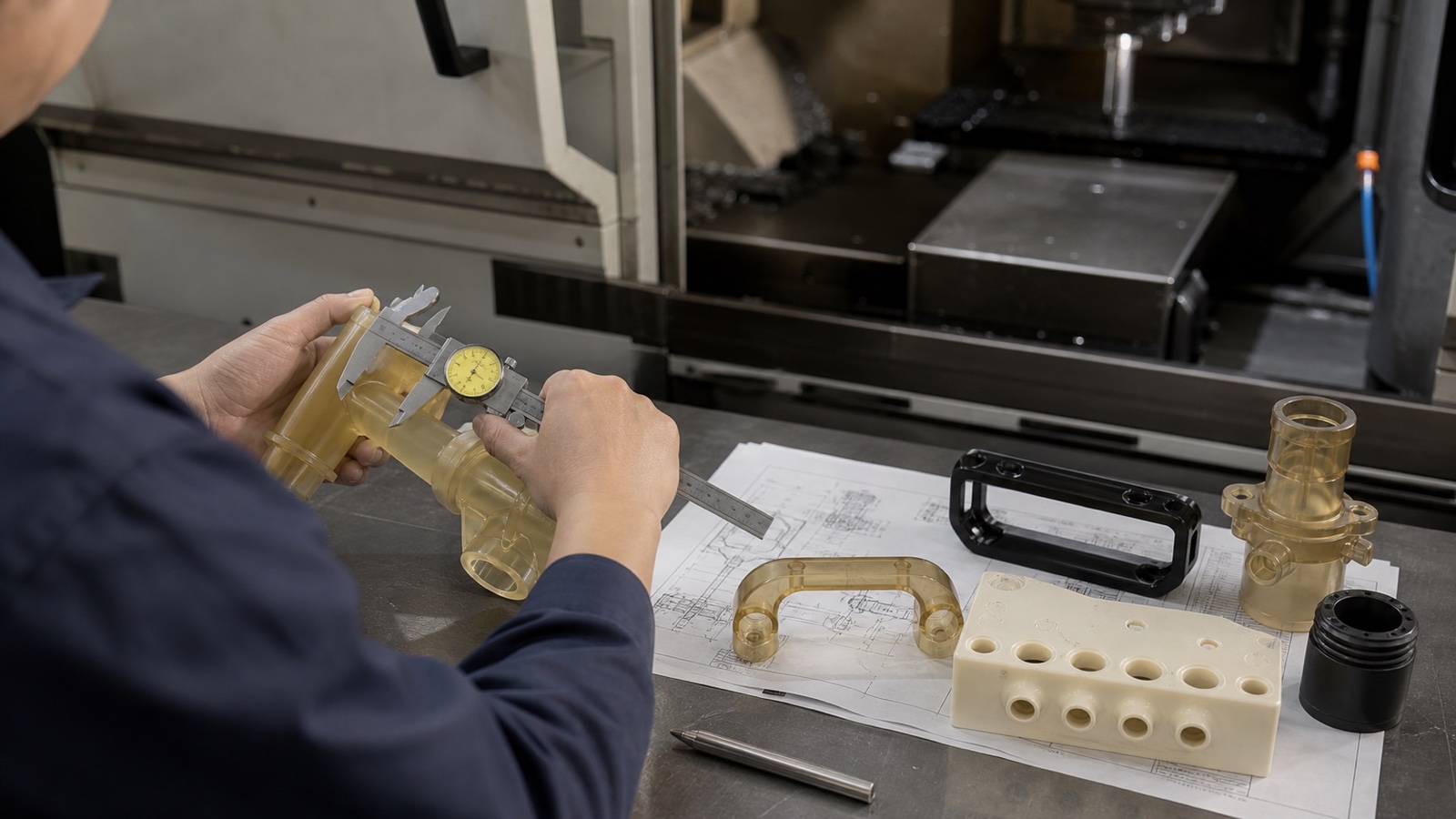
Injection molding is efficient for stable, repeatable volumes when the geometry and tooling investment are justified. CNC machining is often more practical for prototypes, validation builds, low-volume medical equipment, replacement parts, and complex components that may change during development. At PlasticCNCPro, we manufacture custom polymer parts from drawings, samples, and CAD files using milling, turning, drilling, tapping, threading, slotting, and related machining operations.
Confirm the grade before programming
Identify whether the design requires a medical-specific grade, a transparent grade, an additive-free grade, or a reinforced formulation. Resin selection affects cutting behavior, finish, strength, and validation documentation.
Control heat and clamping during machining
PEI and PPSU can be machined accurately, but excessive cutting heat, aggressive feeds, dull tools, or high clamping pressure may create residual stress and later distortion. We review thin walls, deep pockets, threads, and unsupported features before production.
Plan for post-machining inspection
Critical dimensions should be checked with the correct datum strategy and inspection method. If the part will be sterilized, consider inspecting representative pieces after heat exposure rather than approving only the as-machined condition.
Validate sterilization effects
Autoclave cycles can reveal stress cracking, warpage, discoloration, or fit changes that are not visible immediately after machining. Test the finished geometry and the intended cleaning chemistry together.
Manufacturing guidance
Send the 2D drawing, 3D model, material requirement, quantity, tolerance, and application details when requesting a quotation. This allows us to evaluate stock size, machining sequence, inspection needs, and whether the design is better suited to CNC production or future molding.
PEI vs PPSU: When to Choose Each Material
We normally begin with the failure mode, not the material name. Define the maximum temperature, exposure time, sterilization method, chemical environment, mechanical loads, impact risk, dimensional tolerance, appearance, and expected service life. Then compare qualified grades against those requirements. For more context, see a closer look at ppsu vs peek.
| If your priority is... | Usually investigate first | Reason |
|---|---|---|
| Maximum rigidity and tensile performance | PEI | Higher stiffness can help control deflection in precision interfaces |
| Repeated autoclave cycles and impact | PPSU | Strong hydrolytic stability and excellent toughness support reusable hardware |
| Tight dimensions at elevated temperature | PEI | Low moisture uptake and high rigidity can simplify tolerance control |
| Aggressive cleaning and chemical exposure | PPSU, then validate both | PPSU often provides broader practical chemical tolerance, but exposure testing remains essential |
| A lower total project cost | Compare total cost, not resin price | Machining, scrap, validation, service life, and volume can reverse the initial price difference |
Budget should guide the evaluation but should not replace engineering evidence. If a device is exposed to high heat, disinfectants, or repeated sterilization, a short material test can be less expensive than redesigning a failed assembly. For prototypes and low-volume builds, CNC machining also lets your team verify fit and function before committing to injection-molding tooling.
How Does PEI Compare to Other High-Performance Plastics?
PEI and PPSU sit within a wider group of high-performance polymers. PEEK generally offers a higher temperature ceiling, strong chemical resistance, and excellent mechanical performance, but its material and machining cost can be substantially higher. PEEK is often reserved for applications where its broader performance envelope is necessary.
PSU is closely related to PPSU and offers useful high-temperature and chemical performance, but PPSU is commonly selected when impact resistance and repeated steam sterilization are especially important. PPS, or polyphenylene sulfide, provides strong chemical and thermal resistance and can be a good choice in industrial fluid-handling or electrical environments; its behavior and suitability for a particular medical component must be evaluated separately.
In practical terms, PEI often occupies the space between very high stiffness and manageable cost, while PPSU emphasizes toughness and sterilization durability. PEEK becomes more compelling when the application needs its higher performance margin, and PSU or PPS may be better matches when the chemical, electrical, or process environment points in that direction.
FAQ: High-Temperature Medical Plastics
What is the best high-temperature plastic?
There is no universal best material. PEEK may be appropriate for the highest performance demands, PEI is often selected for stiffness and dimensional stability, and PPSU is frequently preferred for repeated sterilization and impact resistance. The best choice depends on temperature, chemicals, load, sterilization, regulatory requirements, and budget.
What temperature can Ultem withstand?
Ultem is a trade name commonly associated with PEI. Typical PEI grades can support continuous service around 170°C, with heat-deflection performance that may approach or exceed 200°C under specified test conditions. The actual allowable temperature depends on grade, load, exposure duration, geometry, and the supplier’s datasheet.
How strong is PEI plastic?
PEI is one of the stronger amorphous engineering thermoplastics and generally provides higher tensile and flexural stiffness than PPSU. Its real load capacity depends on temperature, creep, wall thickness, notch design, machining direction, and how long the load is applied.
Why is PEI plastic so expensive?
PEI costs more because it is a specialized high-performance resin with demanding production and processing requirements, lower market volume, and fewer material suppliers than commodity plastics. For custom parts, machining time, material yield, inspection, and validation can have as much effect on the final cost as the resin itself.
Discuss your component
Need PEI or PPSU parts for a medical or laboratory project?
We at PlasticCNCPro support prototypes, low-volume production, and repeat manufacturing for custom plastic components. Send your drawing, 3D model, sample, material requirement, quantity, tolerance, and application details. We can review manufacturability, material suitability, machining considerations, and inspection requirements before production.