
Engineering material guide
PVDF vs PTFE: Melting Point and Chemical Resistance Comparison
PVDF melts far lower than PTFE and is melt-processable and weldable; PTFE offers broader chemical inertness and a higher temperature ceiling but is sintered and mechanically softer.
Choose PVDF when fabricated structure and weld joints matter in chemical systems; choose PTFE when media compatibility and surface inertness outweigh mechanical strength.
At a glance: key differences and quick picks
PVDF and PTFE are both fluoropolymers, but their molecular structures create very different engineering behavior. PTFE is the specialist for extreme chemical exposure, high temperature, ultra-low friction, and cryogenic service. PVDF is the more structural, weldable, pressure-capable thermoplastic for many chemical systems.
| Property | PVDF | PTFE | Practical meaning |
|---|---|---|---|
| Melting behavior | About 170–177°C; flows when melted | About 327°C; extremely viscous | PVDF supports conventional extrusion and injection; PTFE is sintered |
| Typical continuous service | About 120–150°C, grade-dependent | Up to about 260°C | PTFE has the wider high-temperature envelope |
| Chemical resistance | Excellent, with solvent and temperature limits | Near-universal in normal service | PTFE is preferred for the most aggressive combinations |
| Mechanical behavior | Stronger, stiffer, better pressure support | Softer, higher creep; filled grades improve load performance | PVDF is often easier to use as a structural part |
| Friction and wear | Higher friction; often good abrasion resistance | Extremely low friction; unfilled wear can be high | Choose based on motion, load, and wear mode |
| Processing and cost | Melt-processable; moderate-to-high material cost | Specialized sintering; typically higher cost per kg | Part geometry and volume can change total cost substantially |
Choose PTFE when extremes dominate
Select PTFE for the broadest chemical resistance, service temperatures near 260°C, the lowest friction, or cryogenic flexibility. Plan around creep, joining difficulty, and the sintering process.
Choose PVDF when structure and fabrication matter
Select PVDF for pressure-bearing piping, tanks, welded assemblies, chlorine and water-treatment equipment, outdoor exposure, and designs requiring a stronger, stiffer thermoplastic.
What are PVDF and PTFE?
Chemical identity and structure
PVDF is polyvinylidene fluoride, a partially fluorinated polymer with repeating carbon, fluorine, and hydrogen groups. Its C–F and C–H backbone is polar. PTFE is polytetrafluoroethylene, a fully fluorinated polymer whose carbon backbone is shielded by fluorine atoms and is effectively non-polar.
That polarity helps explain the practical difference. PVDF can interact more readily with some polar solvents and can develop stronger intermolecular forces, giving it useful stiffness and strength. PTFE’s fluorine-rich, low-energy surface gives it exceptional chemical inertness, very low friction, and unusually difficult bonding behavior.
Common grades and forms
PVDF is available as homopolymer and copolymer grades, including grades selected for piping, films, electrical components, high purity, or battery applications. It is commonly supplied as pellets for melt processing, as well as sheet, rod, pipe, film, lining, and coating forms.
PTFE is supplied as unfilled or filled material, with fillers selected to improve wear, compressive strength, dimensional stability, or load capacity. Micro-porous and expanded PTFE are used where controlled permeability or conformability is important. Compression-molded billets, rods, sheets, skived films, tubes, linings, and coatings are common forms.
Brand names and standards
Kynar is an example of a PVDF trade name, while Teflon is a trade name associated with PTFE and related fluoropolymers. These are trademarks, not generic material names. For a production drawing, we recommend specifying the polymer, grade, filler condition, color, and required compliance rather than relying only on a brand name.
Depending on the application, suppliers may offer FDA or EC food-contact grades, NSF or UL-recognized materials, and high-purity variants for semiconductor and laboratory systems. The exact certification belongs to the grade and finished application, so we verify the supplier declaration before production.
Melting point and thermal performance
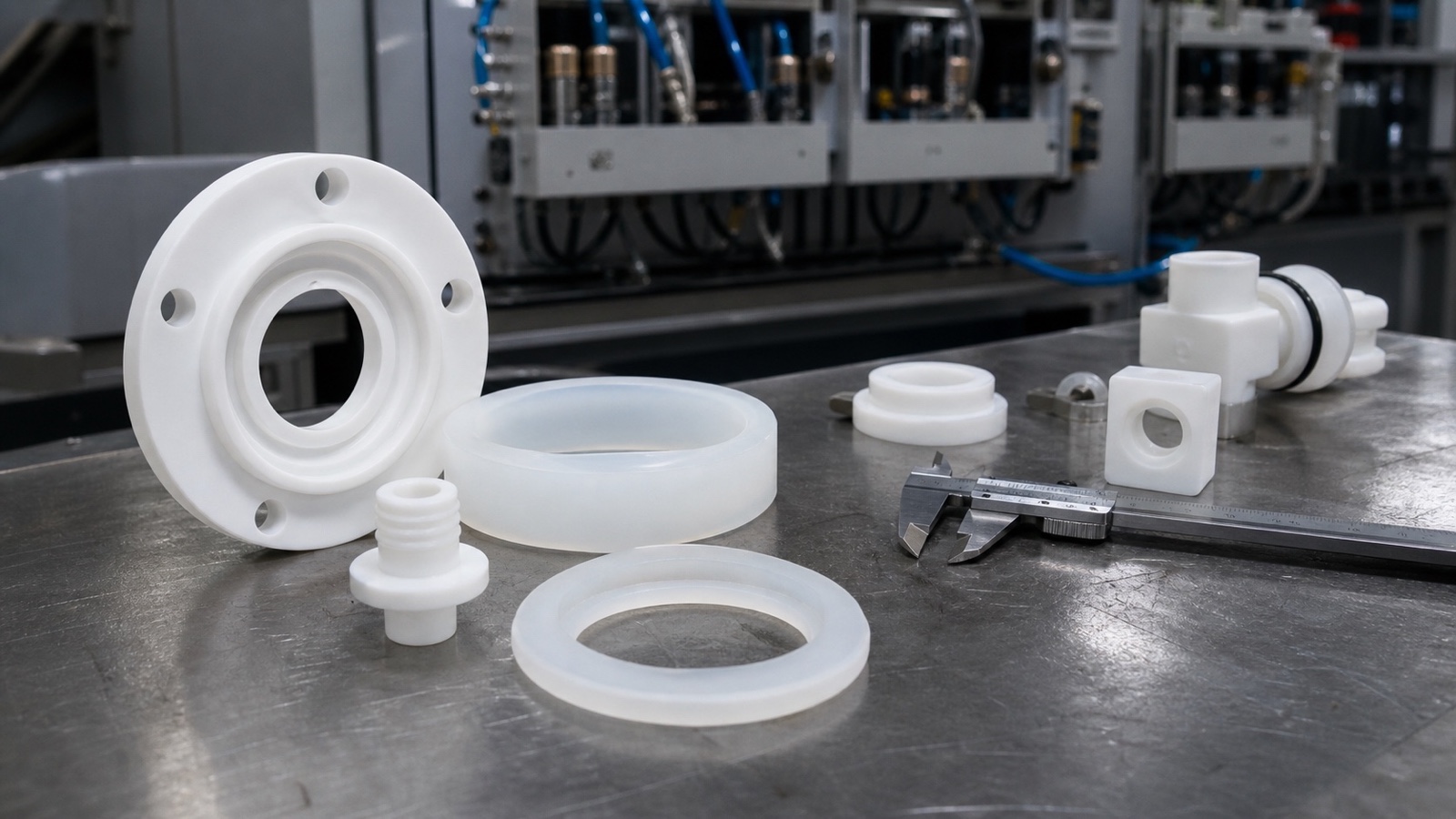
True melting points and melt behavior
PVDF has a melting point of approximately 170–177°C, depending on grade and crystalline structure. Above its melt range it can flow, which makes injection molding, extrusion, blow molding, and other conventional thermoplastic processes practical.
PTFE is often described as melting at approximately 327°C, but this number can be misleading in manufacturing. At that temperature PTFE has extremely high melt viscosity and does not flow like ordinary thermoplastics. It is normally compression molded or paste extruded and then sintered. This distinction affects tooling, wall thickness, available shapes, lead time, and part cost.
Continuous use temperature and heat aging
A typical continuous service range for PTFE reaches approximately 260°C, while PVDF is commonly used around 120–150°C, depending on grade, stress, environment, and design. Neither value should be treated as a universal design limit: pressure, cycling, surface condition, chemical exposure, and duration can all require derating.
Design warning
A chemical compatibility chart at room temperature is not enough for a hot, pressurized line. We evaluate chemical concentration, temperature, stress, and exposure time together before recommending a machined part.
Thermal expansion and dimensional stability
PTFE generally has a higher coefficient of thermal expansion than PVDF. It also exhibits more creep and cold flow under sustained load. PVDF usually offers better dimensional stability for pressure-bearing housings, threaded parts, guides, and fixtures, although both materials require thermal allowances in tight-tolerance designs.
For precision CNC work, we consider the material’s stock condition, machining temperature, feature orientation, wall thickness, and whether the part will be annealed. A dimension that is correct at the inspection bench may shift when a polymer part reaches its operating temperature.
Cryogenic and low-temperature behavior
PTFE retains useful ductility and toughness down to approximately −200°C, making it a strong option for cryogenic seals, hoses, insulation, and lines. PVDF generally remains practical to around −40 to −50°C, depending on grade and loading. For colder service, we assess impact, contraction, seal energization, and thermal cycling rather than choosing by temperature alone.
Flammability and smoke/toxicity
Both polymers can provide strong flame performance, and UL 94 V-0 grades are available. PTFE has a high limiting oxygen index, while PVDF also performs well in many flame-resistant applications. At excessive processing or service temperatures, however, fluoropolymers can decompose and release hazardous fumes. We follow the material supplier’s processing limits and require appropriate ventilation and thermal controls.
Chemical resistance: deep comparison
The phrase “chemical resistant” is incomplete without concentration, temperature, pressure, exposure time, and mechanical stress. PTFE normally provides the broader chemical envelope, but PVDF is highly capable in many industrial environments and can be the better structural choice.
Strong acids and oxidizers
Both materials resist many mineral acids, including hydrochloric acid and sulfuric acid. PTFE generally has the advantage at higher temperatures, higher concentrations, and more aggressive combinations. PVDF performs well in many acid systems but has narrower limits when heat, stress, or strong oxidizers are added.
Fuming acids and powerful oxidizers deserve separate review. A compatibility chart should identify the exact reagent, concentration, temperature, and grade. We do not treat a general “acid service” note as approval for every acid process.
Bases and nucleophiles
PTFE provides broad resistance to strong bases and many nucleophilic chemicals. It can be attacked by highly reactive alkali metals, particularly at elevated temperatures. PVDF generally resists dilute bases but may be attacked or swollen by strong caustics at elevated temperatures.
Solvents: polar vs non-polar
PTFE has near-universal resistance to common solvents, with very little swelling in normal conditions. PVDF has excellent resistance to many hydrocarbons and alcohols, but hot strong polar solvents—especially some ketones, esters, and amine-rich systems—can soften or swell it.
This is where PVDF’s polar structure matters most. If a PVDF component is used in contact with a solvent while under tension, dimensional change and environmental stress cracking must be evaluated together.
Halogens, chlorine, and ozone
PTFE and PVDF both resist ozone and many halogen-containing environments. PVDF is especially common in chlorine, chloramine, and water-treatment service, where its combination of chemical resistance, stiffness, and weldability is valuable. Temperature and concentration limits still apply, particularly for hot or highly concentrated halogen solutions.
Permeation and stress cracking
PTFE typically has lower permeation for many small molecules and is favored when containment and purity are critical. PVDF also offers good barrier behavior, but the specific molecule, wall thickness, temperature, pressure differential, and exposure time must be considered.
Environmental stress cracking is a system effect: media, tensile stress, residual machining stress, temperature, and geometry interact. Sharp internal corners, forced-fit assembly, and over-tightened fasteners can create failures even when the bulk polymer is chemically compatible.
Practical selection by media-temperature-pressure
We use an MTP review before confirming a fluoropolymer choice. The sequence is simple:
- 1
Identify the media
Record chemical name, concentration, contaminants, vapor phase, and cleaning agents.
- 2
Define the operating envelope
Use minimum and maximum temperature, pressure, vacuum, cycling, and exposure duration.
- 3
Check the mechanical load
Include clamp load, pressure stress, sliding contact, vibration, and dimensional tolerance.
- 4
Validate the actual grade
Use supplier compatibility data and, for critical systems, test actual media on representative samples.
Mechanical and physical properties
Strength, stiffness, and creep
PVDF normally offers higher tensile strength and modulus than unfilled PTFE. It therefore provides better pressure-bearing capability and creep resistance in many machined housings, pipe components, brackets, and fluid-handling parts. PTFE is softer and more prone to cold flow, although filled PTFE grades can substantially improve load and creep performance.
Wear and friction
PTFE is famous for ultra-low friction and non-stick behavior. That makes it attractive for sliding seals, guides, bearings, and release surfaces, but unfilled PTFE can show high wear under load or abrasive contact. Filled grades are often selected when service life matters more than the absolute lowest friction.
PVDF has higher friction but often provides better abrasion resistance and structural support. We consider PVDF when a part must resist rubbing, impact, pressure, or dimensional change while still remaining chemically resistant.
Pressure handling and dimensional stability
PVDF is widely suited to pressure-rated piping, valves, fittings, tanks, and process components. PTFE is more commonly used as a liner, gasket, seal, tube, or chemically resistant interface where its creep can be managed through design, backup rings, reinforcement, or external support.
Thermal cycling can amplify dimensional movement in both polymers. For a precision part, we review clearance at the cold condition, operating temperature, and any assembly preload instead of specifying only a room-temperature tolerance.
Electrical and dielectric properties
PTFE has a dielectric constant of approximately 2.1 and very low dielectric loss, making it an excellent insulator for high-frequency, RF, and microwave applications. PVDF has a higher dielectric constant and can exhibit piezoelectric and pyroelectric behavior, which supports sensor, actuator, film, and transducer applications.
Radiation and weathering
PTFE has limited resistance to gamma radiation compared with PVDF. PVDF generally tolerates radiation better, while both materials offer useful UV resistance. PVDF is particularly strong in long-term outdoor weatherability and is used in architectural coatings and exterior systems.
Surface energy, cleanliness, and bonding
PTFE has extremely low surface energy. This supports non-stick performance but makes adhesive bonding, painting, and printing difficult without chemical etching or specialized surface treatment. PVDF is generally more bondable and paintable, and high-purity grades are available for cleanroom and semiconductor environments.
Processing and fabrication
Melt processing vs sintering
PVDF can be processed using standard thermoplastic methods such as injection molding, extrusion, and blow molding. PTFE requires a different manufacturing route: paste extrusion or compression molding followed by controlled sintering. This difference influences part size, geometry, tooling, material utilization, and lead time.
For prototypes and low-volume custom components, CNC machining can be practical for either polymer when suitable stock is available. At PlasticCNCPro, we review stock form, feature geometry, tolerances, thread design, and the expected operating load before confirming manufacturability.
Welding, bonding, and joining
PVDF is readily heat-welded, allowing leak-tight pipe, tank, and process assemblies. PTFE welding is more limited. PTFE systems often rely on mechanical joints, flanges, compression seals, skived liners, or machined interfaces. Adhesive bonding generally requires chemical etching and careful process control.
Machining, finishing, and tolerances
PTFE machines relatively easily, but its softness and creep require sharp tooling, controlled clamping, proper support, and realistic tolerance planning. PVDF also machines well and can support tighter post-anneal tolerances in suitable designs. Thin walls, deep bores, interrupted cuts, and internal threads deserve special review in both materials.
Machining note
For a custom drawing, we can help separate functional tolerances from unnecessary tight tolerances. This often improves yield and cost without changing the performance of the finished component.
Purity and contamination control
Semiconductor, laboratory, and high-purity fluid systems may require dedicated PVDF or PTFE grades with controlled particles, extractables, and metal contamination. Cleaning, handling, packaging, and inspection requirements should be defined before machining, not added after production.
Cost, availability, and sustainability trends
Material and lifecycle cost
PTFE is typically more expensive per kilogram than PVDF, although prices vary with grade, filler, purity, color, form, and supply conditions. PVDF is generally moderate-to-high cost. The material price alone does not determine the best value: processing, machining time, scrap, assembly, maintenance, replacement frequency, and service life can dominate total cost of ownership.
Market dynamics and supply chain
PVDF demand has increased substantially because of lithium-ion battery binders and related energy applications. Capacity expansions are ongoing, but availability and pricing can still vary by grade and region. PTFE supply is comparatively stable, while specialty high-purity, filled, and modified grades can command premiums.
Regulatory and ESG context
PVDF and PTFE are both fluoropolymers and are included in wider PFAS discussions. Some regions are considering or implementing restrictions that may affect specific substances, processing aids, products, or applications. High-molecular-weight fluoropolymers are often treated differently from smaller, bioavailable PFAS, but compliance depends on jurisdiction and use.
PTFE production historically involved processing aids such as PFOA, which have been phased out in many supply chains. We recommend obtaining current supplier declarations, checking local regulations, and reviewing the finished-product requirements before approving a material.
Typical applications
Where PTFE excels
PTFE is a strong choice for high-temperature seals, gaskets, chemical liners, non-stick surfaces, high-frequency cable insulation, laboratory components, and corrosive media at extreme concentrations or temperatures. Its low friction also supports bearings, slide plates, guides, and dynamic sealing applications.
Where PVDF excels
PVDF is well suited to chemical process piping and tanks, chlorine dosing systems, water treatment, wire and cable jacketing, architectural coatings, and lithium-ion battery binders. Its strength, weldability, outdoor durability, and broad chemical resistance make it useful for structural fluid-handling parts.
Industry-specific notes
Semiconductor and ultra-pure chemicals: PTFE and PVDF are both available in high-purity forms. PFA may be preferable when a PTFE-like chemical envelope is needed together with melt processing. The final choice depends on purity, permeation, weldability, temperature, and available validation data.
Energy and EV batteries: PVDF is widely used as a binder and in related battery components. PTFE and other fluoropolymers may appear in insulation, seals, and chemical-handling equipment. The correct selection depends on electrochemical compatibility and the manufacturer’s validated formulation.
Food and pharmaceutical equipment: Confirm the exact FDA or EC food-contact status, cleaning chemistry, temperature, and traceability requirements of the selected grade. A generic polymer name is not a certification.
PVDF vs PTFE selection guide
Decision criteria checklist
Media, concentration, and temperature: verify the exact chemical environment, not only the chemical family.
Pressure and creep: choose PVDF or reinforced PTFE when long-term dimensional support is important.
Motion and wear: PTFE minimizes friction; filled PTFE or PVDF may better control wear and load.
Fabrication: PVDF supports melt processing and heat welding; PTFE requires sintering, machining, and more specialized joining.
Regulatory and purity needs: define the grade, certification, contamination controls, and documentation required.
Budget and lead time: compare total manufacturing and service cost, not only resin price.
Mini case examples
Hot caustic line
For strong hot caustic under pressure, we would begin with PTFE because it offers broader resistance to strong bases. If the temperature and concentration are moderate and the assembly must be rigid and welded, PVDF may still be suitable after compatibility verification.
Chlorine dosing skid
PVDF is often a practical choice for chlorine or chloramine water-treatment systems because it combines chemical resistance, stiffness, and heat-weldable fabrication. PTFE remains attractive for seals, liners, and interfaces where extreme chemical resistance or low friction is the priority.
High-temperature gasket
For a gasket exposed to high temperature and aggressive chemicals, PTFE is usually the starting point. We would then check creep, bolt load, pressure, thermal cycling, and whether a filled PTFE or alternative construction is needed.
Related alternatives to consider
PFA and FEP offer PTFE-like chemical resistance with melt-processable behavior. ETFE and ECTFE can provide tough coatings and linings. PEEK is a candidate when high-temperature mechanical strength is more important than maximum fluoropolymer chemical resistance. UHMW-PE is worth considering for abrasion, impact, and low-cost wear components where the chemical and temperature envelope permits.
FAQs
Is PVDF easier to CNC than PTFE for tight tolerances?
Yes—PVDF typically holds sharper features and tighter tolerances than soft, cold-flow-prone PTFE. If your drawing has fine threads, thin walls, or press fits, PVDF is usually the more cooperative fluoropolymer to machine.
When should lined steel still beat a solid fluoropolymer part?
Large pressure-containing geometries or structural spans often stay as lined metal because solid PTFE/PVDF may creep. Use solid CNC fluoropolymer for small-to-medium parts where full polymer construction simplifies sealing and corrosion control. For more context, see this machining-focused overview.
Do fillers change the PVDF vs PTFE decision?
Glass or carbon fillers can stiffen either family but may reduce some chemical purity advantages and increase tool wear. Re-check media compatibility and abrasion needs whenever you leave virgin grades.
What is the melting point of PVDF material?
PVDF typically melts at approximately 170–177°C, depending on grade and structure. Unlike PTFE, it becomes a practical flowing melt, so it can be injection molded and extruded. PTFE is commonly described as melting around 327°C, but its melt viscosity remains extremely high and it is normally processed by sintering.
Why isn’t PTFE banned?
PTFE is a high-molecular-weight fluoropolymer generally considered inert and not bioavailable in its finished form. Many jurisdictions therefore permit defined PTFE uses, although PFAS policies continue to evolve. Historical processing aids such as PFOA have been phased out in many supply chains, and current compliance still depends on region, grade, and application.
Is PVDF banned?
There is no broad ban on PVDF. It remains widely used in batteries, chemical piping, water treatment, cable jacketing, and coatings. Regional PFAS proposals may affect specific uses, emissions, processing steps, or documentation, so buyers should check applicable regulations and obtain current supplier declarations.
What are the downsides of PVDF?
PVDF has a lower maximum service temperature than PTFE, can swell or soften in certain hot polar solvents, and may be attacked by strong caustics at elevated temperatures. It also has higher friction than PTFE and can experience price or availability pressure from battery demand. Its strengths are mechanical rigidity, weldability, outdoor durability, and useful chemical resistance.
Summary and next steps
In this PVDF vs PTFE comparison, PTFE wins when extreme chemical resistance, high temperature, cryogenic flexibility, or the lowest friction is the main requirement. PVDF wins when the part must carry pressure, hold its shape, be heat-welded, withstand outdoor exposure, or be produced as a conventional thermoplastic component.
The final choice should be confirmed against the actual media, concentration, temperature, pressure, stress, motion, regulatory requirements, and manufacturing route. At PlasticCNCPro, we support global B2B customers with CNC-milled and turned parts in PTFE, PVDF, and other engineering polymers for prototypes, low-volume production, and repeat manufacturing.
Discuss your material choice
Need a PVDF or PTFE part machined to your drawing?
Send us your 2D drawing, 3D model, sample, quantity, tolerance, and application details. We can review the polymer choice, manufacturability, critical dimensions, and inspection requirements before production.