
What Is the Melting Point of PEEK and Why Does It Matter?
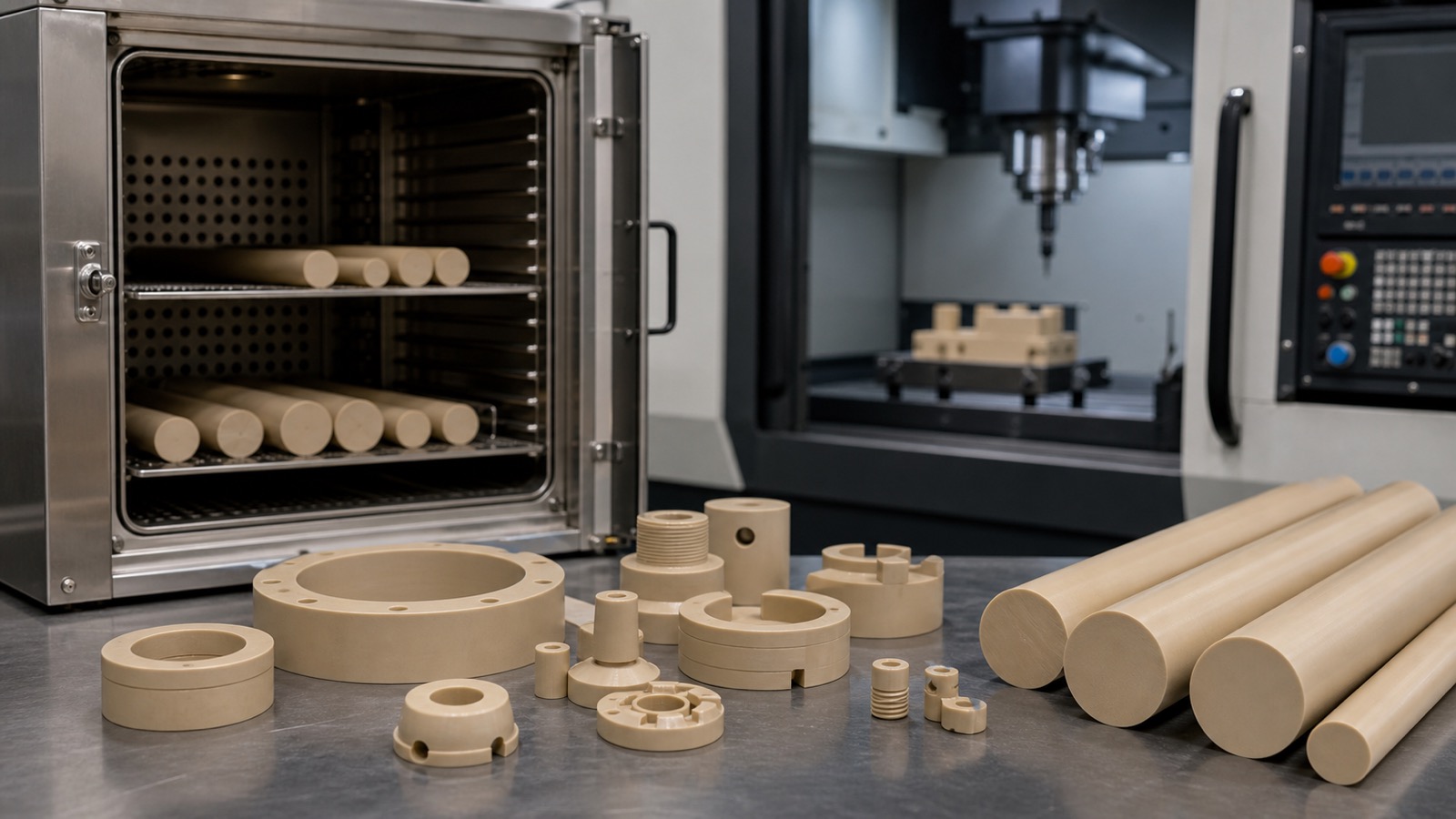
Polyetheretherketone, better known as PEEK, is one of the highest-performing semi-crystalline thermoplastics available today. If you work with engineering polymers—whether for aerospace brackets, medical implants, or automotive under-hood components—you’ve likely run across its datasheet. The single most important thermal property that separates PEEK from nearly every other plastic is its melting point: about 343 °C (649 °F).
That number is more than just a line in a material table. It dictates how we process the material, what environments it can survive, and why it commands the premium price it does. In this article, I’ll walk through what that melting point actually means for a semi-crystalline polymer, why it varies between grades, how it influences manufacturing decisions, and how it compares to other high-performance plastics. Whether you’re specifying PEEK for a custom CNC machined part or evaluating it for an additive manufacturing project, understanding this property will help you make better engineering choices.

---
Understanding the Melting Point of PEEK
The Exact Melting Temperature
When we talk about the melting point of PEEK, the accepted value from most datasheets is 343 °C (649 °F). This is the peak melting temperature measured by differential scanning calorimetry (DSC). In practice, you’ll see a range of ±5 °C depending on the exact grade and testing conditions. Unfilled virgin PEEK (e.g., Victrex 450G) consistently reports 343 °C. This precise value is what we use in our CNC machining shop when selecting tooling and setting processing parameters.
What “Melting Point” Means for a Semi-Crystalline Polymer
Unlike a pure metal that melts at a single sharp temperature, polymers melt over a range. But PEEK is an exception among thermoplastics because its crystalline structure is highly ordered. While amorphous polymers like polycarbonate simply soften gradually into a viscous fluid, PEEK’s crystalline regions hold their form until enough thermal energy is supplied to break the orderly packing. On a DSC curve, you see a sharp endothermic peak at 343 °C. This crystallinity is what gives PEEK its exceptional stiffness, creep resistance, and chemical resistance—even at elevated temperatures.
Factors That Can Affect the Reported Value
Why do some sources say 340 °C and others 348 °C? Several variables come into play:
- Grade variations – Unfilled, glass-filled, or carbon-filled grades all have the polymer matrix as the continuous phase, so the melting point remains near 343 °C. However, processing aids or nucleating agents can slightly shift the peak.
- Heating rate in DSC – A faster ramp rate can shift the apparent melting point by a few degrees because the polymer doesn’t have time to reorganize.
- Molecular weight – Higher molecular weight typically elevates the melting point by a small amount because longer chains require more energy to disentangle.
- Thermal history – If a part has been annealed or slowly cooled, the crystallites are larger and more perfect, leading to a higher, sharper melting peak.
At PlasticCNCPro, when we receive a PEEK part drawing, we always ask for the exact grade. Datasheets for standard unfilled grades quote 343 °C ± 5 °C, and we treat that as the baseline.
---
Why Melting Point Matters in Processing PEEK
Injection Molding and Extrusion Temperatures
You cannot melt-process PEEK at 343 °C and expect a good result. That’s the onset of melting, not the point where the material flows freely. For injection molding or extrusion, we need to heat the polymer 20–40 °C above its melting point, typically in the range of 360–400 °C. The exact barrel temperature profile depends on the screw design and residence time.
Equally important is the mold temperature. For semicrystalline PEEK, mold temperatures of 150–200 °C are required to achieve the right degree of crystallinity. If the mold is too cold, the polymer solidifies in an amorphous state with poor mechanical properties. If too hot, you risk warpage or sticking.
3D Printing (FDM/FFF) Considerations
Additive manufacturing with PEEK is growing rapidly. For FDM printing, the nozzle temperature must exceed 400 °C—often 420–450 °C—to ensure the filament melts completely and bonds to the previous layer. The heated bed is set between 120–160 °C, but an enclosure is essential. Without a controlled, warm environment, the part cools unevenly, causing warping and delamination. The melting point defines the lower limit of printing temperature: go too low and you get cold welding; go too high and you risk degradation.
Preventing Thermal Degradation
PEEK has excellent thermal stability, but it isn’t indestructible. Above about 400 °C, prolonged residence time can cause chain scission (breaking of polymer chains), leading to reduced molecular weight and embrittlement. That’s why we carefully monitor residence time in the injection barrel or extruder. Moisture is another enemy: PEEK must be dried to below 0.02% moisture before processing, because water at 380 °C can hydrolyze the polymer. We use dehumidifying dryers at 150–160 °C for 3–4 hours as standard practice.
---
The Relationship Between Melting Point and Service Temperature
Continuous Use Temperature vs. Melting Point
A common misconception is that if a material melts at 343 °C, you can use it up to that temperature. That would be catastrophic. The continous use temperature of PEEK is about 260 °C (some grades up to 300 °C for short exposures). The difference is fundamental:
- Melting point is an absolute failure point—the material transitions from solid to liquid.
- Continuous use temperature is based on thermal stability over time, where the polymer retains at least 50% of its mechanical properties after thousands of hours.
For US, UL746B ratings, standard PEEK has a Relative Thermal Index (RTI) of 260 °C for mechanical impact, and 240 °C for electrical properties. So while melting point gives you a safety margin, the real-world upper limit is about 80 °C lower.
Impact on Mechanical Retention at High Temperatures
What sets PEEK apart from cheaper high-temperature plastics like PTFE or nylon? Its ability to retain stiffness and strength close to its glass transition temperature (143 °C) and well beyond. For example, at 200 °C, PEEK still retains roughly 70% of its room-temperature tensile modulus, whereas PTFE becomes a soft, creep-prone mass. That’s a direct result of the high crystallinity and the high melting point—the polymer chains don’t start to flow until much higher temperatures.
---
Comparing PEEK’s Melting Point to Other High-Performance Plastics
PEEK vs. PTFE (Polytetrafluoroethylene)
PTFE melts at around 327 °C, slightly lower than PEEK. However, PTFE is not melt-processable in the traditional sense (unless using special forms). Its mechanical strength is much lower, and it deforms under load at elevated temperatures. PEEK is a structural material; PTFE is a lubricious lining material.
PEEK vs. Polyamide (Nylon)
Nylons such as Nylon 66 melt around 265 °C. That’s a full 78 °C below PEEK. In under-hood automotive applications where temperatures can reach 180 °C, nylon may soften or creep significantly. PEEK runs circles around it in thermal resistance.
PEEK vs. Delrin (Polyoxymethylene)
A common question we get: “Is PEEK stronger than Delrin?” Yes, especially at elevated temperatures. Delrin (POM) melts at about 175 °C. Its continuous use temperature is only about 100 °C. PEEK easily doubles that. In strength, PEEK’s tensile strength is around 100 MPa (unfilled) vs. Delrin’s ~70 MPa. More importantly, PEEK retains its strength at 200 °C while Delrin would be a puddle.
PEEK vs. PEK and PEKK
Polyetherketone (PEK) melts at about 373 °C; it’s a few hundred degrees higher than PEEK but is less common. PEKK (polyetherketoneketone) melts in a range of 300–380 °C depending on the ratio of terephthalic and isophthalic isomers. These materials offer even higher thermal performance but come with higher cost and processing challenges.
---
How Fillers and Composites Alter the Melting Point
Glass-Fiber and Carbon-Fiber Reinforced PEEK
Filling PEEK with glass or carbon fibers does not significantly change the melting point of the polymer matrix—it remains at ~343 °C. What changes dramatically is melt viscosity. A 30% glass-filled grade is much thicker and requires higher injection pressure and temperature. The fibers also increase thermal conductivity, which can help (or hurt) mold cycle times. For parts that must hold tight tolerances at high temperatures, carbon-fiber PEEK is a favorite because the fibers reduce thermal expansion and creep.
PEEK Blends and Special Grades (Bearing Grades)
Some manufacturers add PTFE, graphite, or other solid lubricants to create bearing-grade PEEK. These fillers might have lower melting points than PEEK, but they are dispersed in a PEEK matrix. The overall melting point of the composite is still determined by the PEEK phase. However, the processing temperature must be kept below the filler’s degradation temperature—often a few degrees lower than pure PEEK. We always check the TGA data before running a new filled grade.
---
Practical Applications Driven by Melting Point
Aerospace (Structural Brackets, Wire Insulation)
In aircraft, components must withstand prolonged exposure to 260 °C near engines or in bleed air ducts. PEEK’s melting point provides a safety margin of nearly 80 °C. We machine PEEK brackets that hold their shape even when adjacent components overheat.
Medical Implants (Spinal Cages, Dental Healing Caps)
PEEK is biocompatible and can be sterilized repeatedly in an autoclave at 134 °C without any loss of properties. Its melting point ensures that it won’t soften or distort during those cycles. For spinal cages, the melting point also means the material can be machined to tight tolerances without fear of thermal distortion.
Automotive (Transmission Components, Under-Hood Parts)
Transmission oil can exceed 150 °C in some vehicles. PEEK gears, washers, and seal rings survive that environment. If a momentary temperature spike occurs (e.g., due to a blocked oil cooler), the melting point acts as a hard limit—PEEK won’t fail until 343 °C.
Oil & Gas and Chemical Processing (Seal Rings, Bushings)
These environments combine temperature and aggressive chemicals. PEEK’s melting point gives it a high ceiling for thermal excursions, and its chemical resistance (no known solvent at room temperature) means it can handle most media.
---
Frequently Asked Questions About PEEK’s Melting Point
What is the melting point of PEEK?
Standard unfilled PEEK melts at 343 °C (649 °F). That is the peak DSC value.
Is PEEK stronger than Delrin?
Yes, particularly at elevated temperatures. PEEK has higher tensile strength (≈100 MPa) and maintains it far above Delrin’s melting point (175 °C).
Is PEEK as strong as aluminum?
No, not in absolute terms. Aluminum alloys have tensile strengths in the 200–500 MPa range. However, PEEK has a better strength-to-weight ratio (density 1.3 g/cm³ vs. 2.7 g/cm³ for aluminum) and retains properties at higher temperatures than most aluminums. It’s a trade-off.
Is PEEK heat resistant?
Absolutely. It can be used continuously at 260 °C and short-term up to 300 °C. Its melting point of 343 °C is the ultimate thermal limit.
---
Future Trends and Innovations
High-Temperature Additive Manufacturing
As PEEK 3D printing matures, precise control of the melting point becomes critical. Printhead temperature stability, bed adhesion, and layer fusion all rely on staying within a narrow window above 343 °C. We’re seeing more customers request machined PEEK parts as prototypes before committing to additive production—our CNC capabilities offer tight tolerances without the warping risk.
Recycling and Sustainability
PEEK can be reprocessed multiple times without significant property loss—provided melt degradation is avoided. The key is never exceeding 400 °C for prolonged periods. Recycling PEEK scrap is viable, but we must regrind and dry it carefully.
Advanced Composites for Lightweighting
Carbon-fiber-reinforced PEEK is replacing metals in aerospace, automotive, and oil & gas. The melting point remains a key parameter for thermoforming—composite sheets are heated to just above 343 °C, then pressed into shape. Understanding the exact melting behavior of the specific PEEK composite is essential to avoid voids or delamination.
---
Conclusion
The melting point of PEEK—343 °C (649 °F)—is far more than a number in a datasheet. It defines how we process the material, sets the upper limit for service temperature, and explains why PEEK outperforms nearly every other plastic in demanding thermal environments. For engineers and buyers specifying parts, understanding this property means you can make informed decisions about grade selection, processing methods, and design margins.
At PlasticCNCPro, we machine PEEK parts every day for customers in aerospace, medical, automotive, and chemical processing. We know the thermal behavior, the tooling tricks, and the importance of staying within the material’s processing window. Whether you need a prototype bracket or a production run of complex bushings, we’re here to help.
Ready to discuss your PEEK project? Send us your drawing, 3D file, or specification sheet, and we’ll provide a quotation and material recommendation. Our team in Dongguan, China, specializes in custom CNC machined plastic parts—from simple components to tight-tolerance, high-performance polymer parts. Contact us today to get started.
RFQ Support
Send Your Drawing for a Quote
Share your 2D drawing, 3D model, material, quantity, tolerance, surface finish, and application details. Our team will review manufacturability and reply with a practical quotation.
Email: info@plasticcncpro.com
Address: 29 Fuxing Road, Dongguan City, Guangdong Province, China