
Engineering Guide · Material Selection
Why Material Density Matters for Large CNC-Machined Plastic Components
Density is one of the first numbers we check when a customer sends a drawing for a large plastic part. It shapes how a slab holds its flatness on the machine, how much heat the cutter has to fight, and how the finished component behaves in service. Here is how we think about it at PlasticCNCPro.
Introduction
Machining a small plastic bushing and machining a 600 mm wide engineering polymer plate are very different jobs. Once a part grows in footprint, the small problems become large ones: a slab that absorbs heat unevenly, a wall that moves after the first roughing pass, or a fixture that holds the stock well enough to cut but not well enough to keep it flat. Large components expose the properties of the material much more clearly than small ones do.
Density sits underneath many of those behaviors. It is not the only property that matters, but it influences how the material responds to clamping, how it carries heat away from the cutting zone, how rigid it feels under the spindle, and how much mass it adds to the final assembly. Understanding density early lets engineers and machinists make better choices before the first chip is cut.
This guide explains what density means for engineering plastics, how it affects machining stability and cost, and how to balance it against machinability and application requirements. The goal is practical: to help you specify a material and a process that give you predictable results on large parts.
On large parts, density is not just a datasheet number. It decides how much the material will fight you on the machine and how much it will move after you finish.
1. Defining Material Density in Engineering Plastics
Density is mass per unit volume, usually expressed in g/cm³. For polymers, it is governed by how the polymer chains pack together in the solid state, the degree of crystallinity, and whether the grade contains fillers or reinforcements. Two plastics with similar chemistry can have noticeably different densities depending on how they were processed and formulated.
Molecular weight, packing, and physical properties
Higher molecular weight and more efficient chain packing generally push density up and tend to improve stiffness, wear resistance, and dimensional behavior. Crystalline regions pack more tightly than amorphous ones, which is why semi-crystalline materials such as polyethylene and acetal often show higher density than amorphous plastics of similar weight class. Density therefore acts as a quick indicator of how the molecular structure is likely to behave under load and heat.
High-density and low-density plastics
The names can be misleading. HDPE is called "high-density" because it is denser than LDPE within the polyethylene family, but its density is still below that of acetal, nylon, or PEEK. When we talk about high-density materials in a machining context, we usually mean the denser engineering polymers and filled grades. Low-density materials include LDPE and many foamed or cellular products, which are light and easy to cut but offer limited rigidity.
Typical density reference (unfilled grades, approximate)
| Material | Approx. density (g/cm³) | Density band |
|---|---|---|
| LDPE | ~0.92 | Low |
| UHMW-PE | ~0.93 | Low to medium |
| HDPE | ~0.95 | Low to medium |
| Nylon (PA6) | ~1.14 | Medium |
| PEEK | ~1.32 | Medium to high |
| Acetal (POM) | ~1.41 | High |
| PVDF | ~1.78 | Very high |
| PTFE | ~2.2 | Very high |
Values are approximate for typical unfilled grades. Glass-, carbon-, or mineral-filled grades can differ substantially, so always confirm against the supplier datasheet for your exact grade.
Which plastic has the highest density, and why does it matter for industrial use?
Among the common engineering polymers, PTFE is typically the densest unfilled material, followed by PVDF and acetal. Filled grades can exceed these figures. For industrial use, a higher density often accompanies greater stiffness, lower creep, and better dimensional stability under load, but it also means more mass per part and, in some cases, a material that is harder to cut cleanly. PTFE's density comes with a very different profile: excellent chemical resistance and low friction, but soft under load and prone to deformation during machining. The right answer depends on whether your priority is rigidity, chemical resistance, weight, or machinability.
2. Why Density Dictates Machining Performance
On a large part, the material's density shows up on the machine in three main ways. It determines how the slab behaves under clamping and cutting forces, how heat moves out of the cut, and how stable the whole system feels when the spindle is working hard.
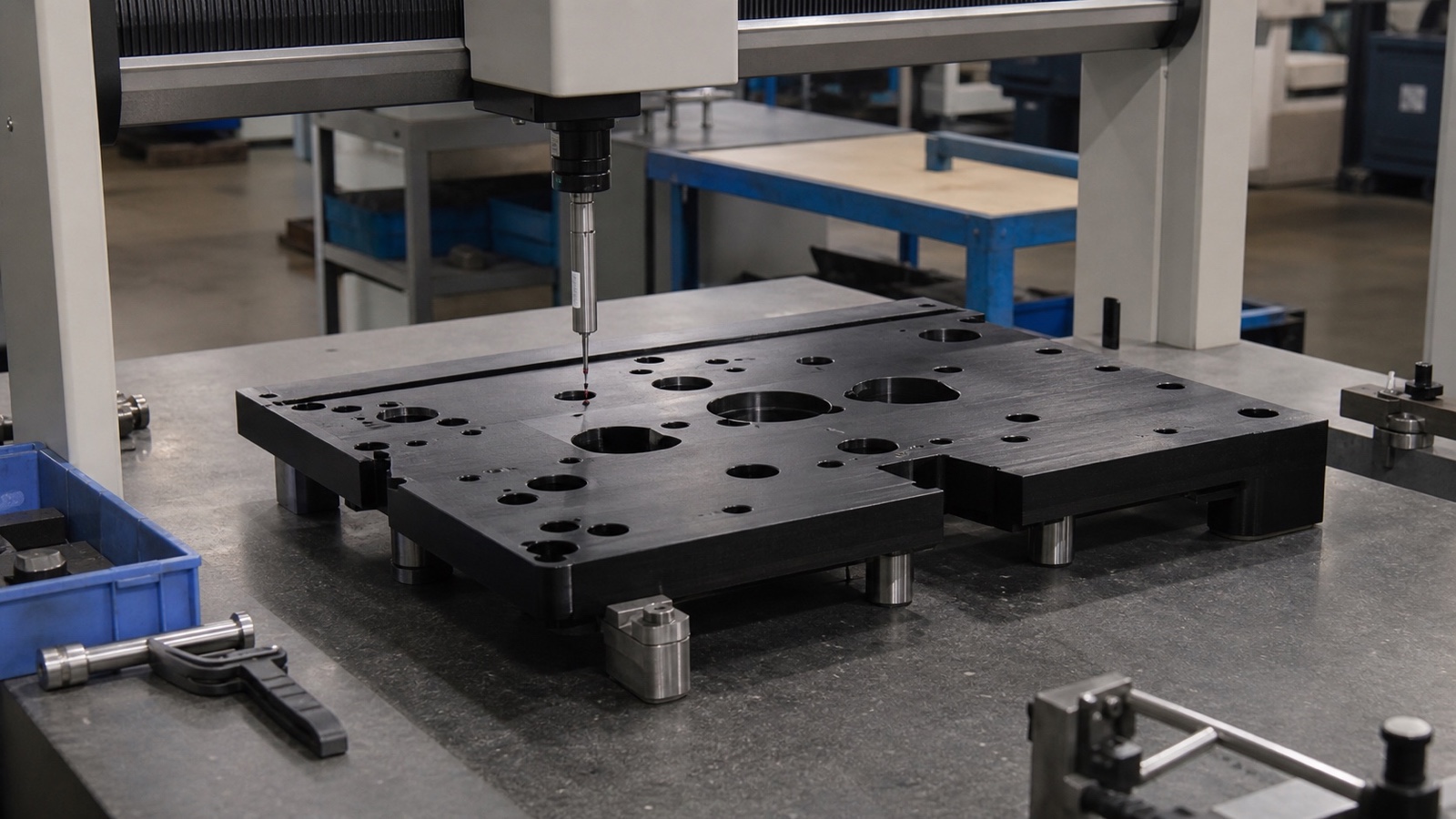
Structural stability: preventing warp and deformation
Denser, more rigid materials resist the small elastic and plastic deformations that become visible on large parts. A thin-walled or wide plate of a low-density, low-modulus plastic can bow under clamping pressure and spring back once released, so the finished flatness no longer matches the program. Higher-density grades usually hold their shape better through roughing and finishing, which makes them a safer choice for long, flat components such as wear strips, machine covers, and large insulation panels.
Engineering note
Stability is not only about density. Moisture uptake, residual stress from extrusion or casting, and temperature all move dimensions too. Density helps, but it should be paired with the right process steps.
Thermal management and heat dissipation
Plastics are poor thermal conductors compared with metals, so heat generated at the cutting edge tends to stay close to the cut. Denser grades often conduct heat somewhat better than light foams, but the bigger effect is on how much heat the cut generates in the first place. A dense, stiff material cut with a sharp tool and steady feed usually produces a cleaner shear, while a soft or low-density material can smear and melt if the feed and speed are not matched to it.
That is why denser materials often need a different cooling strategy. For many engineering plastics we rely on air blast or controlled coolant mist rather than flood coolant, since fluids can cause swelling or stress cracking in certain polymers. The right choice depends on the chemistry of the grade, not just its density, so we confirm compatibility before we set the process.
Vibration and chatter during heavy milling
Chatter is a self-excited vibration between the cutter and the workpiece. Higher-density, stiffer materials give the cutter a more stable platform and damp unwanted resonance better than soft, low-modulus stock. On a large slab that is only supported at a few points, a more rigid material also reduces how much the part itself flexes under cutting load, which keeps the actual depth of cut closer to the programmed value.
3. The Impact of Density on Production Costs
Density affects cost in ways that are easy to miss when comparing raw material prices alone. The effects show up in tool consumption, cycle time, and the amount of stock that ends up as scrap.
Tool wear and longevity
Dense, abrasive fillers are the main driver of tool wear. Glass fiber and carbon fiber reinforcements raise density and stiffness, but they act like fine abrasives against the cutting edge. A cutter that runs for many hours in unfilled acetal may need replacing far sooner in a glass-filled nylon. We track this closely because tool wear changes both the surface finish and the dimensional consistency across a production batch.
Checklist: managing filler-driven wear
-
1
Identify filled grades early
Confirm whether the material is glass-, carbon-, or mineral-filled before quoting tool life.
-
2
Plan tool replacement intervals
Schedule changes by part count or cutting time, not by how the edge looks.
-
3
Watch finish and size drift
Check the first and last parts of a batch against the same gauge to catch wear early.
Processing time and feed balance
Cycle time is set by how aggressively the material can be cut without melting, chipping, or deflecting. Dense, rigid grades can often take heavier radial and axial engagement than soft ones, which shortens roughing. Filled grades, however, may demand lower surface speeds to protect the edge. Balancing feed rate and spindle speed against density is how we keep cycle times competitive without sacrificing surface quality.
Material wastage and stress-relieving needs
Large, dense blanks often carry internal stresses from extrusion or molding. When material is removed, those stresses are released and the part can move. A slab that machines flat on Monday may bow by Wednesday. To avoid scrapping a nearly finished component, we plan stress-relief steps and leave appropriate stock for finishing, which is a direct cost consideration rather than a purely technical one.
Why it matters
A scrapped large part can cost far more than the material it contains, because the machine time, fixturing, and schedule are already spent. Planning for stability upfront is usually cheaper than recovering from a warped part.
4. Selecting the Right Plastic for Your Project
Material selection is always a trade-off. Density is a useful filter, but it should be read together with chemical resistance, operating temperature, friction, electrical properties, and the machinability of the grade. The groupings below are a practical starting point.
Density band
High-density options: HDPE, UHMW, PEEK
Prioritize these when wear resistance, rigidity, or chemical resistance matter most. UHMW-PE is widely used for wear strips and liners, HDPE for chemically demanding components, and PEEK for high-temperature, high-performance parts.
Density band
Medium-density options: Acetal (Delrin) and Nylon
These are the sweet spot for general-purpose machining. Acetal is known for dimensional stability and clean machining, while nylon offers toughness and wear performance. Both suit tight-tolerance parts in many industrial applications.
Low-density options and their compromises
Choose lightweight materials when mass matters more than rigidity, for example in covers, insulation parts, or handling components that do not carry significant load. The compromises are real: low-density and foamed materials deflect more under clamping, may tear or fuzz at the edges, and can be harder to hold to tight tolerances over large spans. Design the fixturing and the cutting strategy around these limits rather than hoping they will not appear.
Tip
If you are unsure between two grades, send us the drawing, the operating environment, and the load case. We can compare the options against your tolerances and machining risk before you commit to stock.
5. Best Practices for Machining Large-Scale Plastic Parts
The following practices help large dense components stay on size from the first roughing pass to final inspection. They are not complicated, but they are easy to skip under schedule pressure.
Clamping and fixturing large, dense slabs
Dense slabs are heavy, and heavy stock is awkward to hold. Over-clamping a plastic part crushes it and produces a surface that springs back after release, while under-clamping lets it move under cutting forces. We distribute clamps across the footprint, use support pads to limit deflection, and check the hold with a light cut before committing to the full program.
Workflow for large-part setup
-
01
Support the full footprint
Use pads or a sacrificial base so the slab is not carried on only a few points.
-
02
Clamp with controlled pressure
Tighten to hold, not to compress. Check for visible deformation at the clamp points.
-
03
Verify with a test pass
Run a light trial cut and re-check the position before the full program starts.
Stress relieving: roughing, rest, then finishing
For large or thick parts, we commonly separate roughing from finishing. The roughing pass removes most of the stock and releases internal stress, the part is allowed to rest, and then a finishing allowance is machined to final size. Where the material and geometry call for it, a controlled annealing or stress-relief step before finishing reduces the movement that density-related internal stress can cause. Leaving a consistent finishing allowance is essential for this approach to work.
Tool geometry for dense polymers
Chip load and edge geometry matter more as density rises. Sharp, polished flutes with positive rake angles tend to shear dense plastics cleanly, while fewer flutes give more chip room for gummy materials. For filled grades, we favor tools with edge preparation that resists abrasion. The right geometry depends on the grade, the operation, and the chip evacuation strategy, so we select it for each job rather than using one tool for everything.
6. Overcoming Common Machining Challenges
Most problems on dense-to-light material changes come from assuming that a process that works for one plastic will work for the next. Here are the patterns we see most often.
What are the common mistakes machinists make when switching between plastic densities?
The most common error is reusing feeds, speeds, and clamping force from a previous job without adjusting for the new density and stiffness. Other frequent mistakes include keeping the same coolant approach across chemically different grades, ignoring the stress-relief needs of a new blank, and assuming that a light foam will hold the same tolerance as a dense engineering polymer. Each change should trigger a short review of the setup.
Checklist before changing material
-
1
Reset feeds and speeds
Start from a conservative test program rather than the previous job's parameters.
-
2
Confirm coolant compatibility
Check that the cooling method suits the chemistry of the new grade.
-
3
Recheck clamping and allowances
Adjust clamp pressure, support layout, and finishing stock for the new stiffness.
Chip control and chip type
Density and ductility together determine chip form. Tough, dense materials can produce long, continuous chips that wrap around the tool and the workpiece, while brittle or filled grades tend to break into short, discontinuous segments. Long stringy chips can recut and mar the surface, and fine chip dust from filled grades can settle in guides and fixtures. Managing chip evacuation with the right flute count, air flow, and feed direction keeps the cut clean and the machine running.
Tolerance control and thermal expansion
Plastics expand and contract far more than metals for the same temperature change. On a large, high-density part, even a modest temperature swing between the machine shop and the assembly floor can shift critical dimensions. We account for this by measuring at controlled temperature where possible, allowing for expansion in the design, and specifying realistic tolerances for long spans. For large parts that must hold tight dimensions, we recommend discussing the thermal environment during the quotation stage rather than after the first inspection.
Warning
Do not assume a metal tolerance strategy will hold on a large plastic component. Thermal movement and moisture uptake can exceed what a tight metal-based tolerance allows.
7. Frequently Asked Questions (FAQ)
These are the questions we hear most often from engineering and sourcing teams planning large machined plastic parts.
What is the best plastic for CNC milling large parts?
There is no single answer, but for stability and machinability, acetal and many nylon grades are common choices for general-purpose work. For wear-critical or chemically demanding applications, UHMW-PE, HDPE, or PEEK may be a better fit. The deciding factors are the load, temperature, chemical environment, and tolerance requirement.
How does material density affect tool wear compared to aluminum?
Aluminum is much denser than most engineering plastics, but it is a metal and generally cuts with different wear mechanisms. In plastics, wear is driven more by abrasive fillers and heat than by bulk density alone. Glass- or carbon-filled grades can wear tools faster than many metals, while unfilled plastics often cause less abrasive wear but may demand sharper edges to avoid smearing.
Can I machine high-density materials with standard CNC tools?
Often yes, but with caution. Standard tools with sharp, polished flutes can work well on many unfilled grades. Filled or very hard materials may wear standard tools quickly, so tool selection, edge condition, and replacement intervals should be planned for the specific grade.
How do I optimize CNC parameters for varying material densities?
Start with a conservative test program, then adjust feed, spindle speed, depth of cut, and cooling based on chip form, surface finish, and dimensional results. Denser, more rigid materials usually tolerate heavier cuts, while softer or filled grades may need slower speeds or lighter engagement. Document the settings for each grade so repeat production runs stay consistent.
Conclusion
Density affects far more than the weight of a part. On large CNC-machined plastic components it influences flatness, heat behavior, chatter, tool life, cycle time, and scrap risk. Denser and stiffer materials generally give more stability, while lighter materials offer weight savings with machining compromises that must be planned for. The best choice is the one that balances density with wear, chemical, thermal, and cost requirements for your application.
For large-scale production, we strongly recommend running a short material and process trial before committing to the full run. A test slab, a measured finishing allowance, and a short dimensional check can reveal how a specific grade will behave on your geometry. At PlasticCNCPro, we work with global customers from our base in Dongguan, China, to review drawings, recommend materials, and machine prototypes, small batches, and repeat orders with consistent inspection.
Step 1
Define the load and environment
Step 2
Shortlist density-appropriate grades
Step 3
Trial-machine before scaling up
Request a quotation
Match your material to your application
Send us your 2D drawing, 3D model, material requirement, quantity, tolerance, and application details. Our engineering team will review the design, recommend a suitable grade and process, and return a quotation for prototypes, small batches, or repeat production.