
PTFE vs PFA vs FEP: Complete Melting Point Comparison & Selection Guide for High-Temperature Fluoropolymers
Every week, I talk to engineers who are staring at the same problem: they need a fluoropolymer for a high-heat, chemically aggressive environment, but they can’t decide between PTFE, PFA, and FEP. On paper, the three materials look nearly identical — all perfluoropolymers, all famously inert, all with that non-stick, low-friction character. But once you start specifying actual parts, the differences become glaring. The melting points differ by as much as 67°C. Processing routes diverge completely. And picking the wrong one can mean a part that sags, warps, or fails in the field.
This guide breaks down the melting point differences between PTFE, PFA, and FEP, explains why they exist at the molecular level, and shows you how those differences translate into real-world application selection. By the end, you’ll know which fluoropolymer to choose for your next machined or molded component — and why melting point is only part of the story.
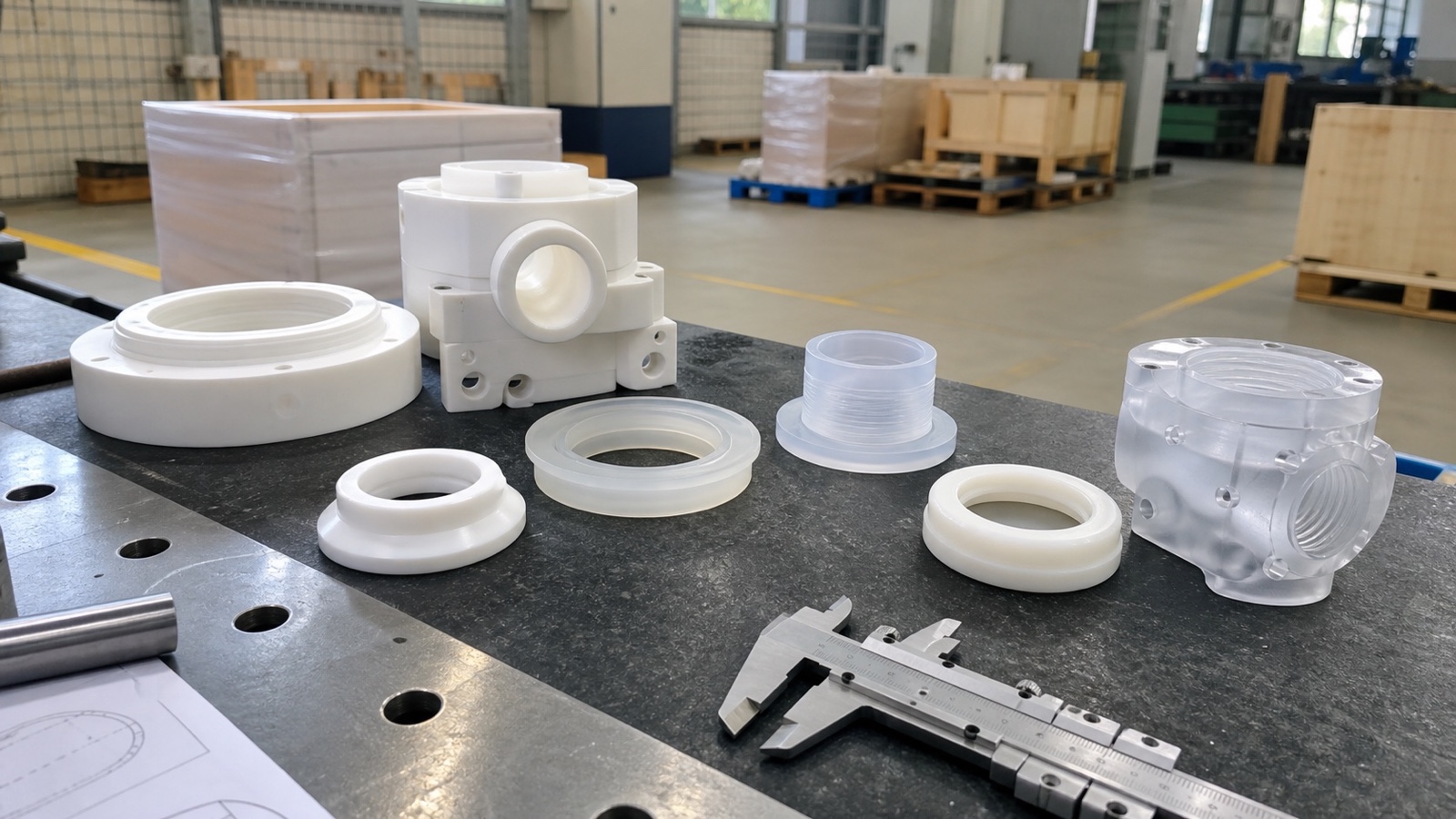
Why Melting Point Matters When Choosing a Fluoropolymer
Melting point is the single most critical thermal property when you’re molding, extruding, welding, or exposing a fluoropolymer to high-heat service. It sets two separate boundaries: the maximum temperature the material can withstand before losing dimensional integrity, and the processing window required to turn raw resin into a finished part.
For PTFE, PFA, and FEP, melting point also dictates which manufacturing methods are even possible. PTFE, despite having the highest melting point, cannot be injection molded like a normal thermoplastic. PFA and FEP can. That means melting point doesn’t just tell you how hot a part can get — it tells you how the part gets made in the first place.
The simple takeaway is this: PTFE > PFA > FEP in terms of melting point. But the nuance lies in processability. A higher melting point doesn’t automatically make a material better; it often makes it harder to fabricate. Let’s look at each material in turn.
What Are PTFE, PFA, and FEP? A Quick Overview
All three belong to the perfluoropolymer family — their carbon backbones are fully saturated with fluorine atoms. That’s what gives them their extreme chemical resistance and low surface energy. Beyond that, their molecular architectures diverge, producing distinctly different thermal and mechanical profiles.
PTFE (Polytetrafluoroethylene)
PTFE is the grandfather of fluoropolymers, discovered by accident in 1938 by Roy Plunkett at DuPont. It became famous under the Teflon™ brand and remains the most widely used fluoropolymer in the world. PTFE has a linear, highly crystalline structure with a melting point of approximately 327°C (620°F) — the highest of the three. It also has an extraordinarily high melt viscosity, which is why you never see PTFE injection molded. Instead, it’s sintered, like a ceramic.
PFA (Perfluoroalkoxy)
PFA is essentially PTFE’s melt-processable cousin. It has the same perfluorinated carbon backbone, but with perfluoroalkoxy side groups attached. Those side groups disrupt crystallinity slightly, dropping the melting point to a range of 305°C–310°C (581°F–590°F) — still very close to PTFE. PFA can be injection molded, extruded, and blow molded, making it the go-to choice when you need PTFE-like performance but with conventional melt processing.
FEP (Fluorinated Ethylene Propylene)
FEP is a copolymer of tetrafluoroethylene and hexafluoropropylene. The bulky CF₃ side branches from the hexafluoropropylene comonomer interfere with chain packing, reducing crystallinity and lowering the melting point to around 260°C (500°F). That makes FEP the easiest of the three to process, with excellent heat-sealing and welding characteristics. The trade-off is a lower continuous service temperature ceiling.
Chemical Structure: Why PTFE, PFA, and FEP Melt at Different Temperatures
The melting point of a semi-crystalline polymer is governed by how tightly its molecular chains can pack together and how much energy is required to break apart that ordered structure. The three fluoropolymers illustrate this perfectly.
PTFE's Linear, Highly Crystalline Structure
PTFE consists of a straight chain of CF₂ units. The fluorine atoms are arranged symmetrically around the carbon backbone, creating a rigid, rod-like molecule that packs efficiently into crystallites. This high crystallinity — often 90% or more in virgin resin — is what gives PTFE its exceptionally high melting point. It also gives PTFE its famously high melt viscosity. At temperatures above 327°C, PTFE doesn’t become a free-flowing liquid; it becomes a translucent, rubbery gel that is still far too viscous to flow through a mold or die. That’s why PTFE is processed by sintering: compacting powder into a shape, then heating it to fuse the particles without ever achieving true melt flow.
PFA's Alkoxy Side Chains
PFA is a copolymer of tetrafluoroethylene and a perfluoroalkoxy co-monomer. The side groups are relatively small and flexible, and they hang off the main chain at random intervals. They slightly disrupt the ability of adjacent chains to pack into large, perfect crystallites, which reduces the melting point by roughly 17–22°C compared to PTFE. However, because the side groups are perfluorinated and chemically similar to the main backbone, the material retains nearly all of PTFE’s thermal stability and chemical resistance. The net result is a polymer that melts at around 305–310°C, yet still flows well enough for conventional injection molding at high barrel temperatures — typically 350–400°C.
FEP's Hexafluoropropylene Comonomer
FEP is also a copolymer of tetrafluoroethylene, but the comonomer is hexafluoropropylene. The HFP unit introduces a bulky trifluoromethyl (CF₃) branch directly on the backbone. This branch is much more disruptive to chain packing than PFA’s longer alkoxy side chain, because it creates a large steric hindrance and reduces crystallinity significantly. The melting point drops to about 260°C, and the crystalline content is lower as well. The benefit is excellent melt flow at moderate temperatures — FEP can be extruded at roughly 300–350°C — and it heat-seals beautifully. The cost is a lower maximum service temperature and slightly reduced mechanical strength compared to PTFE and PFA.
PTFE vs PFA vs FEP: Melting Point Comparison Chart
Here’s a clean reference table to keep handy when you’re evaluating materials:
| Property | PTFE | PFA | FEP |
|---|---|---|---|
| Melting Point (°C / °F) | ~327°C / 620°F | ~305–310°C / 581–590°F | ~260°C / 500°F |
| Continuous Service Temperature (°C / °F) | ~260°C / 500°F | ~250–260°C / 482–500°F | ~200°C / 392°F | For more context, see this machining-focused overview.
| Maximum Short-Term Temperature | ~300°C / 572°F | ~280°C / 536°F | ~205°C / 400°F |
| Processing Method | Sintering (compression molding, ram extrusion, isostatic molding, skiving) | Melt processing (injection molding, extrusion, blow molding) | Melt processing (extrusion, injection molding, heat sealing) |
| Crystallinity Level | Very high (typically 90%+) | Moderate (compared to PTFE) | Low to moderate |
| Melting Point Key Takeaway | Highest heat resistance, but no true melt flow | Near-PTFE thermal performance with full melt processability | Easiest to process, lowest heat ceiling |
What this means in practice:
- PTFE is your choice when the part will see continuous temperatures up to 260°C and you need the ultimate in chemical resistance. Just be ready to accept a sintered, machining-based manufacturing route.
- PFA is the melt-processable workhorse for high-temperature applications. It gets you 90% of PTFE’s thermal and chemical performance, but you can injection mold it into complex geometries.
- FEP is the best option when processing ease, clarity, and heat sealing matter more than extreme temperature resistance.
Continuous Service Temperature vs. Melting Point: The Critical Difference
One of the biggest mistakes I see in the industry is confusing melting point with continuous operating temperature. They are not the same thing. A polymer’s melting point is the thermodynamic transition where the crystalline structure collapses. Its continuous service temperature is a practical limit based on long-term thermal degradation, creep, and mechanical property retention.
PTFE, for instance, melts at 327°C, but it is generally rated for continuous use up to only 260°C. Fine, you might think — that’s close enough. But go higher, and you start to see slow depolymerization and the release of toxic fluorinated breakdown products. Even below the melting point, sustained heat causes molecular weight loss and reduced mechanical strength.
PFA is rated for continuous service at 250–260°C, nearly the same as PTFE. FEP, with its lower melting point, is typically limited to 200°C continuous. That difference is significant in applications like semiconductor process chambers, heat exchangers, and electrical insulation, where every 10°C of rating matters.
You should also consider low-temperature performance. All three fluoropolymers remain tough and impact-resistant down to cryogenic temperatures. The glass transition temperatures are all well below −100°C, so brittle failure is rarely a concern at the low end — one of the great advantages of the entire fluoropolymer family.
How Melting Point Affects Processability: Sintering vs. Melt Extrusion
The practical consequence of the melting point differences is the way each material is fabricated. Let’s walk through that.
PTFE: High Melt Point, No Melt Flow
PTFE’s melt viscosity at 380°C is on the order of 10¹⁰ poise — roughly a million times higher than typical thermoplastics. It simply does not flow. So we can’t inject it, can’t extrude it through a die in the conventional sense, and can’t blow mold it. Instead, PTFE parts are made by a process called sintering.
The typical route starts with PTFE powder that is compacted in a mold under high pressure to form a “preform.” The preform is then heated above its melting point, usually to 360–380°C, so the particles fuse together into a homogeneous mass. After cooling, the part can be machined to final dimensions. For rods and tubes, ram extrusion is common. For sheet and film, the material is often skived — peeled like a layer cake from a cylindrical billet on a lathe.
All of this is more expensive than simple injection molding, and it limits geometric complexity. On the other hand, sintered PTFE delivers the maximum crystallinity and the best thermal margin of any fluoropolymer. When we machine PTFE components at PlasticCNCPro — seals, bushings, insulators, and custom linings — we almost always start with sintered, stress-relieved stock to ensure dimensional stability.
PFA: Melt-Processable with Near-PTFE Properties
Because PFA melts at 305–310°C and has a much lower melt viscosity than PTFE, it can be processed in standard thermoplastic equipment. Injection molding, screw extrusion, blow molding, even thermoforming are all viable. The caveat is that PFA requires high processing temperatures — barrel zones in the 350–400°C range — and corrosion-resistant tooling, because the hot polymer can attack standard steel.
The payoff is enormous: you can mold PFA into complex manifold bodies, fitting elbows, valve components, and high-purity pump heads that would be impossible to machine economically from PTFE. And because PFA’s continuous service temperature is nearly equal to PTFE’s, these parts can be used in the same demanding environments. For more context, see this machining-focused overview.
FEP: Easiest to Process of the Three
FEP has the lowest melting point, and it shows in how easily it processes. Extrusion temperatures are typically 300–350°C, which means less thermal stress on the resin and faster cycle times. FEP also has outstanding heat-sealing characteristics — you can weld it to itself with simple heated tools, which is why FEP film is a favorite for linings and labware.
It’s not surprising that FEP dominates wire and cable insulation, heat-shrink tubing, and release films. When you need long continuous lengths of insulation and don’t need the absolute maximum temperature rating, FEP is the low-effort, reliable choice.
Comparing Mechanical, Chemical, and Electrical Properties
Melting point is rarely the only selection criterion. Let’s do a rapid-fire comparison of the other properties you’ll be evaluating.
Mechanical Strength & Wear
- PTFE: High strength, but poor wear resistance and significant creep under load. That’s why PTFE is often filled with glass, carbon, or bronze — or used as a thin lining on a metal substrate.
- PFA: Better creep resistance than PTFE, similar flex life, and a reasonably low coefficient of friction. It’s the more dimensionally stable choice for molded parts.
- FEP: Slightly lower tensile strength than PTFE and PFA, but excellent flexibility and impact resistance. It’s the most forgiving of the three under repeated flexing.
Chemical Resistance
All three are highly inert to acids, bases, organic solvents, and oxidizing agents. PTFE and PFA are nearly identical in chemical resistance — both are considered essentially impervious to all chemicals at temperatures up to their service ratings. FEP is only marginally less resistant, and in most real-world environments that difference is invisible.
The exceptions are exotic conditions: molten alkali metals, elemental fluorine at high temperatures, and certain highly reactive halogen fluorides. In those cases, all perfluoropolymers will eventually degrade, and PTFE performs best only in terms of time-to-failure.
Electrical & Dielectric Properties
All three fluoropolymers offer outstanding dielectric strength, low dielectric constant, and extremely high volume resistivity. They are industry standards for wire insulation, coaxial cable dielectrics, and semiconductor equipment components that must not leach ions. The practical difference is thermal: PFA can be used at higher conductor temperatures than FEP, while FEP offers easier extrusion for fine-gauge wires.
Optical Transparency & Surface Properties
FEP and PFA are significantly more transparent than PTFE. FEP in particular is almost clear, which is why it’s used in laboratory tubing and sight-glass linings. PTFE is translucent to opaque, depending on thickness and crystallinity. All three have non-stick, low-friction surfaces with a coefficient of friction around 0.05–0.10.
Application Comparison: Which Fluoropolymer Wins Where?
Mapping melting point and processability to real-world usage makes the decision much easier.
PTFE Applications
PTFE is the default for gaskets, seals, O-rings, pump diaphragms, bearings, and chemical linings where service temperatures naturally run hot. It’s also the material of choice for skived films used in high-temperature capacitors and insulation tapes. If your part will be exposed to continuous heat around 260°C, or to chemicals so aggressive that nothing else survives, PTFE is almost certainly the answer.
PFA Applications
PFA shines in semiconductor wet-process equipment: fittings, valve bodies, high-purity tubing, and wafer carriers. These components need the chemical purity and temperature tolerance of PTFE, but they also need the design freedom of injection molding. PFA’s low extractables and smooth surfaces make it the standard material for carrying ultrapure chemicals at elevated temperatures.
FEP Applications
FEP is the right choice for wire and cable insulation, heat-shrink tubing, roll covers, release films, and laboratory beakers. If you’re heat-sealing a liner or need a material that can be easily welded into complex shapes, FEP’s low melting point is a feature, not a bug. Just keep the service temperature under 200°C and you’ll be well within its comfort zone.
Cost & Total Cost of Ownership Comparison
Raw material prices can be misleading. PTFE resin is generally the most economical of the three on a per-kg basis. PFA is more expensive than FEP, and both are noticeably pricier than PTFE. But processing costs can flip the entire equation.
PTFE’s sintered manufacturing route involves multiple steps: preforming, sintering, cooling, and often extensive machining. For a simple gasket, that’s fine. For a complex manifold that would have to be machined from solid PTFE, the cost skyrockets. PFA, by contrast, can be injection molded into that same manifold in seconds. The mold cost is high, but at production volumes above a few thousand parts, PFA wins on per-part cost.
FEP is cheaper to process than PFA because of lower temperatures and faster cycle times, but its lower temperature rating restricts where you can use it. For more context, see this practical selection guide.
Practical guidance:
- For large-volume, high-temperature, simple geometries → Consider PTFE.
- For complex, high-temperature parts in medium-to-high volume → Consider PFA.
- For low-temperature heat-sealed assemblies at high volume → Consider FEP.
- For prototypes and low-volume parts, machined PTFE or PFA is often more economical than investing in molds — and at PlasticCNCPro, we machine all three.
How to Choose the Right Fluoropolymer: A Practical Selection Checklist
Use this decision framework to narrow down your options quickly.
- If maximum continuous temperature exceeds 260°C → Choose PTFE.
- If you need melt processing but still require near-PTFE thermal and chemical performance → Choose PFA.
- If ease of processing, clarity, and heat sealing are your top priorities → Choose FEP.
- If cost-per-part is the primary driver → Consider PTFE for large, simple, high-volume parts; consider FEP for low-temperature heat-sealed assemblies.
And a “don’t-do” list:
- Don’t choose FEP for continuous exposure above 200°C. You’ll get premature creep and embrittlement.
- Don’t choose PTFE if you need tight tolerances via injection molding. It can’t be injection molded at all.
- Don’t assume PFA can do everything PTFE can. In the most extreme thermal and chemical edge cases, PTFE still has the upper hand.
- Don’t spec a material based on melting point alone. Always compare continuous service temperature, mechanical requirements, and processing method.
Frequently Asked Questions (FAQ)
What is the melting point of PTFE, PFA, and FEP?
PTFE melts at approximately 327°C (620°F). PFA melts in the range of 305–310°C (581–590°F). FEP melts at approximately 260°C (500°F).
Which fluoropolymer has the highest melting point?
PTFE has the highest melting point at ~327°C, followed by PFA at ~305–310°C, and then FEP at ~260°C.
What is the maximum operating temperature of FEP vs PFA vs PTFE?
For continuous service, PTFE is rated up to 260°C, PFA is rated up to 250–260°C, and FEP is rated up to 200°C. Short excursions are possible, but long-term exposure should stay within these limits.
Can PFA replace PTFE?
In many applications, yes — particularly where melt processing is required and the service temperature stays below 260°C. PFA offers similar chemical resistance and thermal stability. However, PTFE still wins for the absolute highest temperature margins and the lowest friction coefficient. If the part will be continuously exposed to temperatures right at 260°C, validate with thermal testing before switching.
Why is PTFE hard to process even though it has a high melting point?
Because PTFE’s melt viscosity is extraordinarily high — around one million times higher than a typical thermoplastic. It doesn’t “flow” like a liquid; it just softens into a gel. That’s why PTFE is sintered rather than injection molded or conventionally extruded.
Is FEP as chemically resistant as PTFE?
FEP is very close, but PTFE and PFA offer marginally superior chemical resistance in the most aggressive environments. In ordinary acids, bases, and solvents, FEP performs to the same standard. Only in extreme conditions — molten alkali metals, high-temperature fluorine gas — does the difference become measurable.
Which is better for wire insulation: FEP or PFA?
FEP is easier to extrude, has better electrical properties at lower frequencies, and is very common for wire and cable insulation. PFA is chosen when higher temperature ratings are required — for example, in aerospace or automotive applications where the conductor is expected to run hot. For most general-purpose wiring, FEP is sufficient and more economical.
Conclusion & Final Recommendations
Let’s recap the melting point hierarchy: PTFE > PFA > FEP. That single ranking drives everything else. PTFE gives you the highest temperature resistance and ultimate chemical inertness, but demands a sintered manufacturing route. PFA gives you almost the same thermal performance with full melt processability. FEP gives you the easiest fabrication and best heat sealing, but lowers the temperature ceiling to 200°C.
When I work with customers at PlasticCNCPro, the conversation almost always comes down to four questions: What temperature does the part actually see? What chemical environment? How is the part being made? And what does the per-part cost need to be? Once you answer those, the right fluoropolymer usually becomes obvious.
| Quick Reference | PTFE | PFA | FEP |
|---|---|---|---|
| Melting Point | ~327°C | ~305–310°C | ~260°C |
| Continuous Service | ~260°C | ~250–260°C | ~200°C |
| Processing Method | Sintered | Melt-processable | Melt-processable |
| Best For | Max heat and chemical resistance | PTFE-like performance with complex molding | Ease of processing and heat sealing |
Of course, every application has its own wrinkles. That’s why I always recommend consulting a materials engineer before finalizing a design. If you’re working on a part that needs precision machining in PTFE, PFA, or FEP — or any other engineering plastic — I’d be happy to help you evaluate the options.
Send us your drawing, 3D file, or project requirements today. Our team at PlasticCNCPro will review your material, tolerances, and manufacturing route, and we’ll respond with a quotation and production recommendation. Whether you need one prototype or a repeat production run, we’ll make sure you get the right fluoropolymer for the job.
Additional Resources & Related Reading
- PTFE temperature limits for fluoropolymer parts
- how PTFE and PCTFE differ in practice
- PTFE versus ECTFE for machined parts
Have questions about your specific application? Leave a comment below, or contact us for custom engineering support. We’re here to help you choose the right material and manufacture your parts with precision.