
What Is the Melting Point of PTFE? Temperature Limits Explained
Introduction to PTFE and Its Thermal Profile
If you’ve ever worked with PTFE—polytetrafluoroethylene—you already know it’s no ordinary plastic. This fluoropolymer shrugs off almost every chemical, slides with near-zero friction, and maintains its properties across a temperature range that would destroy most thermoplastics. But here’s the catch: to use PTFE safely and effectively, you need to understand its thermal limits.
At PlasticCNCPro, we machine PTFE every week for gaskets, seals, liners, and electrical components. And the most common question we get from engineers and buyers is: “What exactly is the melting point of PTFE—and can I run it hotter than the data sheet says?”
The short answer: PTFE melts at 327 °C (620 °F), but that number is not the whole story. Its continuous service limit is 260 °C (500 °F), and once you cross 350 °C (662 °F), you enter dangerous territory. In this article, I’ll explain the full thermal profile of PTFE, why it behaves differently from other plastics, and how to apply these limits in real-world engineering.
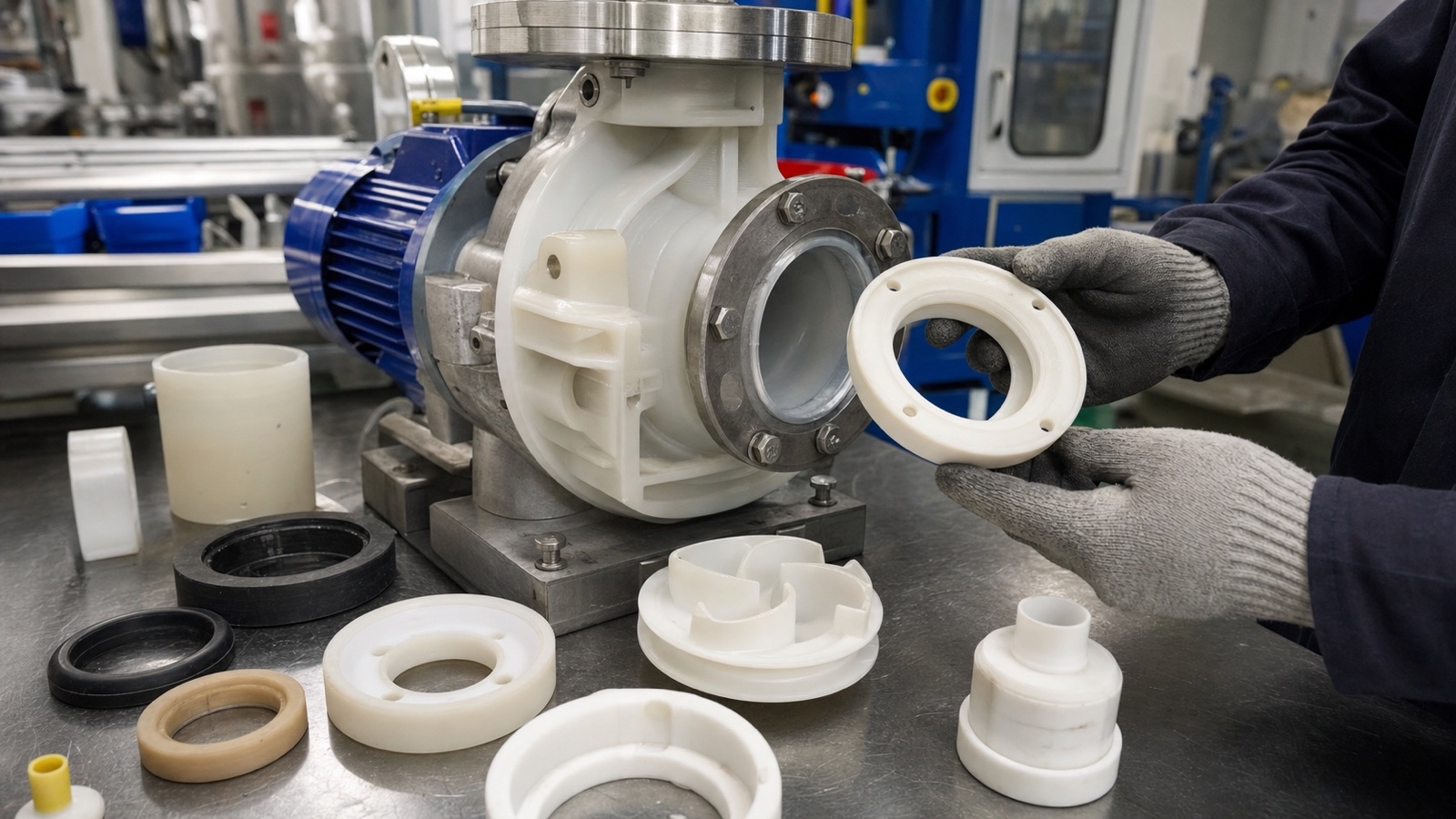
What Is the Exact Melting Point of PTFE?
The Standard Melting Point (327 °C / 620 °F)
Pure, virgin PTFE has a crystalline melting point of approximately 327 °C. This is a well-established value, confirmed by differential scanning calorimetry (DSC) and decades of industrial use.
But here’s the crucial distinction: PTFE does not melt into a free-flowing liquid like polyethylene or nylon. Instead, it transitions from a solid semicrystalline state into a translucent, gel-like mass with extremely high viscosity—think more like cold honey than water. This high melt viscosity (often above 10¹¹ Pa·s) is why PTFE cannot be processed by conventional injection molding or extrusion without special techniques (e.g., paste extrusion or compression molding followed by sintering).
For us at PlasticCNCPro, this means that when we machine PTFE, we never approach the melting point. Our cutting tools generate localized heat, but we manage speeds and feeds to keep the material below 150–200 °C to avoid deformation, gumming, or dimensional changes.
Why PTFE’s Melting Point Differs from Other Fluoropolymers
PTFE isn’t the only fluoropolymer on the market. When engineers compare materials, they often look at these common alternatives:
| Polymer | Melting Point (approx.) | Continuous Use Limit |
|---------|------------------------|----------------------|
| PTFE | 327 °C | 260 °C |
| FEP | 260 °C | 200 °C |
| PFA | 305 °C | 260 °C |
| ETFE | 270 °C | 150–180 °C |
| PCTFE | 215 °C | 150 °C |
The reason PTFE stands out is the strength of the carbon‑fluorine bond—one of the strongest single bonds in organic chemistry. Combined with a highly crystalline structure and extremely long polymer chains, this gives PTFE its exceptional thermal stability. It simply takes more energy to break those bonds or disrupt the crystalline order.
What Happens When PTFE Reaches Its Melting Point?
At 327 °C, the crystalline regions within PTFE break down. The material becomes amorphous and begins to flow very slowly. In practice:
- Volume expansion occurs; PTFE can swell 15–25% as it transitions.
- Mechanical integrity is lost—it becomes soft and easily deformed.
- Grain structure disappears; sintered PTFE parts may lose their shape entirely.
This is why you never design a PTFE part to operate at its melting point. The material ceases to function as a structural element.
Maximum Continuous Service Temperature vs. Melting Point
Typical Maximum Use Temperature (260 °C / 500 °F)
The most important temperature number for design engineers is not the melting point—it’s the maximum continuous service temperature (MCST). For unfilled PTFE, this is universally accepted as 260 °C (500 °F).
At this temperature, PTFE retains most of its mechanical strength, chemical resistance, and electrical properties for extended periods (thousands of hours). It does not degrade, nor does it melt. The MCST is a safe, practical limit set by industry standards such as ASTM D3295 and UL 746B.
We always tell our customers: “You can run PTFE at 260 °C every day; 327 °C is the absolute ceiling, but you never want to live there.”
Short‑Term Peak Temperature Tolerance
In many applications—like a momentary steam spike in a valve or a brief electrical overload in an insulator—PTFE can tolerate short excursions up to 300 °C (572 °F). The key word is short: typically minutes, not hours.
Beyond that, you risk:
- Irreversible deformation (creep)
- Loss of sealing force in gaskets and O‑rings
- Surface cracks or “cheese‑cutting” under pressure
Factors That Affect Temperature Ratings (Fillers, Processing)
PTFE is rarely used in its pure form for demanding applications. Fillers modify its thermal behavior:
- Glass‑filled PTFE (15–25% glass) increases stiffness and reduces creep, but can lower continuous use temperature slightly (to ~230 °C) due to thermal expansion mismatch.
- Carbon‑filled PTFE improves wear resistance and thermal conductivity; continuous limits stay around 260 °C, but peak tolerance may drop.
- Bronze‑filled PTFE is excellent for bearings but should not exceed 200 °C continuous because the metal filler oxidizes.
Processing also matters. Compression‑molded and sintered PTFE has a different crystalline structure than ram‑extruded material. Always check the manufacturer’s datasheet for the specific grade you plan to use.
At What Temperature Does PTFE Degrade?
Onset of Thermal Decomposition (~350 °C / 662 °F)
Above 350 °C, PTFE begins to undergo thermal degradation. The polymer chains break, releasing hazardous gases:
- Hydrogen fluoride (HF)
- Carbonyl fluoride (converts to HF in moisture)
- Perfluoroisobutylene (PFIB) – a highly toxic compound if inhaled.
This is why we have a strict rule in our shop: never heat PTFE above 400 °C. At that temperature, decomposition becomes rapid, and the fumes are not only toxic but also corrosive to metals and equipment.
Degradation Under Continuous Heat
Even below 350 °C, prolonged exposure can cause visible and functional changes:
- Yellowing or browning of the surface.
- Embrittlement – the material becomes chalky and loses tensile strength.
- Mass loss – thermogravimetric analysis (TGA) shows a slow weight loss beginning around 320 °C in some grades, accelerating after 350 °C.
For continuous heat exposure, stay at or below 260 °C. If your process cycles above that, limit the time and monitor for changes.
Real‑World Implications for Heat Exchangers, Seals, and Cookware
- Heat exchangers using PTFE tubes often run at 200–230 °C because the tube walls are thin and thermal cycling can cause fatigue.
- Seals in steam valves may see short spikes to 280 °C; that’s acceptable, but we recommend a filled grade (e.g., glass‑filled) to reduce creep.
- Non‑stick cookware: PTFE‑coated pans are safe up to 260 °C. Overheating an empty pan on high heat can easily exceed 350 °C, causing the coating to degrade and release fumes (the well‑known “polymer fume fever” risk). Never preheat an empty PTFE pan on high.
How Temperature Impacts PTFE’s Key Properties
Coefficient of Thermal Expansion (CTE)
PTFE has a very high CTE: about 120–170 × 10⁻⁶ / °C (depending on crystallinity), which is 10–20 times greater than steel. This means a PTFE part that fits perfectly at room temperature may loosen or tighten significantly at 200 °C.
In practice, we always account for this when designing interference fits, seal grooves, or lined pipes. For example, a PTFE‑lined steel pipe must have the liner designed with a clearance to avoid buckling during cooldown.
Mechanical Strength and Creep
As temperature rises, PTFE’s tensile strength falls off dramatically. At 150 °C, it’s about half of its room‑temperature value. Above 200 °C, creep (cold flow) becomes a serious concern, especially under sustained load.
This is why PTFE gaskets should be used only under moderate bolt loads, and why we often recommend using a filled grade or a different material (e.g., PFA) if high‑temperature creep is an issue.
Electrical and Chemical Resistance vs. Temperature
PTFE’s dielectric properties remain excellent up to near‑decomposition temperatures. Its volume resistivity stays above 10¹⁵ Ω·cm, and its dielectric constant (~2.1) is stable. Chemical resistance is also essentially unchanged across the useful temperature range—one of PTFE’s greatest strengths.
Thermal Conductivity and Insulation
PTFE is a good thermal insulator, with thermal conductivity roughly 0.25 W/m·K. This is low compared to metals or carbon‑filled grades (which can reach 0.5–0.8 W/m·K). If you need to conduct heat away, consider a filled PTFE or a different polymer.
Practical Temperature Limits for Common PTFE Applications
PTFE Gaskets and Seals
- Max continuous: 260 °C (unfilled), 230 °C (filled).
- Short peaks: up to 300 °C, but beware of creep relaxation—bolt re‑tightening may be needed after cooldown.
- Design tip: Use a confined gasket design to limit lateral flow.
PTFE Linings in Chemical Processing
- Typically rated 200–230 °C continuous, because the lining must adhere to a metal shell. Thermal cycling differential can cause delamination.
- Thicker linings (3 mm+) allow higher peak temperatures.
PTFE Cookware and Food Contact
- Safe continuous use: 260 °C.
- Avoid high‑heat searing (above 260 °C) or preheating an empty pan. For professional kitchens, we recommend using PFA‑coated pans if higher temperatures are needed.
PTFE in Electronics and Insulation
- Wire insulation and circuit board standoffs: continuous up to 260 °C.
- PTFE’s flame‑retardant properties (UL 94 V‑0) hold up to near‑decomposition temperatures.
- In applications where soldering (short contact at 300 °C+) occurs, use PTFE tape or sleeving rated for that peak.
Frequently Asked Questions About PTFE’s Melting Point and Heat Limits
At what temperature does PTFE melt?
Pure PTFE melts at 327 °C (620 °F). Unlike many thermoplastics, it transitions to a gel rather than a free‑flowing liquid.
What is the maximum use temperature of PTFE?
260 °C (500 °F) for continuous service. Short‑term excursions to 300 °C are possible with caution.
At what temperature does PTFE degrade?
Degradation begins around 350 °C (662 °F) and becomes rapid above 400 °C. Toxic gases (HF, carbonyl fluoride) are released—avoid overheating in any application.
Can PTFE withstand heat?
Yes, it is one of the most heat‑resistant thermoplastics. But it is not designed for prolonged exposure near its melting point.
Does PTFE burn?
PTFE is inherently non‑flammable (it does not support combustion). However, at extreme temperatures (above 500 °C in a flame), it will decompose and release toxic fumes.
Why doesn’t PTFE melt like other plastics?
Because of its extremely high melt viscosity caused by long polymer chains, strong intermolecular forces, and high crystallinity. It never becomes a runny liquid.
Summary – Key Takeaways for Engineers and Users
Let me sum up the essentials for specifying, machining, or using PTFE:
- Melting point: 327 °C – a crystalline transition, not a flow point.
- Safe continuous limit: 260 °C – don’t exceed this for long‑term use.
- Degradation begins: 350 °C – stay well below to avoid hazards.
- Thermal expansion: PTFE expands a lot—design clearances accordingly.
- Creep and strength: Fall off above 150 °C; use filled grades or support structures.
- Always consult the data sheet: Filled grades and different processing methods can shift these values.
At PlasticCNCPro, we help engineers select the right material and design for high‑temperature applications. If you’re machining PTFE parts or need custom components that must hold up at 200 °C+, we can quote your project and advise on tolerances, fillers, and thermal fit.
Related Articles / Further Reading
- PTFE vs. FEP vs. PFA: Choosing the Right Fluoropolymer for High‑Temperature Applications
- How to Machine PTFE Without Melting or Deforming
- Understanding Thermal Expansion in PTFE Seals and Gaskets
---
Need custom PTFE parts for your next project?
We at PlasticCNCPro machine PTFE (and dozens of other engineering plastics) every day. Send us your drawing, 3D model, or project requirements. We’ll review the design, recommend the best material grade, and provide a competitive quotation for prototypes or production runs.
📧 Email us with your application details – we reply in 24 hours.
📐 Tight tolerances, complex geometries, export‑ready packaging – let’s discuss your project.
RFQ Support
Send Your Drawing for a Quote
Share your 2D drawing, 3D model, material, quantity, tolerance, surface finish, and application details. Our team will review manufacturability and reply with a practical quotation.
Email: info@plasticcncpro.com
Address: 29 Fuxing Road, Dongguan City, Guangdong Province, China