
PVDF vs PTFE: Which Plastic Is Better for Chemical Processing?
For chemical processing hardware, PTFE is the safer default for extreme chemical inertness; PVDF is better when you need higher mechanical strength, weldability, and easier fabrication of structural CNC parts.
Pick PTFE for seals, linings, and parts that see the harshest media; pick PVDF for valves, manifolds, and machined components that must hold pressure and geometry while still resisting many corrosives.
Understanding the Materials
What Is PVDF?
PVDF is a semi-crystalline thermoplastic with the chemical formula -(CH₂-CF₂)ₙ-. It contains alternating carbon-hydrogen and carbon-fluorine bonds. That partial fluorination gives it a unique balance: strong mechanical properties plus good chemical resistance.
Key traits:
- High tensile strength and stiffness — about 2–3 times stronger than PTFE.
- Good resistance to acids, hydrocarbons, alcohols, and most organic solvents.
- UV stable — excellent for outdoor exposure.
- Easily processed: can be welded, thermoformed, and machined with standard tooling.
- Lower melting point (~170°C) and continuous use limit around 150°C.
Common applications in chemical processing:
- Piping and fittings for moderate chemical service
- Tank linings, valve bodies, and pump impellers
- Membrane support structures and filter housings
- Components requiring both chemical resistance and structural load-bearing
What Is PTFE?
PTFE is a fully fluorinated polymer — every hydrogen atom in the backbone is replaced by fluorine. This makes it one of the most chemically inert materials known. You probably know it better by the brand name Teflon™.
Key traits:
- Near-total chemical inertness — attacked only by molten alkali metals and a few fluorinated compounds at extreme conditions.
- Extremely wide temperature range: –200°C to +260°C continuous.
- Lowest coefficient of friction of any solid material (~0.05–0.10).
- Non-stick surface, excellent for sealing and release applications.
- Very soft and prone to creep under load — not mechanically strong.
- Difficult to process: cannot be welded; requires compression molding, sintering, or specialized machining.
Common applications in chemical processing:
- Gaskets, seals, and packing rings for aggressive service
- Lined pipes and vessels for hot corrosive fluids
- Sliding bearings and wear pads where low friction is critical
- High-purity fluid handling (semiconductor, pharmaceutical)
Head-to-Head Comparison: Key Properties for Chemical Processing
Let’s put PVDF and PTFE side by side across the properties that matter most in chemical processing.
Chemical Resistance
PTFE is the gold standard. It resists almost all chemicals up to its maximum service temperature. Dilute sulfuric acid, concentrated hydrochloric acid, sodium hydroxide, aqua regia, chlorinated solvents — PTFE shrugs them all off.
PVDF is good but not universal. It performs well against many acids, hydrocarbons, and halogens. However, it is attacked by strong bases (e.g., concentrated NaOH above 60°C) and hot sulfuric acid above 60–70°C. Some polar solvents like acetone and dimethylformamide can cause swelling or cracking.
PAA answer: Is PVDF chemical resistant? Yes, but with clear limitations. Always consult a chemical resistance chart and test under actual process conditions.
Temperature Resistance
- PTFE: Continuous use from –200°C to +260°C, with short-term excursions possible up to 300°C.
- PVDF: Continuous use typically –40°C to +150°C. Above that, mechanical properties drop off sharply.
For high-temperature chemical processing — say, handling hot sulfuric acid at 200°C — PTFE is the only choice among these two. For lower-temperature applications like electroplating baths or water treatment, PVDF is adequate. For more context, see the companion guide on pvdf vs ptfe.
Mechanical Strength and Rigidity
This is where PVDF shines.
| Property | PVDF | PTFE |
|----------|------|------|
| Tensile strength (MPa) | 50–70 | 20–30 |
| Flexural modulus (GPa) | 1.5–2.5 | 0.5–0.7 |
| Elongation at break (%) | 10–30 | 200–400 |
| Creep resistance | High | Low |
PVDF can support heavier loads and resist deformation under pressure and vibration. That makes it ideal for structural components like valve bodies, pump housings, and pipe flanges. PTFE, being soft, tends to cold-flow — gaskets can creep out of place, bearings can lose clearance. For load-bearing applications where chemical resistance alone isn’t enough, PVDF is often the better structural choice.
Friction and Wear Performance
PTFE has the lowest coefficient of friction of any solid polymer — around 0.05–0.10 against steel. That makes it unbeatable for non-lubricated sliding seals, rotary lip seals, and bearings where low friction prevents stick-slip and reduces heat generation.
PVDF’s friction coefficient is moderate (~0.2–0.4) and it has higher wear rates in dry sliding. Adding fillers like carbon fiber or graphite can improve wear, but PTFE remains the standard for low-friction applications.
Electrical and Other Properties
Both materials offer excellent electrical insulation. PVDF has a higher dielectric constant and is piezoelectric — it generates a voltage under mechanical stress — which makes it useful in sensors and actuators.
UV resistance: PVDF is excellent; PTFE degrades slowly under prolonged UV but doesn’t yellow. For outdoor chemical storage tanks, PVDF is preferred.
Radiation resistance: PVDF tolerates gamma and electron beam radiation well. PTFE degrades rapidly under high-energy radiation — not suitable for nuclear applications.
Cost and Total Cost of Ownership
Raw material cost — PVDF is typically 30–50% less expensive than PTFE on a per- kilo basis.
Processing cost — PVDF is much easier to fabricate. It can be welded (hot gas, ultrasonic, laser) and thermoformed, which simplifies joining and assembly. Machining PVDF is straightforward with standard carbide tools. PTFE cannot be welded; components must be machined from sheet or rod, or compression molded. PTFE also cuts with a “gummy” feel, requiring sharp tooling and careful chip control. For more context, see our notes on pvdf density vs pp density.
Total cost of ownership:
- In moderate conditions (below 150°C, mild chemicals), PVDF often wins on upfront savings and easier fabrication.
- In extreme environments where PTFE prevents catastrophic leaks and unplanned downtime, its higher material cost is easily justified.
- PTFE parts also last longer in aggressive hot chemicals — fewer replacements, less maintenance.
Pros and Cons Summary
PVDF
Pros:
- High mechanical strength and rigidity
- Excellent UV resistance
- Good chemical resistance to many acids and solvents
- Easy to fabricate (weldable, machinable)
- Lower material cost than PTFE
Cons:
- Limited continuous use temperature (150°C max)
- Poor resistance to strong bases and hot sulfuric acid
- Not suitable for extreme or universal chemical service
PAA answer: What are the disadvantages of PVDF? Limited thermal range, susceptibility to strong bases and hot acids, and lower chemical resistance than PTFE.
PTFE
Pros:
- Ultimate chemical inertness — resistant to almost everything
- Widest temperature range (–200°C to +260°C)
- Lowest coefficient of friction
- Non-stick, non-wetting surface
Cons:
- Low mechanical strength — cold flows under load
- Cannot be welded; complex fabrication
- Higher material cost
- Degrades under radiation
Decision Framework: Which One Is Better for Your Application?
There’s no universal winner. The right material depends on your process conditions. Here’s a simple decision guide:
Choose PVDF when:
- Operating temperature stays below 150°C.
- Chemical exposure is moderate (no strong bases or hot concentrated acids).
- The part must carry mechanical loads — support structural weight, withstand pressure, resist vibration.
- You need to weld or thermoform the material.
- Cost is a primary concern.
Choose PTFE when:
- Temperature exceeds 150°C (or goes below –40°C).
- The chemical cocktail is aggressive — strong acids, bases, oxidizers, or mixed solvents.
- Low friction is essential (seals, bearings, sliding surfaces).
- High purity is required (semiconductor, pharmaceutical).
- You can tolerate lower mechanical strength and higher cost.
PAA answer: Which is better PTFE or PVDF? It depends. For general chemical processing, PTFE wins on chemical and temperature range; PVDF wins on mechanical strength, ease of fabrication, and cost.
Quick Decision Matrix
| Condition | PVDF | PTFE |
|-----------|------|------|
| Temperature < 150°C | ✓ | ✓ |
| Temperature > 150°C | ✗ | ✓ |
| Strong bases (NaOH > 60°C) | ✗ | ✓ |
| Hot sulfuric acid | ✗ | ✓ |
| High mechanical load | ✓ | ✗ |
| Need for welding | ✓ | ✗ |
| Low friction requirement | ✗ | ✓ |
| Budget sensitive | ✓ | ✗ |
Conclusion
PVDF and PTFE are both excellent materials for chemical processing, but they serve different roles. PVDF is the workhorse for moderate-condition structural parts — strong, cost-effective, easy to fabricate. PTFE is the specialist for extreme chemical and thermal duty — almost invincible but mechanically weaker and pricier.
Neither material is universally superior. The key is to match the material to your operating parameters: temperature, chemical cocktail, pressure, mechanical loads, and budget. Always test prototypes in actual process fluids before committing to full-scale production.
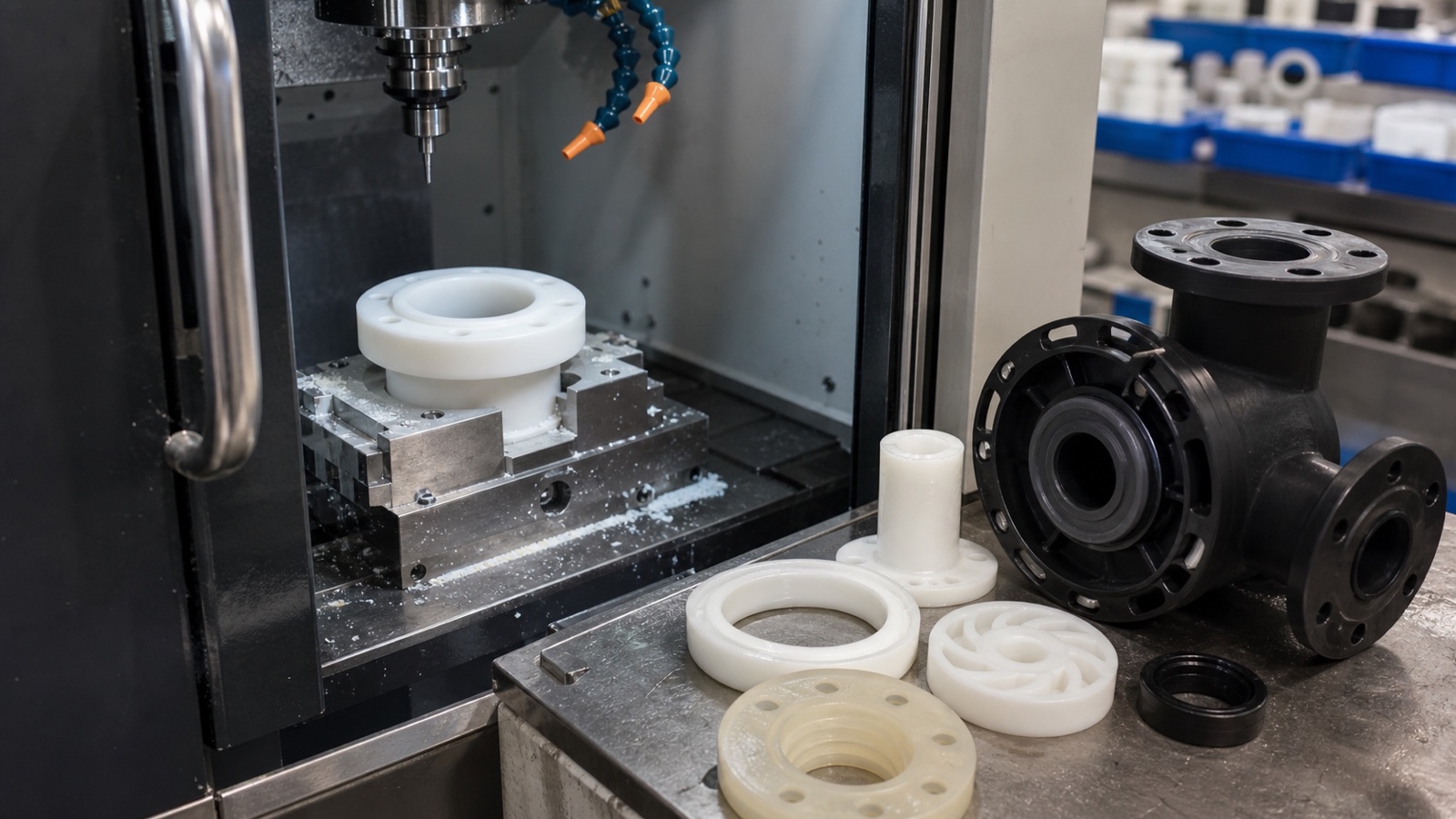
At PlasticCNCPro, we’ve machined thousands of PVDF and PTFE components for chemical processing equipment — from lined pipe tee fittings to precision seal rings. We can help you select the right material and manufacture custom parts to your exact specifications.
Frequently Asked Questions
Which is better, PTFE or PVDF?
It depends on your application. PTFE is better for extreme chemicals and high temperatures; PVDF is better for structural parts at moderate conditions and lower cost.
What are the disadvantages of PVDF?
PVDF has a limited continuous-use temperature of ~150°C. It exhibits poor resistance to strong bases (e.g., concentrated sodium hydroxide above 60°C) and hot sulfuric acid. It also has lower chemical compatibility than PTFE overall. For more context, see our notes on pps vs pvdf.
Is PVDF chemical resistant?
Yes, PVDF resists many acids, hydrocarbons, alcohols, and halogens. However, it is not suitable for all chemicals. Always consult a chemical resistance chart and perform testing under your process conditions.
Is PTFE good for chemicals?
PTFE is among the most chemically resistant plastics known. It is attacked only by molten alkali metals and a few highly fluorinated compounds at extreme temperatures. For almost all industrial chemicals, PTFE is completely inert.
Can PVDF be used for high-temperature chemical processing?
Only up to about 150°C continuous. Above that, mechanical properties degrade and the material may soften. For higher temperatures, PTFE, PFA, or PEEK are better choices.
Which material is easier to fabricate for custom components?
PVDF is much easier. It can be welded, thermoformed, and machined with standard tools. PTFE requires specialized machining (sharp tools, controlled speeds) and cannot be welded. Compression molding or sintering is often needed for complex PTFE shapes.
How do I choose between PTFE and PVDF for a lined pipe system?
Consider operating temperature and chemical aggressiveness. PTFE-lined pipe is best for hot corrosive media (e.g., concentrated acids above 150°C). PVDF-lined pipe works well for less aggressive fluids at temperatures below 150°C and offers significant cost savings.
---
Ready to manufacture your next chemical processing component in PVDF, PTFE, or another high-performance polymer? At PlasticCNCPro, we specialize in precision CNC machining of engineering plastics. We can review your drawing, help select the best material, and deliver custom parts with tight tolerances — backed by clear communication and export-ready packaging.
Contact us today with your 2D drawing, 3D file, or sample, and let’s discuss how we can support your project from prototype to production.
RFQ Support
Send Your Drawing for a Quote
Share your 2D drawing, 3D model, material, quantity, tolerance, surface finish, and application details. Our team will review manufacturability and reply with a practical quotation.
Email: info@plasticcncpro.com
Address: 29 Fuxing Road, Dongguan City, Guangdong Province, China