
Nylon Melting Point: PA6 vs PA66 vs Cast Nylon – The Ultimate Comparison
When an engineer sends us a drawing for a nylon gear, wear pad, or bushing, the first question we ask is rarely about price or lead time. It's about melting point. That single number tells us more about the part's thermal limits, processing behavior, and long-term reliability than almost any other specification on the datasheet.
Over the years, we've machined thousands of nylon parts at PlasticCNCPro — from small automotive clips to meter-wide conveyor wheels. And one confusion keeps coming up again and again: what's the actual difference between PA6, PA66, and cast nylon? They all get called "nylon," but they are not interchangeable.
This guide breaks down the melting points, mechanical properties, and real-world trade-offs of each material so you can make the right call on your next project.
What Is Nylon? A Quick Primer on Polyamides
Nylon, technically known as polyamide (PA), is a synthetic thermoplastic polymer prized for its strength, toughness, and exceptional wear resistance. It was the first truly successful engineering thermoplastic, and it remains one of the most widely specified materials in industrial manufacturing.
The numbers that follow the name tell you about the molecular building blocks:
- PA6 is made from a single monomer called caprolactam, which contains 6 carbon atoms.
- PA66 is made from two monomers — hexamethylenediamine and adipic acid — each containing 6 carbon atoms. That's where the "66" comes from.
That small difference in chemistry has a big effect on how the polymer chains pack together, how strongly they bond, and ultimately how much heat the material can withstand before its crystalline structure gives way.
Cast nylon, sometimes called MC nylon or cast polyamide, is not a different polymer family. It's the same polyamide chemistry — usually PA6-based, occasionally PA66-based — but produced through a completely different process called monomer casting. Instead of melting polymer pellets and injecting them into a mold, the monomer is polymerized directly inside a mold to form large sheets, rods, and tubes. This yields a material with far higher molecular weight and crystallinity, which changes its mechanical and thermal behavior in important ways.
Why does melting point matter so much? Because it's the ceiling. It defines the absolute limit of what a nylon part can tolerate before it softens, deforms, or fails. Every other property — service temperature, creep resistance, processing parameters, even wear performance — hangs off that number.
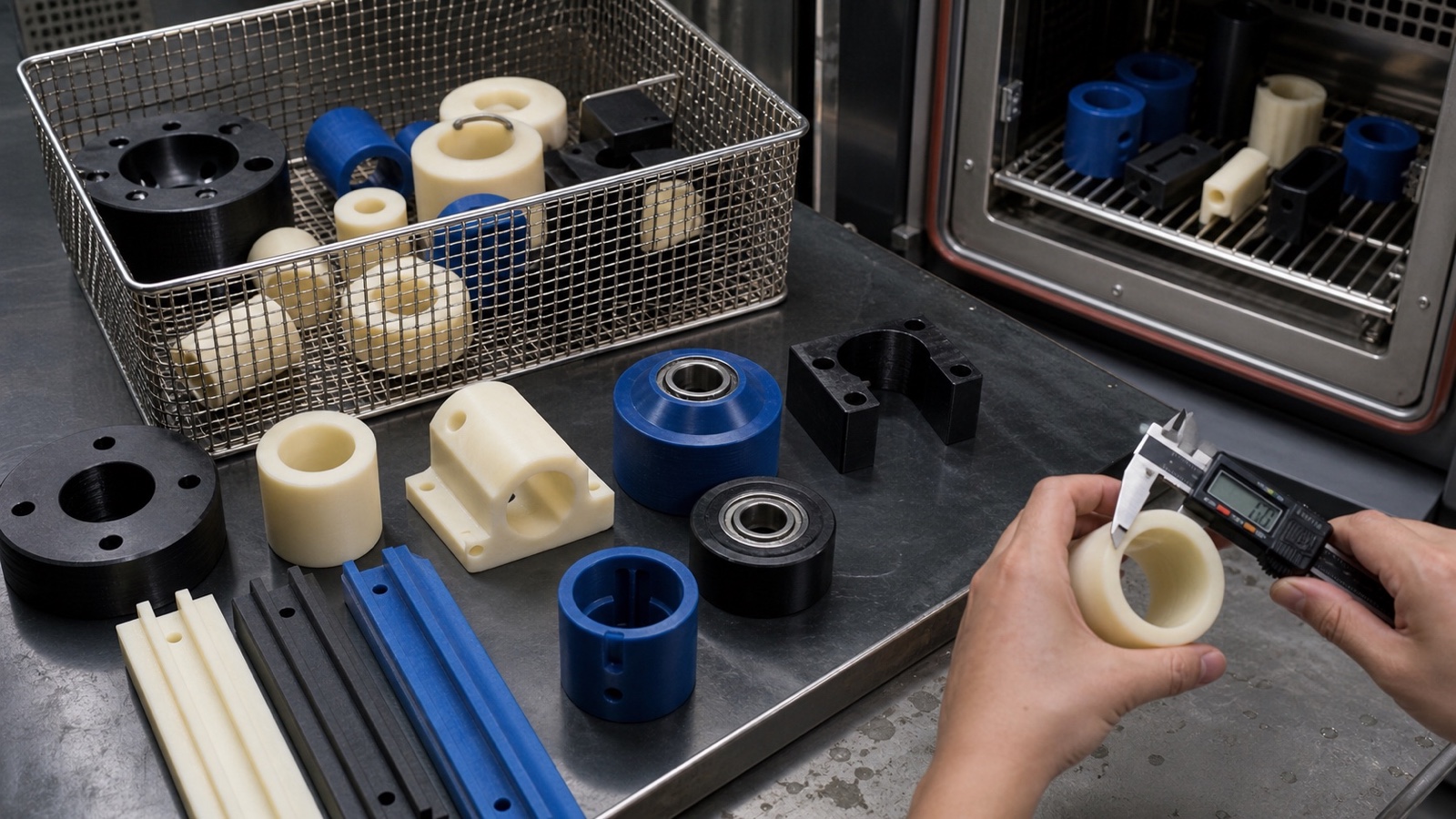
Why Melting Point Matters in Nylon Selection
Melting point is the temperature at which the crystalline regions of the polymer transition from an ordered solid to a viscous liquid. For semicrystalline materials like nylon, this is a sharp, well-defined transition — not a gradual softening like you'd see in amorphous plastics.
But melting point is only the beginning. Here's why it matters in practical engineering terms:
Continuous service temperature. A nylon part will never run continuously anywhere near its melting point. Under sustained load, creep and oxidation set in far earlier. In general, you want a continuous service temperature roughly 100–120°C below the melting point. That's why a PA6 part with a 225°C melting point is typically rated for around 100°C continuous use, while PA66 with a 265°C melting point stretches that to about 120°C.
Injection molding parameters. The melting point dictates barrel temperatures, mold temperatures, and cycle times. PA66 requires hotter tooling and more energy to process, which translates into higher part costs. If you don't actually need the extra heat resistance, you're paying for it on every cycle.
Tooling design and shrinkage. Higher melting points mean higher mold temperatures, which affect cooling rate, crystallinity, and final shrinkage. Parts molded in PA66 cool differently than PA6 parts, and the tool designer must account for that.
Sterilization and automotive under-hood use. Many medical devices require steam sterilization at 121–134°C. Many automotive components sit near engines where ambient temperatures exceed 100°C. In both cases, a higher melting point gives you the safety margin you need to survive repeated thermal spikes.
One critical distinction: melting point is not the same as heat deflection temperature (HDT). HDT measures how much a loaded bar deflects as temperature rises — it's a mechanical test, not a phase transition. A glass-filled PA66 might have a melting point of 260°C, but its HDT at 1.8 MPa is around 240°C. Conversely, an unfilled PA6 might melt at 225°C but have an HDT of only 65–75°C. When you're designing a part, both numbers matter — melting point sets the ultimate ceiling, HDT tells you how it behaves under load.
PA6 Melting Point and Core Properties
The melting point of PA6 is 220–225°C (428–437°F).
If you've been searching for "what is the melting point of nylon PA6," that's your answer — a tightly defined crystalline transition, usually cited as 223°C in most datasheets.
PA6 is the workhorse of the nylon family. It offers an excellent balance of strength, toughness, and affordability, which makes it the default choice for a massive range of injection-molded and machined components.
Key properties of PA6:
- Tensile strength: ~75–85 MPa (dry as molded)
- Flexural modulus: ~2,800–3,200 MPa
- Impact resistance: Excellent — PA6 absorbs energy well and resists crack propagation
- Wear characteristics: Good, though not as robust as PA66 or cast nylon in abrasive environments
- Moisture absorption: Higher than PA66 — about 2.7% at 50% relative humidity, and up to 9.5% fully saturated
Because PA6 has a lower melting point, it processes more easily than PA66. It flows into thin-wall molds more readily, requires lower barrel and mold temperatures, and develops less internal stress. From a manufacturing standpoint, PA6 is friendlier and cheaper to produce.
The trade-off is thermal capability. If your application runs hot — sustained temperatures above 100°C, or frequent thermal spikes — PA6 will start to creep and lose mechanical strength. That's when you step up to PA66.
Common PA6 applications: gears and pinions, plain bearings, housings and casings, automotive clips and fasteners, cable ties, zipper teeth, and structural brackets where impact resistance is key.
PA66 Melting Point and Core Properties
The melting point of PA66 is 255–265°C (491–509°F).
That's roughly 30–40°C higher than PA6 — a significant jump when you're designing for heat. In fact, when someone asks "what is the temperature difference between PA6 and PA66?", the answer is right there: PA66 typically melts about 35°C higher.
Why? It comes down to hydrogen bonding. In PA66, the repeating unit has a more symmetric arrangement of amide groups, which allows the polymer chains to pack more tightly and form more intermolecular hydrogen bonds. Those bonds take more thermal energy to break, so the crystalline structure resists melting to a higher temperature.
The higher melting point brings real mechanical advantages:
- Tensile strength: ~80–90 MPa (dry as molded) — measurably stronger than PA6
- Stiffness: Higher flexural and tensile modulus
- Wear resistance: Superior to PA6, especially in dry-running or lightly lubricated conditions
- Dimensional stability: Better than PA6 — lower moisture absorption (around 2.5% at 50% RH, ~8.5% saturated) means less swelling and warpage in humid environments
- Creep resistance: Retains stiffness under sustained load at elevated temperatures far better than PA6
The catch is processing. PA66 needs hotter barrels (270–300°C), hotter molds (80–120°C), and more careful control during molding. It's also slightly more expensive per kilogram. But for applications that combine heat, load, and wear, PA66 is worth every cent.
Common PA66 applications: high-temperature electrical connectors and switchgear, automotive engine components (air intake manifolds, radiator end tanks, timing chain guides), industrial gears and sprockets, power tool housings, and any component that must hold tolerances near 120°C.
What Is Cast Nylon? Melting Point and How It's Different
Cast nylon is the specialist of the family. It's produced via anionic monomer casting — a process where liquid caprolactam monomer is polymerized directly inside a mold at atmospheric pressure, forming finished shapes without going through melt processing.
The melting point of cast nylon (PA6-based) is 218–225°C (424–437°F) — essentially the same as extruded or molded PA6. PA66-based cast grades melt in the 255–265°C range.
But here's what makes cast nylon different: molecular weight.
Extruded PA6 or PA66 typically has a molecular weight in the range of 20,000–40,000 g/mol. Cast nylon, by comparison, reaches 50,000–100,000 g/mol or higher. That's a massive difference. Longer polymer chains mean more chain entanglements, higher crystallinity, and dramatically better mechanical properties.
What does that translate to in practice?
- Superior wear resistance — cast nylon outlasts extruded nylon in abrasive and sliding applications
- Lower coefficient of friction — often 20–30% lower than regular PA6
- Better vibration dampening — the higher molecular weight absorbs shock and noise more effectively
- Higher impact strength and creep resistance — long chains resist deformation under sustained load
- Excellent dimensional stability in thick sections — the casting process produces near-net-shape blanks (sheets, rods, tubes) that are then CNC machined to final tolerances
Cast nylon is not injection-molded. It's machined from stock shapes, which means you can make parts that would be impossible to mold — oversized gears, thick-walled bushings, custom profiles, and short-run components without the cost of a mold.
Common cast nylon applications: large gears and pinions, guide wheels and rollers, conveyor components, wear pads and strips, marine bushings, crane sheaves, and any heavy-duty part where lubrication is difficult and wear life is critical.
PA6 vs PA66 vs Cast Nylon: Side-by-Side Comparison Table
Let's put the three materials next to each other. These numbers represent typical values for unfilled grades — always confirm against the specific datasheet for your chosen formulation.
| Property | PA6 (Extruded/Molded) | PA66 (Extruded/Molded) | Cast Nylon (PA6-based) |
|---|---|---|---|
| Melting point (°C) | 220–225°C | 255–265°C | 218–225°C |
| Heat deflection temp (HDT) @ 1.8 MPa | 65–75°C | 80–100°C | 80–100°C (varies by grade) |
| Tensile strength (dry) | 75–85 MPa | 80–90 MPa | 75–95 MPa (grade dependent) |
| Tensile modulus (dry) | 2,800–3,200 MPa | 3,000–3,600 MPa | 3,200–4,000 MPa |
| Moisture absorption (saturation) | ~9.5% | ~8.5% | ~5.5–9.5% (grade dependent) |
| Wear resistance | Good | Very good | Excellent |
| Coefficient of friction (dry vs steel) | 0.3–0.45 | 0.25–0.40 | 0.15–0.30 |
| Impact strength | Excellent | Good | Very good |
| Machinability | Good | Good | Excellent — low internal stress, machines cleanly |
| Relative cost | $ (Lowest) | $$ (Moderate) | $$$ (Higher material cost, but no mold investment) |
The takeaway row: PA6 is the best value for general-purpose parts where heat stays below 100°C. PA66 is the best balance of heat resistance and stiffness for demanding engineering applications. Cast nylon is the best choice for extreme wear environments, large cross-sections, and machined components where molded parts aren't practical.
Is PA6 Stronger Than PA66? (PAA Answer Section)
No — PA66 is generally stronger, stiffer, and more heat-resistant than PA6 in both dry and moisture-conditioned states.
The numbers back this up:
- Dry tensile strength: PA6 ~75–85 MPa vs PA66 ~80–90 MPa
- Dry flexural modulus: PA6 ~2,800–3,200 MPa vs PA66 ~3,000–3,600 MPa
- At elevated temperatures, the gap widens even further — PA66 retains a higher percentage of its room-temperature strength because its higher melting point delays the onset of crystalline softening.
That said, there's an exception worth noting. PA6 can outperform PA66 in impact resistance and energy absorption, particularly at low temperatures or in high-moisture conditions. The slightly more flexible polymer chains in PA6 absorb impact energy more effectively, which is why PA6 is often specified for snap-fit clips, cable ties, and other parts that must survive repeated deformation without cracking.
And if you bring cast nylon into the conversation, it typically exceeds both in strength-per-weight and load-bearing capacity — again, thanks to its high molecular weight. A cast nylon gear running against a steel worm gear will outlast a PA6 or PA66 gear in most industrial applications.
Heat Resistance: Continuous Service vs Short-Term Peaks
Melting point gets all the attention, but in real engineering, you design around service temperature — and there are actually three numbers you need to know:
- Melting point — the absolute physical limit. The part becomes a liquid.
- Continuous service temperature — the temperature at which the part can run indefinitely without significant loss of mechanical properties.
- Short-term peak temperature — what the part can survive for minutes or hours without catastrophic failure.
Typical ranges for our three materials:
| Material | Continuous Service | Short-Term Peak |
|---|---|---|
| PA6 | −40°C to 100°C | Up to 150–180°C briefly |
| PA66 | −40°C to 120°C | Up to 180–200°C briefly |
| Cast Nylon (PA6-based) | −40°C to 110°C | Up to 150–170°C briefly |
| Cast Nylon (PA66-based) | −40°C to 130°C | Up to 200°C briefly |
Annealing can push these numbers higher. Cast nylon parts, in particular, benefit from annealing, which relieves internal stresses, increases crystallinity, and raises the maximum service temperature. We frequently anneal machined cast nylon components at PlasticCNCPro when they're destined for hot, high-load applications.
It's also worth mentioning that glass-fiber reinforcement dramatically raises the thermal ceiling. A PA66-GF30 grade can run continuously at 150°C or even higher, because the glass fibers carry the load even as the polymer matrix softens. The melting point doesn't change much — the fibers don't melt at these temperatures — but the HDT and creep resistance skyrocket.
Moisture Absorption and Dimensional Stability
Every nylon absorbs moisture. That's a fundamental characteristic of the amide groups, which are hydrophilic. And it has a profound effect on performance.
Water acts as a plasticizer in nylon. As moisture content rises, the polymer chains slide past each other more easily. The result:
- Tensile strength decreases (by 10–20% from dry to saturated)
- Stiffness and modulus drop significantly
- Impact resistance typically improves (it gets tougher, but softer)
- Dimensions increase — nylon swells as it absorbs water
Here's how the three materials compare:
- PA6: ~2.7% moisture at 50% RH, ~9.5% at saturation
- PA66: ~2.5% at 50% RH, ~8.5% at saturation
- Cast nylon (PA6-based): similar equilibrium moisture to PA6, but the higher crystallinity reduces the practical impact; machined surfaces hold tighter tolerances because internal stress is lower
When someone asks "what is the difference between PA6 and PA66 nylon?", moisture behavior is a big part of the answer. PA66 absorbs less water, changes dimensions less, and retains more of its stiffness in humid environments. For precision machined parts, press-fit bushings, or any component with tight mating tolerances, this is the difference between a part that works and a part that seizes.
Mitigation strategies we use regularly:
- Conditioning — pre-soaking nylon parts to their equilibrium moisture content before final machining or assembly
- Vacuum drying — removing moisture before molding or machining critical parts
- Filled grades — glass fiber, mineral, or molybdenum disulfide (MoS₂) fillers reduce moisture uptake and stabilize dimensions
A practical rule: if your machined nylon part must hold a tolerance tighter than ±0.1 mm in a humid environment, design for the wet state, not the dry state.
Glass-Fiber Reinforced Grades: PA6 GF30 vs PA66 GF33
Around 30% glass fiber is the sweet spot for glass-reinforced nylon. It roughly doubles tensile strength, triples stiffness, and dramatically improves creep and fatigue resistance compared to unreinforced grades. That's why PA6 GF30 and PA66 GF33 dominate heavy-duty engineering applications.
Do glass fibers change the melting point? No — not significantly. Glass fibers are inorganic and don't melt at polymer processing temperatures. The melting point of PA6 GF30 is still ~220–225°C, and PA66 GF33 still melts around 260°C. What changes is the HDT. Unreinforced PA6 has an HDT of ~65°C at 1.8 MPa; PA6 GF30 jumps to ~190–200°C. That's a massive improvement for applications that see moderate heat under load.
Comparing the two filled systems:
- PA66 GF33 offers higher tensile strength (~180–200 MPa), higher flexural modulus (~9,000–10,000 MPa), and superior fatigue resistance. It's the go-to for structural automotive parts, pump housings, and power tool components.
- PA6 GF30 delivers ~150–170 MPa tensile strength and ~8,000–9,000 MPa modulus — close, but a step behind. However, it offers better surface finish, lower warpage, and easier mold filling for complex geometries. For thin-wall enclosures or cosmetic parts, PA6 GF30 often wins.
Both systems can be modified with impact modifiers (for toughness) and heat stabilizers (for long-term thermal aging). If your application involves continuous exposure above 120°C, heat-stabilized PA66 GF33 is the benchmark.
Processing Considerations: Injection Molding vs Machining Cast Nylon
The way you manufacture a nylon part is just as important as which nylon you choose.
Injection molding PA6 vs PA66:
| Parameter | PA6 | PA66 |
|---|---|---|
| Barrel temperature | 230–280°C | 270–300°C |
| Mold temperature | 70–90°C | 80–120°C |
| Injection pressure | Moderate | Higher |
| Shrinkage | ~1.0–1.5% | ~1.2–1.8% |
| Warpage risk | Lower | Higher |
The higher melting point of PA66 demands higher processing temperatures on both sides of the mold. That increases energy costs, lengthens cycle times (hotter molds take longer to cool), and raises the risk of degradation if the resin sits too long in the barrel. PA6, by contrast, flows more easily, fills thin sections better, and produces parts with lower residual stress.
Machining cast nylon:
Cast nylon completely sidesteps melt processing. The material is supplied as stock shapes — plates, rods, tubes, and custom cast blanks — and then machined to final dimensions using CNC milling, turning, and drilling.
This opens up possibilities that injection molding can't match:
- Large cross-sections — solid cast nylon rods up to 500 mm diameter or more
- Thick walls without sink marks or internal voids
- Low internal stress — cast blanks are polymerized slowly and uniformly, so machined parts hold their shape far better than injection-molded equivalents
- Low-volume production — no mold investment means a single custom gear or a batch of twenty bushings is economically viable
There's a crossover point. For high-volume parts (tens of thousands per year), injection molding wins on cost per part. For prototypes, low volumes, large parts, or complex geometries, machining cast nylon is almost always the smarter choice.
How to Choose: PA6 vs PA66 vs Cast Nylon — A Decision Guide
Here's a straightforward framework I use with customers when they're choosing between these three materials. Walk through your application and match the scenario.
Choose PA6 when:
- Cost is a primary driver
- Operating temperature stays below 100°C
- You need maximum impact resistance and toughness
- You're molding thin-wall parts with complex geometries
- Moisture-related dimensional changes are acceptable
- Examples: snap-fit housings, cable management, general-purpose gears, automotive interior clips
Choose PA66 when:
- Operating temperature runs between 100°C and 150°C
- You need high stiffness and low creep under sustained load
- Wear resistance is critical
- Dimensional stability in humid environments matters
- You're making electrical components that must survive heat
- Examples: engine bay components, high-temp connectors, industrial gears, pump parts
Choose cast nylon when:
- Parts have large cross-sections that can't be molded economically
- You need extreme wear resistance and low friction
- Noise and vibration dampening are priorities
- You need only a few parts or custom shapes
- You want the lowest internal stress possible
- Examples: large gears, guide wheels, conveyor wear strips, marine bushings, custom rollers
Quick checklist before you specify:
- What is the maximum continuous operating temperature?
- Are there short-term thermal spikes? How hot, how long?
- Is the load static, dynamic, or impact?
- Will the part be exposed to high humidity or immersion?
- What is the part size and wall thickness?
- What is the production volume — 5 parts or 50,000?
- Do you have machining capability, or do you need molding?
And to answer the recurring question one more time: Is PA6 stronger than PA66? No. If you need strength, stiffness, and heat resistance, PA66 beats PA6. Choose PA6 for toughness, ease of processing, and cost — not for strength.
Sustainability and Recycling of PA6 and PA66
Nylon's environmental footprint is a growing concern, and it's worth understanding how PA6 and PA66 differ in their recyclability.
PA6 is uniquely circular. It can be depolymerized back into caprolactam — its original monomer — and then re-polymerized into virgin-quality nylon. This is true chemical recycling, and it's commercially proven. The Econyl process, for example, recovers caprolactam from post-consumer fishing nets and carpet fiber to produce new PA6. For parts machined from cast nylon, the offcuts and swarf can similarly be collected and recycled into new feedstock.
PA66 is harder to chemically recycle. Its two-monomer structure makes depolymerization more complex and less economical. Most PA66 recycling today is mechanical — grinding, melting, and re-extruding — which typically results in downgraded properties. This is one reason why PA6 is increasingly preferred in sustainability-driven design.
Thermal degradation is the hidden cost of reprocessing. Every melt pass breaks polymer chains and reduces molecular weight. Injection-molded nylon regrind loses properties each cycle, which is why most processors limit regrind content to 10–25%. Cast nylon and machined parts avoid this entirely — the material is processed once, and the machining process doesn't degrade the polymer.
Bio-based alternatives are emerging. Castor-oil-derived PA11 and PA6.10 are gaining traction in automotive and consumer electronics. They offer lower carbon footprints, lower moisture absorption, and excellent dimensional stability — though at a higher price point. For some applications, they're a superior drop-in replacement for PA6 or PA66.
Frequently Asked Questions (FAQ)
What is the melting point of nylon PA6?
PA6 melts at 220–225°C (428–437°F). Its continuous service temperature is approximately −40°C to 100°C.
What is the melting point of PA66?
PA66 melts at 255–265°C (491–509°F), roughly 30–40°C higher than PA6.
Why is PA66 melting point higher than PA6?
PA66 has stronger interchain hydrogen bonding and tighter crystalline packing due to its symmetrical repeating unit structure. More energy is required to break these bonds and disrupt the crystal lattice.
What is the melting point of cast nylon?
PA6-based cast nylon melts at 218–225°C. PA66-based cast grades melt at approximately 255–265°C.
Is PA6 stronger than PA66?
No — PA66 is stronger, stiffer, and more heat-resistant. PA6 can be tougher (better impact resistance) and is lower cost.
Can I use PA6 instead of PA66?
Only if your operating temperature stays below ~100°C and moisture-related dimensional changes are acceptable. For hot, high-load, or high-humidity environments, PA66 is the safer choice.
Does cast nylon have a different melting point than extruded nylon?
The melting point is similar, but cast nylon's much higher molecular weight and crystallinity change how heat affects it — offering better creep resistance and property retention at elevated temperatures.
Conclusion — Which Nylon Wins?
If you came looking for a single winner, here's the honest answer: there isn't one. The melting point hierarchy is clear — PA66 > PA6 ≈ cast nylon (PA6-based) — but melting point is only the starting line.
- For heat, pick PA66.
- For cost and toughness, pick PA6.
- For wear and large machined parts, pick cast nylon.
The right choice depends on your operating temperature, load profile, moisture exposure, part geometry, production volume, and budget. No datasheet can replace real-world testing — so get samples, run them in your actual environment, and measure the results.
At PlasticCNCPro, we machine all three materials every week. Whether you need a single cast nylon gear, a small batch of precision PA66 bushings, or a prototype run of PA6 components, we can help you select the right grade, hold your tolerances, and ship parts that perform.
Send us your drawing, 3D model, or sample today. Our engineering team will review your application, recommend the right nylon, and provide a quotation with honest lead times. Email us your project requirements — let's build something reliable together.
RFQ Support
Send Your Drawing for a Quote
Share your 2D drawing, 3D model, material, quantity, tolerance, surface finish, and application details. Our team will review manufacturability and reply with a practical quotation.
Email: info@plasticcncpro.com
Address: 29 Fuxing Road, Dongguan City, Guangdong Province, China