
POM Melting Point: What CNC Machinists Need to Know
If you machine plastics for a living, you already know that POM (polyoxymethylene, or acetal) is one of the most forgiving and rewarding materials on the shop floor. It cuts cleanly, holds tolerances beautifully, and its low friction and high wear resistance make it the go-to choice for gears, bushings, valve components, and a hundred other precision parts.
But that doesn't mean POM is foolproof. Every plastic has a personality, and POM's personality is defined by its thermal behavior. The melting point is the headline number, but what actually matters during machining is how heat builds up at the cut zone, how the material expands, and how it responds to stress. Get those wrong, and you'll scrap parts that looked perfect when they came off the machine.
I've spent years machining POM and dozens of other engineering plastics at PlasticCNCPro in Dongguan. In this article, I'll break down everything CNC machinists need to know about POM's melting point, how it affects real machining decisions, and how to select and process this material for dimensionally stable, repeatable parts.
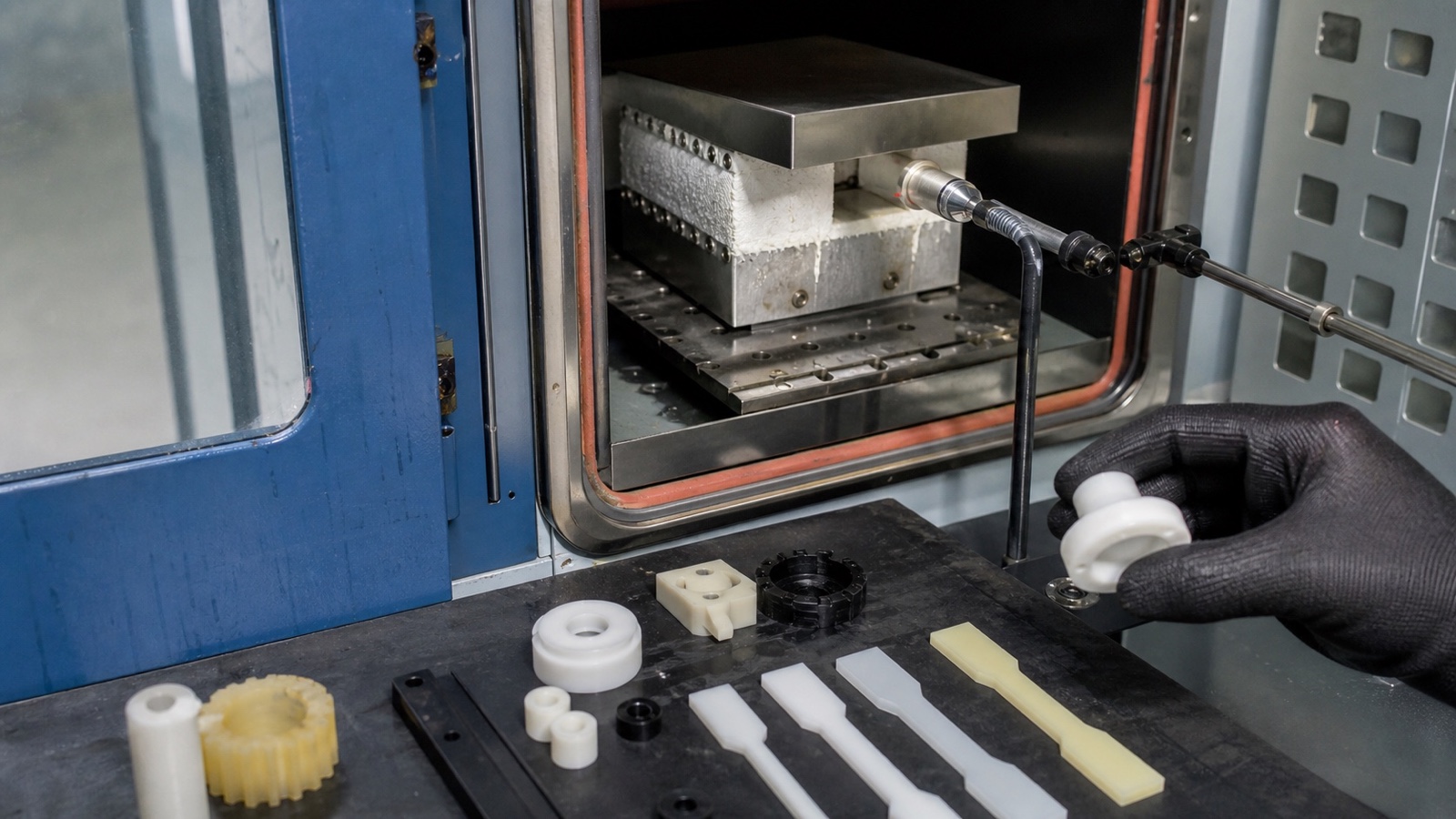
Understanding POM and Its Thermal Profile
What Is POM (Polyoxymethylene)?
POM is a semi-crystalline engineering thermoplastic. It has a regular, ordered molecular structure that gives it excellent mechanical strength, stiffness, and dimensional stability. Unlike amorphous plastics such as ABS or polycarbonate, which soften gradually when heated, POM has a sharp, well-defined melting point. That crystalline structure is also why POM machines so well: it tends to produce clean, crisp chips rather than gummy, stringy swarf.
There are two main families of POM: homopolymer and copolymer. Homopolymer acetal (sold by DuPont under the brand name Delrin) has slightly higher mechanical strength and stiffness, while copolymer POM (such as Celcon or Ticona grades) offers better thermal stability and chemical resistance. For CNC machinists, the differences are small but worth keeping in mind, especially when a part sits near a heat source in service.
POM Melting Point vs. Glass Transition vs. Heat Deflection Temperature
Let's get the numbers on the table. The melting point of POM is roughly 160–175°C (320–347°F). Homopolymer grades typically sit at the higher end, around 175°C, while copolymers melt closer to 160°C.
But melting point is only one part of the thermal story. Three other temperatures matter just as much:
- Glass transition temperature (Tg): For POM, this is around –60°C. Below Tg, the amorphous regions are rigid; above it, they become rubbery. Since Tg is far below room temperature, POM's amorphous content doesn't constrain machining the way it does for amorphous plastics.
- Heat deflection temperature (HDT): Measured at 1.82 MPa, POM typically shows an HDT of about 90–110°C. This is the temperature at which a loaded specimen begins to deform. It's far lower than the melting point, and it's the number to watch if your part will experience mechanical stress plus heat in service.
- Decomposition temperature: Above roughly 230°C, POM begins to degrade and release formaldehyde fumes. This is a health hazard, and we'll address it later.
Here's the key insight for machining: you won't melt the entire part during cutting, but you can absolutely push the surface temperature of the cut zone well above the melting point. And even if you stay below melting, you can easily exceed the HDT in thin sections. So melting point alone doesn't dictate machining limits — HDT and Tg matter more during cutting.
Key Mechanical Properties of POM That Affect Machining
POM is a workhorse mechanical plastic. You can expect:
- Tensile strength: roughly 60–70 MPa, comparable to many nylons but with better stiffness.
- Flexural modulus: around 2.5–3.1 GPa — stiff enough to hold shape under load.
- Low coefficient of friction: around 0.2 against steel, which is why POM parts run quietly in gears and slides.
- Excellent wear resistance: particularly against metal mating surfaces.
- Low moisture absorption: less than 0.3% by weight when saturated, versus nylon's 1.5–3%. That means POM parts hold their dimensions in humid environments, a huge advantage for precision machining.
During cutting, these properties interact with thermal behavior. POM's stiffness means it resists deflection, but its high thermal expansion coefficient (around 110–120 µm/m·°C) means it expands and contracts more than aluminum, which is already roughly twice as thermally active as steel. If you don't control heat, your "cold" part won't match the dimensions it had when you measured it at the machine.
Why the Melting Point of POM Matters in CNC Machining
Heat Generation and Thermal Expansion
Every cut generates friction. The friction between a cutter's rake face and a plastic chip, plus the friction of the chip sliding up the flute, produces localized heat. For metals, this heat is often a minor nuisance. For plastics, it's everything.
Let's put some numbers on it. POM expands about 1.1 mm per meter per 10°C. That might not sound like much, but consider a 150 mm long part. If the part heats up by 20°C during a roughing pass, it grows by about 0.33 mm. Once it cools back to 22°C in the measuring room, it shrinks back. If your programmed toolpaths assumed the part was at nominal size while it was actually hot and swollen, you've now cut a part that is oversized by roughly the same amount in the feed direction.
Uneven cooling is worse. If one edge of the part is held against a cold fixture while the other edge is exposed to warm air, the differential contraction can bow a flat plate by measurable millimeters. We've seen customers send us "hopelessly warped" POM parts that were actually machined perfectly — they just didn't manage cooling during the final passes.
Localized Melting, Smearing, and Surface Defects
When a cutting edge encounters too much feed rate, too high a spindle speed, or a dull tool, the local temperature at the shear zone can exceed POM's 175°C melting point in milliseconds. The plastic doesn't turn to a puddle, but it does soften dramatically and begin to smear.
You'll know immediately from the surface finish. Instead of clean, matte-white chips, you'll get stringy ribbons. The machined surface will look:
- Smear marks: POM is pressed and dragged across the tool face instead of cleanly sheared.
- Torn or woolly surfaces: Local melting re-solidifies as a rough, fibrous layer that can be visible to the naked eye.
- White chalky streaks: Micro-tearing at the surface creates regions of micro-voids that scatter light.
- Micro-cracks: Rapid heating and cooling at the surface can create shallow stress cracks that propagate under load.
These defects aren't just cosmetic. A smeared surface loses its friction and wear advantage. A torn micro-structure creates stress concentrators that can lead to premature part failure. And for parts subjected to cyclical loads, micro-cracks can be the starting point of fatigue failure.
Impact on Dimensional Accuracy and Stability
There's a subtler problem: heat doesn't just expand the part while it's in the vice. It can also change the part permanently.
POM is a semi-crystalline plastic with internal stresses locked in during manufacturing (sheet extrusion, rod extrusion, or casting). When you machine away material, you release some of those locked-in stresses. The part may then want to relax into a new shape. If you've heated the part significantly during machining, you accelerate that relaxation — which means the part can move out of tolerance before you've even unclamped it.
Thin-walled features are particularly vulnerable. A thin web or a delicate fin that gets hot during machining will soften enough to be pushed out of shape by cutting forces. When it cools, it doesn't spring back to the correct position; it stays distorted. We call this "spring-back," and it's the enemy of tight-tolerance POM parts.
That's why we always advise customers to think of heat management as part of the machining process — not just as a material property to note in a datasheet.
Optimal Machining Parameters for POM
What Is the Cutting Speed of POM?
The answer depends on your tooling and operation, but here are solid starting points that we use at PlasticCNCPro:
- Turning: 100–300 m/min (330–985 ft/min) with carbide inserts.
- Milling: 150–500 m/min for high-speed milling cutters, with lower values for long-reach or small-diameter tools.
- Drilling: 30–100 m/min depending on hole depth and whether you can use peck cycles.
Why can POM be machined so much faster than aluminum (which is often limited to 150–300 m/min for similar tooling)? Because POM is soft and has a low cutting energy per volume removed. It doesn't harden like metals, and it doesn't generate the same high forces. The limiting factor isn't the tool's ability to cut — it's the tool's ability to clear chips and avoid overheating the plastic.
Here's a practical formula for spindle speed in milling:
\[
\text{RPM} = \frac{\text{cutting speed (m/min)} \times 1000}{\pi \times \text{tool diameter (mm)}}
\]
For example, with a 6 mm end mill and a cutting speed of 250 m/min:
\[
\text{RPM} = \frac{250,000}{3.14 \times 6} ≈ 13,300 \text{ RPM}
\]
That's achievable on most CNC spindles. If your machine maxes out at 8,000 RPM, reduce the cutting speed or use a smaller tool to maintain a reasonable chip load.
Feed Rates and Depth of Cut
A common beginner mistake is running POM at low chiploads "to be safe." Actually, very low chiploads are dangerous — they cause rubbing, which generates frictional heat without shearing a chip. You need enough feed per tooth to create a proper cutting action while still leaving a good finish.
Our typical starting feed rates:
- Roughing (end milling): 0.05–0.15 mm/tooth (0.002–0.006 in/tooth)
- Finishing: 0.02–0.05 mm/tooth
- Turning roughing: 0.1–0.3 mm/rev
- Turning finishing: 0.05–0.1 mm/rev
Depth of cut is a balance. For roughing, I like 1–2× the tool diameter in axial engagement for full-width slotting, but for profiling work I'll use radial engagement of 30–50% of tool diameter and maybe 1× diameter axial depth. For finishing passes, keep the radial engagement light — 5–10% of tool diameter — and consider leaving 0.25–0.5 mm stock for the finish pass.
The rules of thumb are:
- Never let the tool rub. If the chipload gets too thin, you deserve what happens.
- Keep the final pass light. This minimizes deflection and heat.
- Watch the chips. If your chips are discolored, stringy, or sticking to flutes, back off the speed or increase feed per tooth.
Tool Selection and Geometry for Plastics
POM doesn't need exotic tooling, but it does need geometry designed for polymers. Here's what works:
- Sharp carbide or HSS tools. Sharpness is non-negotiable. A dull edge will heat and smear before it cuts.
- Positive rake angle. Preferably 10–15°. Positive rake creates a shearing action instead of a squeezing action, reducing heat.
- Single-flute end mills for slotting and roughing, because they give chips the most room to clear. For finishing, a 2-flute or 3-flute polished tool can improve surface finish.
- Polished flutes. A mirror finish on the flute face reduces friction between the chip and the tool. This alone can cut machining temperatures by 10–20°C, which is often the difference between a clean edge and a smeared one.
At PlasticCNCPro, we keep a dedicated set of "plastic-only" tooling for acetal and similar materials. Cross-contamination from cutting aluminum, for example, can leave micro-debris embedded in the tool edge that ruins plastic finishes.
Milling, Turning, and Drilling Best Practices
Milling:
- Face milling: Use a 45° lead angle cutter with a wiper flat to achieve a smooth, flat finish. Climb mill (down milling) whenever possible — it produces a cleaner cut and carries less heat into the work zone.
- Profiling: Choose conservative radial engagement. Always climb-mill the final finish pass to minimize burr formation and edge tearing.
- Thin walls: Reduce axial engagement, slow down, and use a sizable stepover to avoid pushing the wall sideways.
Turning:
- Use positive rake inserts that are ground or polished for plastic. Keep our recommended speeds.
- Use a sharp tool with a small nose radius (0.2–0.4 mm) for finishing.
- For turning long, thin parts, support the part with a steady rest or center — POM is springy enough to deflect away from the tool.
Drilling:
- POM tends to "grab" on drill entry and exit because it's elastic. Use a drill angle of 90–118°, with a positive rake and polished flutes.
- Peck drilling is essential for holes deeper than 3× diameter. Withdrawing the drill periodically breaks the chips, flushes them out, and gives the hole a chance to cool. Without pecking, the chips can weld onto the drill flutes and the hole wall will melt and frost.
- For very small holes (<1 mm), consider a rotating tool with a high-pressure air blast to assist chip evacuation.
Cooling and Chip Evacuation
You don't need a flood coolant system for POM — in fact, flood coolant can create thermal shock and make dimensional control harder. But you absolutely need to manage heat and chips.
Our preferred strategy is:
- Air blast directed at the cutting zone. This clears chips quickly and provides some cooling. It's clean, cheap, and doesn't require drying parts afterward.
- Mist coolant (a fine oil-water mist) for longer runs or when finishing tolerances are critical. Use a low mist volume to avoid thermal shock.
- Flood coolant is fine if you already have it, as long as you ensure parts are dry before inspection — wet parts can also expand and distort during measuring.
Efficient chip evacuation is underrated. Re-cutting chips — whether from a deep pocket or a drilling operation — turns a two-flute tool into a heat generator. The chips carry heat away; if they stay in the cut zone, that heat goes back into the part.
Preventing Warping and Residual Stress in POM
Pre-Machining Annealing (Heat Treatment)
POM stock material contains internal stresses from extrusion or casting. If you machine a highly stressed rod into a thin plate, the plate may warp as soon as you unclamp it. Annealing the stock before machining relaxes those stresses and dramatically improves dimensional stability.
The recommended annealing range for POM is 135–160°C, below the melting point but high enough to allow molecular relaxation. Soak times depend on thickness:
- Rod or sheet up to 6 mm: 30–60 minutes
- 6–25 mm: 1–2 hours
- 25–50 mm: 2–4 hours
After soaking, cool slowly — no faster than 20°C per hour — to prevent re-introducing thermal stress. Annealing near the melting point must be controlled carefully; get too close to 175°C and the part can slump or distort under its own weight.
In an ideal workflow, we anneal our POM blanks before machining, then let them cool fully to shop temperature before processing. For many standard jobs, it's not strictly necessary, but for tight tolerances or thin features, it's a game-changer.
Workholding Strategies
How you hold POM matters as much as how you cut it.
- Soft jaws: Machine soft jaws to match the part profile. This spreads clamping pressure over a larger area and avoids point loading that can crush or distort the part.
- Vacuum fixturing: The best choice for thin, flat parts. A vacuum chuck holds the part gently and uniformly, with no localized stress. Just make sure the vacuum is strong enough to avoid movement during heavy cuts.
- Avoid crushing: A standard milling vice with steel jaws can easily over-clamp POM. The material is stiff but not hard; a too-strong clamp creates compression and can even push the part out of parallel. Use a torque wrench or a light clamping setting, and check that the part does not move under hand pressure.
- Support large flat areas: For sheets or plates, use sacrificial support or a spoil board to prevent vibration and flexing. A vibrating plate creates chatter, which increases heat and ruins finish.
Stress Relief Strategies During Machining
Even with annealed stock, cutting introduces new stresses at the surface. The following strategies keep residual stresses low:
- Rough and finish in separate operations. Rough off the majority of the stock with aggressive parameters, then let the part rest and cool to room temperature. Then come back and finish-cut the final profile. We often leave parts overnight between rough and finish for very tight-tolerance work.
- Use multiple passes rather than hogging everything in one pass. Yes, it takes more time, but it also prevents deep heat soak.
- Climb mill for finishing. Climb milling produces a chip that starts thin and gets thicker, which reduces rubbing and heat generation compared to conventional milling.
Post-Machining Cooling and Storage
POM parts should cool flat. Immediately after the last cut, place thin components on a flat granite table or a known-flat plate. Never let a freshly machined POM part sit on an uneven plastic bench or near a window with direct sunlight — the temperature differential will warp it.
Keep machined parts away from heat sources: motors, ovens, welding stations, even strong incandescent lights. And if your shop is air-conditioned, let parts acclimate to the measuring room temperature for at least an hour before final inspection.
For critical components, we sometimes specify a secondary annealing cycle after roughing and before finishing. This is rare, but when a customer needs ±0.005 mm over a 100 mm part, it's the only reliable way to achieve that.
POM Grades and Their Melting Points
Homopolymer vs. Copolymer (Delrin vs. POM)
Let's clear up a common confusion: Delrin is a brand name for homopolymer POM. It's made by DuPont (now DuPont Mobility & Materials). When a drawing says "Delrin," it usually means homopolymer acetal, not a separate material.
The key thermal differences:
- Homopolymer (Delrin, etc.): Melting point ~175°C. Higher tensile strength, higher stiffness, and better creep resistance. However, it can be more prone to the formation of porosity in thick sections, and its chemical resistance is slightly lower than copolymer grades.
- Copolymer POM: Melting point ~160°C. Better thermal stability, better resistance to hot water and alkaline chemicals, and less tendency to produce surface porosity.
From a machining standpoint, both behave almost identically. Some machinists claim homopolymer gives a slightly crisper finish due to its higher crystallinity. The differences are minor compared to the influence of tool sharpness, speed, and feed.
Filled, Lubricated, and Impact-Modified Grades
POM is often compounded with additives to alter performance:
- PTFE-lubricated POM: Contains PTFE microparticles to reduce the coefficient of friction further. During machining, the PTFE reduces friction but can also make chips more slippery and harder to control. Tool sharpness is even more critical.
- Glass-filled POM: Typically 10–30% glass fiber increases stiffness and heat deflection temperature, but it also makes the material abrasive. Expect faster tool wear and a rougher finished surface. Use carbide tools with robust edge preparation. Melting point of the matrix stays the same, but the HDT can rise by 20–30°C.
- Impact-modified POM: Adds rubber or other elastomers to improve toughness. This often makes machining more challenging because chips are more stringy and the material is less brittle, but a sharp tool with generous clearance handles it fine.
One practical tip: glass-filled POM can leave a fuzzy surface if tools are dull. Send those parts to a shop that understands the fillers.
How to Select the Right Grade for Your Parts
Ask yourself these questions:
- Will the part be exposed to hot water, acids, or bases? → Choose copolymer POM.
- Does the part need maximum stiffness and strength? → Choose homopolymer POM (Delrin).
- Is wear on mating components a concern? → Choose PTFE-lubricated POM.
- Are service temperatures above 90°C under load? → Consider glass-filled POM or a different polymer entirely.
- Is dimensional stability in humid air essential? → Standard POM outperforms nylon, but consider a low-emission (low-odor) grade for enclosed areas.
Finally, always check the material datasheet for the exact melting point, HDT, moisture absorption, and coefficient of thermal expansion for your chosen grade. Supplier-specific formulations can shift the numbers by a few degrees.
Tolerance and Design Considerations
What Is the Tolerance of POM Machining?
At PlasticCNCPro, we routinely hold the following tolerances on CNC-machined POM parts:
- Precision work: ±0.005 mm on features up to 25 mm, ±0.01 mm on larger features.
- Standard commercial work: ±0.01–0.05 mm, which most machined plastic parts fall into.
- Non-critical features: ±0.1 mm or looser.
Why can't every POM part be ±0.005 mm? Because thermal expansion and residual stress make it hard to hold extremely tight tolerances in long or thin sections. The plastic expands during cutting, and when it cools down, it shrinks. If the part is measured at a different shop temperature on the receiving end, you can see differences of 0.02–0.05 mm over 100 mm length — all from a 5–10°C variation.
For truly tight tolerances, we recommend:
- Machining in a temperature-controlled shop (20–22°C)
- Measuring parts after they have equilibrated to that same temperature for at least an hour
- Designing the machining strategy to leave favorable stock for the finish pass
Designing for Thermal Expansion
If you're designing a POM part from scratch, don't fight the material's coefficient of thermal expansion — design for it.
- Long dimensions: Allow a clearance gap of 0.15–0.25 mm per meter per 10°C if the operating temperature will deviate from the machining temperature.
- Press fits: A POM bushing pressed into an aluminum housing will loosen as the system heats up. Use a press-fit allowance of about 0.2–0.4% of the nominal shaft diameter, and consider adding a retaining feature or adhesive if thermal cycling is severe.
- Metal inserts: When pressing a steel insert into POM, remember that POM expands and contracts far more than steel. At elevated temperatures, the insert may loosen. A knurled insert or an insert with an undercut will lock mechanically. The insert should be installed at room temperature, and the POM boss should be thick enough to resist hoop stress.
- Slots and clearance holes: Always provide elongated slots or extra clearance in locations where mating parts may expand differently.
Cost Implications of Tight Tolerances
Tighter tolerances cost more. Every extra pass, additional measurement step, or post-machining process adds time. If a customer specifies ±0.01 mm but the application only needs ±0.05 mm, the part will be 20–30% more expensive than necessary.
My advice is to call out tolerances only where they matter functionally. For most POM parts, tolerances of ±0.05 mm or ±0.1 mm are perfectly adequate, and they allow faster machining setups and less risk of scrap. Save the ±0.005 mm for critical bearing bores or mating surfaces.
Also, remember that material cost is a small fraction of the finished part cost. A 50 mm diameter POM rod costs a few dollars per meter. The machining time is what you pay for. Designing the part so it can be machining-efficient is the best way to control total cost.
POM vs. Other Engineering Plastics
Is POM Stronger Than ABS?
Yes — for most definitions of "strong." POM has roughly 60–70 MPa tensile strength, while ABS sits around 35–45 MPa. POM is also much stiffer (flexural modulus ~2.5–3 GPa vs. ABS ~2.2 GPa). POM wins in strength and stiffness, and its fatigue resistance is far superior, which is why gears and springs are made from POM rather than ABS.
A key difference for CNC machinists: ABS is amorphous and has no true melting point. When heated, it just softens gradually over a wide range. This makes it gum up and smear more easily during cutting. POM, with its sharp melting point, cuts cleaner — as long as you stay below its melt threshold.
The catch is that POM has lower notched impact strength than ABS. If you need a part that absorbs impact without cracking, ABS can be a better choice, though it won't hold dimensions as precisely. In short: choose POM for precision mechanical parts; choose ABS for low-cost enclosures or prototypes, or for 3D printing where ABS is easier to print.
POM vs. Nylon (PA)
This is a classic matchup. Nylon (polyamide, PA) is tough, with similar tensile strength to POM, and it has excellent abrasion resistance. But nylon absorbs moisture — up to 3% by weight — which changes its dimensions and mechanical properties. A nylon part machined to ±0.01 mm can swell 0.1–0.3 mm after sitting in a humid warehouse for a week.
POM absorbs far less moisture and therefore holds its machined tolerances far better. POM also has better creep resistance at moderate temperatures and a lower coefficient of friction.
Nylon's advantages: higher peak melting point (around 220–260°C depending on grade), better impact resistance, and often a lower price. Nylon also tolerates higher service temperatures, making it a better choice for parts near engines or hot fluids.
For CNC applications requiring repeatable tolerances and low moisture uptake, POM is the winner. Use nylon when you need maximum toughness and are willing to account for moisture-driven size changes.
Material Selection Guide for CNC Machinists
| Material | Melting Point / Softening | Moisture Absorption | Machinability | Key Advantage |
|---|---|---|---|---|
| POM (Acetal) | 160–175°C | Low (<0.3%) | Excellent | Dimensional stability, low friction |
| ABS | Amorphous, softens 90–110°C | Moderate | Good | Impact strength, low cost |
| Nylon (PA) | 220–260°C | High (1.5–3%) | Good to moderate (tends to string) | Toughness, wear resistance |
| PET | 245–255°C | Low | Good | Strength, chemical resistance |
| PEEK | 343°C | Very low | Moderate (abrasive to tools) | High-temperature performance |
POM's sweet spot is clear: it's low-cost, rigid, easily machined, and dimensionally stable in humid environments. If your application doesn't need PEEK's 343°C melting point or nylon's impact toughness, POM is usually the right engineering choice.
Common Applications of CNC-Machined POM
Automotive and Industrial Components
POM is everywhere in automotive and industrial equipment:
- Gears and gear racks — low friction, quiet running, no lubrication required.
- Bushings and bearings — excellent wear against steel shafts, especially when PTFE-lubricated.
- Valve parts and pump components — chemical resistance to fuels, solvents, and mild acids.
- Conveyor chain guides and wear strips — self-lubricating, abrasion-resistant, easy to machine from plate.
The melting point matters for these parts because many sit near engines, motors, or exhaust systems. At temperatures above 100°C, unmodified POM begins to lose stiffness. If a gear is near a hot component, verify the gear's operating temperature stays well below POM's HDT — otherwise choose a high-temperature grade or another polymer.
Electronics and Consumer Goods
In electronics, POM is used for:
- Insulators and spacers — excellent dielectric strength and low moisture absorption.
- Switch components and slider mechanisms — low friction and wear for repeated movement.
- Precision spacers and standoffs — dimensional stability in varying climates.
One caution: machining heat can degrade POM's dielectric properties in the surface layer. If you're manufacturing high-voltage insulators, use sharp tooling and minimal heat generation, and inspect the surface for any signs of whitening or smearing.
Medical and Food-Contact Applications
POM is widely used in medical devices and food processing equipment because it can be machined to tight tolerances and is resistant to many cleaning agents.
Common applications:
- Surgical instrument handles — autoclavable at lower temperatures, but note that high-temperature autoclaving can warp POM. Most POM grades are only viable for steam sterilization up to about 120°C.
- Drug delivery components — dimensional accuracy is critical, and POM's low moisture uptake keeps dimensional changes minimal.
- Food-contact parts — certain POM grades are FDA-compliant for repeated food-contact surfaces. They resist fats, oils, and mild acids.
At PlasticCNCPro, we always ask about the end-use environment before selecting a grade. A medical device requiring repeated autoclaving might be better served by a PPS or PEI, while a one-time-use device handles POM perfectly.
Health and Safety Considerations When Machining POM
Decomposition Fumes and Ventilation
Here's the serious part. When POM is overheated — whether from a dull cutter, a too-high spindle speed, or a laser — it can decompose. Above about 230°C, POM releases formaldehyde gas, a known irritant and suspected carcinogen.
The smell is a warning: POM has a distinctive, acrid "waxy" odor when overheated. If you smell it, stop, reduce parameters, and check your tooling. In a CNC shop, you should always have:
- Local exhaust ventilation at the machining area.
- Air filtration for fine plastic dust.
- A dust collection system — POM chips and dust are not toxic, but airborne dust can irritate lungs.
As long as you machine with sharp tools, proper speeds, and good chip evacuation, POM will not decompose. But never be complacent. We've seen burnt POM emit visible fumes, and that's a red flag.
Safe Handling and Storage
- Store POM sheet and rod away from UV light (sunlight or strong fluorescent light can cause surface discoloration) and away from heaters.
- Keep material wrapped or covered to avoid picking up dust and dirt that could embed in the surface during machining.
- Handle chips and dust with gloves or wash hands frequently. Fine POM particles can cause mild skin irritation, especially with repeated exposure.
Laser Cutting Concerns
If you've seen POM laser-cut in a DIY shop, avoid it. Laser cutting POM produces toxic formaldehyde gas, plus acrid smoke that damages laser optics and contaminates the shop environment. Most professional thermal-cutting services refuse to laser-cut POM for this reason.
The safe alternatives are CNC machining and waterjet cutting. CNC machining keeps the material below decomposition temperatures and produces clean chips. Waterjet cutting is a cold process, ideal for thin sheets and flat blanks.
At PlasticCNCPro, we CNC machine everything — no laser ablation on plastics unless the customer explicitly requires it, and then only with proper ventilation and protective measures.
Frequently Asked Questions (FAQs)
What Is the Melting Temperature of POM?
The melting temperature of POM is 160–175°C (320–347°F). Homopolymer acetal (like Delrin) melts at about 175°C, while copolymer POM melts around 160°C. However, the decomposition temperature of POM is around 230°C, and formaldehyde gas begins to be released at that point. That decomposition limit is a bigger safety concern during machining than the melting point itself — you should never approach either parameter in a cut.
Is POM Stronger Than ABS?
Yes, POM is significantly stronger and stiffer than ABS. POM has a tensile strength of roughly 60–70 MPa and a flexural modulus around 2.5–3 GPa, while ABS typically has a tensile strength of 35–45 MPa and a flexural modulus around 2 GPa. POM also has much better fatigue resistance and low friction. The main area where ABS wins is notched impact resistance — ABS is more forgiving under rapid impact. For precision mechanical parts, POM is the stronger choice.
What Is the Cutting Speed of POM?
For CNC milling, expect 150–500 m/min depending on tool diameter and machine capability. For turning, use 100–300 m/min with sharp inserts. For drilling, 30–100 m/min is a safe starting range. The ideal speed depends heavily on tool sharpness and chip evacuation. Push the speed until the chips flow nicely; if the part starts to smear or smell, reduce speed and increase feed per tooth.
What Tolerance Can Be Achieved with POM Machining?
Commercial CNC machining of POM can typically hold ±0.01–0.05 mm (about ±0.0004–0.002 in) for standard features. For precision work in a temperature-controlled shop, ±0.005 mm or better is achievable on smaller features. The main tolerance risks are thermal expansion during cutting, uneven cooling, and internal stress release. Annealing the material, controlling shop temperature, and using a proper rough-finish workflow are the keys to holding tight tolerances.
Work With PlasticCNCPro for Your POM Machining
I hope this guide gives you a practical handle on POM's thermal behavior and machining best practices. POM is one of my favorite materials to machine — it's forgiving, versatile, and yields beautiful, precise parts when treated with respect.
At PlasticCNCPro in Dongguan, we specialize in precision CNC machining of POM and other engineering polymers. We've made thousands of acetal parts: gears, valves, spacers, insulators, wear strips, prototype components, and production runs. We know how to control heat, hold tolerances, and deliver parts that are flat, clean, and ready to assemble.
If you have a POM part that needs machining, a drawing that needs material selection advice, or a challenging tolerance we can help you hit, send us your files. We'll review the design, recommend the right grade, and give you a clear quotation with a production plan.
Email us at [sales@plasticcncpro.com](mailto:sales@plasticcncpro.com) or send your 2D drawing, 3D model, and specifications through our website. We're happy to help you turn raw plastic into precise, reliable components.
Let's machine something great together.
RFQ Support
Send Your Drawing for a Quote
Share your 2D drawing, 3D model, material, quantity, tolerance, surface finish, and application details. Our team will review manufacturability and reply with a practical quotation.
Email: info@plasticcncpro.com
Address: 29 Fuxing Road, Dongguan City, Guangdong Province, China