
Material Science for Design Engineers
Melting Point vs Glass Transition Temperature in Engineering Plastics: A Design Guide
Thermal properties decide whether a plastic part survives its environment or quietly deforms in service. Here is how we at PlasticCNCPro think about Tg and Tm when we quote, machine, and inspect custom polymer components for industrial customers.
Introduction
When a customer sends us a drawing for a machined plastic component, one of the first questions I ask is not about tolerances or surface finish. It is about temperature. What is the maximum continuous service temperature? Are there thermal cycling loads? Does the part see steam, hot oil, or radiant heat from a nearby motor? Those answers shape the entire material conversation, because thermal properties are the most critical factors in polymer selection for engineering applications.
Two numbers dominate that conversation: the glass transition temperature (Tg) and the melting point (Tm). They are frequently confused, sometimes treated as interchangeable, and almost always oversimplified in marketing datasheets. This guide is written for engineers and product designers who need to understand how Tg and Tm actually dictate material performance under heat, and how to translate those numbers into a manufacturable, reliable part.
Tg tells you when a plastic starts to soften and lose stiffness. Tm tells you when its crystalline structure collapses. Designing to the wrong one is one of the most common causes of field failures we see in machined polymer parts.
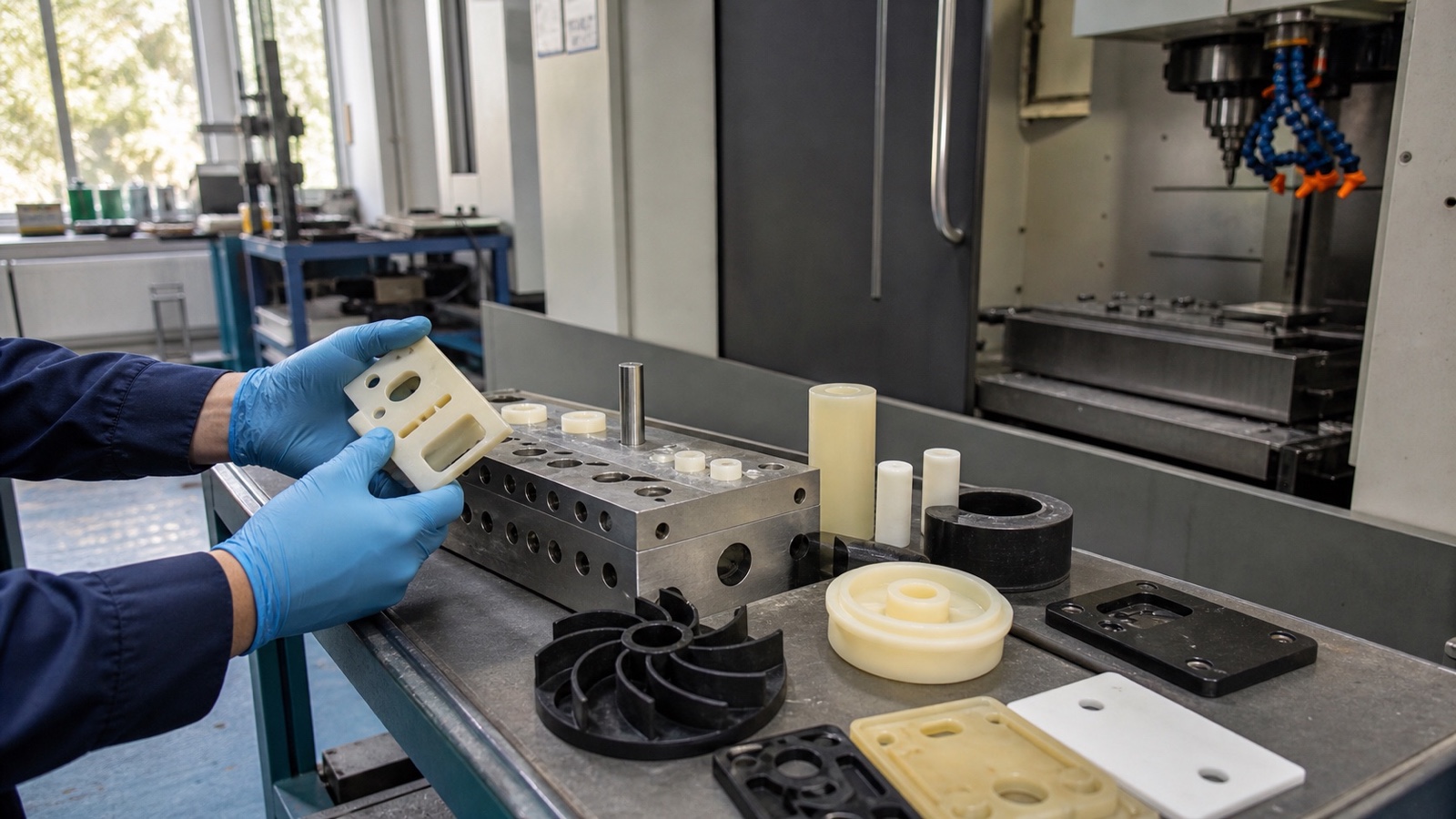
Understanding the Fundamentals: Tg vs. Tm
Before we compare the two, it helps to separate what is actually happening at the molecular level. Tg and Tm describe two very different physical events, and confusing them leads to bad design decisions.
What is Glass Transition Temperature (Tg)?
Tg is the temperature range where an amorphous polymer transitions from a hard, glassy state into a soft, rubbery state. Below Tg, the polymer chains are essentially frozen in place. They can vibrate, but they cannot slide past one another. Above Tg, the onset of long-range chain mobility begins. The material does not melt, and it does not become a liquid, but it loses much of its stiffness and load-bearing capability.
This is why Tg matters so much for structural parts. A polycarbonate bracket that feels rigid at room temperature can creep and deflect under the same load once it approaches its Tg. The transition is not a sharp line, it happens over a range, which is why datasheets usually quote a single representative value rather than a precise threshold.
What is Melting Point (Tm)?
Tm is the temperature at which the crystalline regions of a polymer transition into a disordered liquid state. This is a true phase change. The ordered crystalline lattice structure is destroyed, and the material becomes a flowable melt. For semi-crystalline polymers, Tm is the upper thermal boundary, the point at which the material can no longer hold its shape at all.
Because Tm involves breaking the crystalline lattice, it requires significantly more energy than the Tg transition. That energy difference shows up directly in processing, since semi-crystalline materials need to be heated well above Tm to flow properly during molding or extrusion.
Key Distinction
So is glass transition temperature the same as melting point? No, and the difference is fundamental. Tg is a softening event. The material changes from glassy to rubbery, but it is still a solid. Tm is a structural melting event. The crystalline order disappears and the material becomes a liquid. A part can survive above its Tg for a short time in some cases, but no plastic part survives above its Tm.
Why it matters
For most structural designs, Tg is the number that governs stiffness and dimensional stability. Tm is the number that governs processability and the absolute upper limit of existence. Design to Tg, process around Tm.
Polymer Structure: Amorphous vs. Semi-Crystalline
Whether a plastic has a meaningful Tm at all depends on its molecular structure. This is the single most useful classification for anyone selecting a material for a thermal application.
Amorphous Polymers
In amorphous polymers, the molecular chains are arranged randomly, with no long-range order. These materials exhibit a Tg but do not have a distinct Tm, because there is no crystalline lattice to melt. Common examples include polycarbonate (PC) and polystyrene (PS). They tend to be transparent, dimensionally stable, and relatively easy to machine, but they soften progressively as they approach Tg.
Semi-Crystalline Polymers
Semi-crystalline polymers contain both ordered crystalline regions and disordered amorphous regions. They exhibit both a Tg and a Tm. Examples we machine regularly include PEEK, PTFE, and polypropylene (PP). The crystalline regions act as physical cross-links, giving these materials better chemical resistance, higher stiffness above Tg, and a sharp melting transition.
Why Structure Matters
Crystalline content directly impacts chemical resistance and mechanical strength. Semi-crystalline materials generally resist solvents and chemicals better, because the tight crystalline packing blocks penetration. They also retain more stiffness above Tg than amorphous materials, which is why high-temperature structural parts often lean toward semi-crystalline grades. Amorphous materials, on the other hand, offer better dimensional consistency and transparency, which matters for optical and precision-fit components.
Amorphous
Tg only, no true Tm
Random chain structure. Progressive softening above Tg. Typically transparent and dimensionally stable. Examples: PC, PS, PMMA, PSU.
Semi-Crystalline
Both Tg and Tm
Ordered and disordered regions coexist. Sharp melt transition. Better chemical resistance and stiffness above Tg. Examples: PEEK, PTFE, PP, POM.
Comparing Tg and Tm: A Quick Reference Table
This table summarizes the practical differences we use when advising customers on material selection.
| Property | Glass Transition (Tg) | Melting Point (Tm) |
|---|---|---|
| State change | Glassy to rubbery softening | Solid to liquid phase change |
| Energy required | Relatively low, gradual over a range | High, breaks crystalline lattice |
| Structural impact | Loss of stiffness and load capacity | Loss of all structural integrity |
| Typical materials | All polymers, amorphous and semi-crystalline | Semi-crystalline polymers only |
| Reversibility | Reversible softening and hardening | Reversible only on cooling below Tm |
The Engineering Impact: Designing for Thermal Performance
Knowing the definitions is only useful if they change how you design, machine, and specify a part. Here is where Tg and Tm show up in real projects.
Injection Molding & Manufacturing
Tg influences ejection temperatures and internal stress buildup. If a molded part is ejected too far above Tg, it can warp or deform because the material has not regained enough stiffness to hold its shape. For machined parts, Tg matters differently. When we machine a semi-crystalline polymer, the heat generated at the cutting edge can locally raise the material above Tg, softening it and causing smeared surfaces or poor chip formation. Controlling speeds, feeds, and coolant keeps the cut below that threshold.
Mold temperature plays a direct role in achieving crystallinity, and therefore in hitting the target properties associated with Tm. A semi-crystalline part molded with a cold tool may not reach full crystallinity, leaving it weaker and less chemically resistant than the datasheet implies.
Machining note
When customers send us PEEK or POM parts with tight tolerances, we often discuss thermal history first. Machining stresses and local heating near Tg can move dimensions after the part leaves the machine, so we plan for stress relief and stable fixturing.
Load-Bearing Applications
A part must stay below its Tg to maintain stiffness and rigidity. This is the core rule for structural components. Above Tg, the polymer chains gain mobility, and the material creeps under sustained load even if it has not melted. This is why service temperature limits are usually set well below Tg for safety.
Engineers look at Tg for amorphous plastics and Tm for semi-crystalline plastics, but with a caveat. For semi-crystalline materials, the usable service temperature is often limited by Tg, not Tm, because the amorphous regions soften first. The crystalline regions hold the shape, but the part still loses stiffness. Tm remains the absolute ceiling, not a working limit.
Dimensional Stability
Operating near the Tg can lead to part deformation or creep. A bushing that runs slightly above its Tg will slowly take a permanent set, and a precision spacer can lose its fit. For applications where heat is unavoidable, we look at materials with higher Tg values, such as PEI (ULTEM) or PEEK, and match them to the specific thermal environment rather than defaulting to the most expensive option.
A common case we handle: a customer needs an insulating component near a heated assembly. ULTEM offers a high Tg and good dimensional stability at a moderate cost, while PEEK pushes the thermal and chemical envelope further at a higher price. The right choice depends on the actual peak temperature, chemical exposure, and load, not on brand preference.
Factors Influencing Thermal Transitions
Tg and Tm are not fixed constants for a material family. They shift with formulation, processing, and service conditions. Here are the factors we watch most closely.
-
1
Molecular Weight
Longer chains generally increase Tg, because more entanglement restricts chain mobility. Higher molecular weight grades often show better toughness and higher heat resistance.
-
2
Additives & Plasticizers
Plasticizers decrease Tg by increasing free volume between chains, making them easier to move. This improves flexibility but lowers heat resistance.
-
3
Cross-linking
Chemical bonds between chains restrict motion and raise Tg. Heavily cross-linked thermosets do not melt at all, because there is no chain mobility to allow flow.
-
4
Moisture & Water Content
Absorbed moisture acts as a plasticizer, effectively lowering Tg. Nylon is a classic example, and its heat resistance drops noticeably when conditioned in humid environments.
Design tip
Always check whether a datasheet Tg value was measured dry or conditioned. For hygroscopic materials, the in-service Tg can be meaningfully lower than the published number.
Frequently Asked Questions
Is Vicat softening temperature the same as glass transition temperature?
No. Vicat is a standardized test method that measures heat resistance by pressing a needle into a specimen under controlled load and heating rate. Tg is a fundamental material property describing the onset of chain mobility. The two are related, and a higher Vicat usually implies a higher Tg, but they are not interchangeable. Use Vicat as a comparative processing and heat-resistance indicator, and Tg for structural design decisions.
What is the glass transition temperature (Tg) of polypropylene?
The Tg of polypropylene is generally reported in the range of about -10°C to 0°C. Because this is well below typical ambient and service temperatures, PP is usually above its Tg in normal use, which is why it feels flexible and tough rather than glassy. For structural applications, its melting point, typically around 160°C, is often the more relevant number, along with heat deflection temperature under load.
How do I determine which temperature limit is most important for my part?
Use this rule of thumb: if the part needs to remain rigid, treat Tg as the absolute ceiling and design well below it. If the part is load-bearing, consider the heat deflection temperature (HDT), which accounts for both temperature and applied stress. HDT is often the most practical single number for structural components, because it reflects real loading conditions rather than a pure material transition.
Conclusion
Matching material thermal properties to the end-use environment is one of the highest-leverage decisions in a plastic part design. Tg tells you when stiffness starts to fade. Tm tells you when structure disappears entirely. Designing to the correct one, and accounting for molecular weight, additives, cross-linking, and moisture, keeps parts reliable in the field.
At PlasticCNCPro, we work with global customers to translate these material properties into machined parts that hold their dimensions and performance. From prototypes to repeat production, we help select suitable grades and machine them consistently. Always confirm values against the specific grade datasheet and manufacturer guidelines, because formulation differences matter.
Start a Project
Send us your drawing, material requirement, and application details
Share your 2D drawing, 3D model, target quantity, tolerances, and thermal or chemical environment. Our team will review the design, recommend a suitable engineering plastic, and return a quotation with production guidance.