
Engineering Material Guide
Melting Point vs. Continuous Service Temperature: The Key Differences
Confused by plastic temperature ratings? We explain the difference between melting point and continuous service temperature so you can select materials that remain reliable under real operating conditions.
Introduction
One of the most common plastic-selection errors we see is treating a material’s melting point as its maximum operating temperature. A drawing may specify that a component must tolerate a hot environment, and someone may compare that temperature with the polymer’s Tm. The comparison looks logical, but it answers the wrong engineering question.
A plastic can lose stiffness, begin to creep, change dimensions, or suffer chemical degradation long before it becomes a liquid. For a load-bearing bushing, guide, insulator, valve component, or automation fixture, that early loss of performance can cause failure even when the part is nowhere near its melting point.
Key takeaway
Melting point describes a processing transition. Continuous service temperature describes dependable use over time.
In this guide, I will define both ratings, explain why polymers fail before melting, and outline the practical checks we use when reviewing material choices for precision CNC-machined plastic parts.
Understanding the Definitions: Melting Point (Tm) vs. Continuous Service Temperature (CST)
What Is Melting Point (Tm)?
Melting point, commonly written as Tm, is the temperature at which a solid material transitions into a liquid state. For a polymer, the transition is associated mainly with the crystalline regions becoming disordered and mobile.
Tm is primarily a manufacturing reference. Molders and compounders use it to establish suitable processing windows for injection molding, extrusion, and related operations, including flow behavior, mold filling, cycle timing, and machine settings.
What Is Continuous Service Temperature (CST)?
Continuous service temperature is the approximate temperature a material can withstand for a long period—often thousands of hours—without significant loss of the mechanical properties required by the application.
CST is therefore an end-use performance consideration. It relates to stiffness, tensile strength, dimensional stability, creep resistance, electrical behavior, and the overall structural integrity of the finished part.
| Property | Melting Point (Tm) | Continuous Service Temperature (CST) |
|---|---|---|
| Primary purpose | Material processing | Long-term application performance |
| What it describes | A phase transition | Retention of useful properties over time |
| Most relevant to | Molders and manufacturing engineers | Designers, users, and purchasing teams |
| Can it predict part life alone? | No | It is more relevant, but must still be checked against load and environment |
The Critical Distinction: Processing vs. Performance
Processing and melting point: During molding or extrusion, the manufacturer must make the polymer sufficiently fluid to fill a tool or pass through a die. Tm, where applicable, helps define that process window. It is not intended to tell an equipment designer how hot a finished component may safely operate.
Performance and CST: In service, the polymer must retain the properties that make the part useful. Heat reduces stiffness and strength, accelerates creep, and can promote oxidation or other degradation. Those changes begin well before a thermoplastic reaches a visibly molten state.
Design rule
We design around the application’s continuous service rating and the actual load profile—not around the polymer’s melting point. A safety buffer is essential because published ratings are measured under defined test conditions and may not match every geometry or environment.
Why Materials Fail Before They Melt
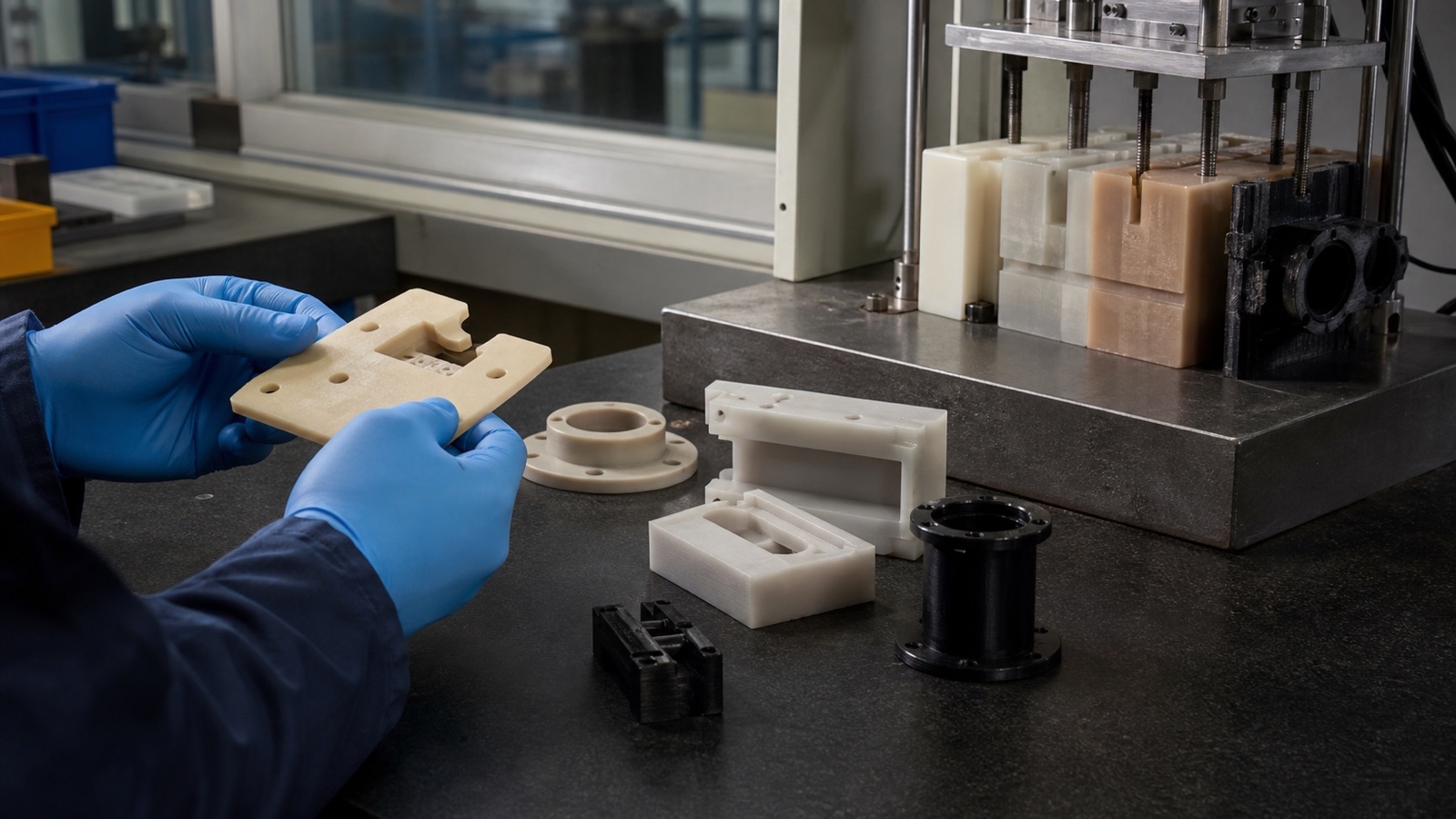
The relevant temperature limit depends on the finished part, its load, and its service environment.
Glass Transition Temperature (Tg)
For amorphous polymers, the glass transition temperature is where molecular motion increases and the material changes from a hard, glass-like condition toward a softer, more rubbery condition. This is not the same as melting, but it can represent a practical soft limit for a precision part. If a bracket, spacer, or insulator must remain rigid, a temperature near Tg may already be unacceptable.
Creep and Deformation
Creep is time-dependent deformation under a sustained load. A polymer shaft support may look accurate when installed, yet gradually deflect under a constant radial force. Heat accelerates this behavior. The part does not need to melt for a hole to enlarge, a seal to relax, or a mounting face to lose alignment.
Environmental Factors
Humidity, chemicals, UV exposure, and mechanical stress can reduce the effective service temperature of a plastic. Nylon, for example, can be sensitive to moisture, while a chemically aggressive fluid may alter a polymer’s strength or dimensions. We therefore review temperature together with the complete operating environment rather than treating CST as an isolated number.
Softening
Loss of rigidity can occur before a phase change.
Creep
Constant load produces dimensional drift over time.
Degradation
Chemicals and moisture can lower usable performance.
Material Behavior: Amorphous vs. Semi-Crystalline
Amorphous Plastics
Amorphous plastics do not have a regularly ordered crystalline structure, so they generally do not exhibit a single sharp melting point in the same way semi-crystalline materials do. Their behavior becomes progressively softer as temperature rises, making Tg especially important when the part must maintain rigidity, tight tolerances, or optical geometry.
Semi-Crystalline Plastics
Semi-crystalline plastics contain ordered regions that can provide stronger resistance to heat, wear, and certain chemicals. They generally have a more defined melting transition. That structure can support higher service temperatures in suitable designs, but it does not eliminate creep, oxidation, thermal expansion, or the effects of load.
Factors Influencing Temperature Ratings
A data-sheet temperature rating is a starting point, not a complete design approval. When we review a custom part, we ask how the component is loaded, how long it sees heat, and what the surrounding media can do to the material.
Load-Bearing Requirements
A lightly loaded cover may tolerate a temperature that would quickly deform a structural bracket or bearing. Compressive stress, bending, torque, and contact pressure all affect the usable temperature range.
Time and Exposure
An intermittent heat spike is different from continuous exposure for thousands of hours. Thermal cycling also matters because repeated expansion and contraction can affect fits, joints, and dimensional stability.
Additives and Fillers
Glass fibers, mineral fillers, flame retardants, and other reinforcements can improve stiffness retention or raise the effective temperature capability of a base resin. They may also affect anisotropy, surface finish, wear, and machining behavior.
How to Select the Right Plastic for Your Temperature Needs
For global B2B projects, the best choice is rarely based on temperature alone. We recommend documenting the application first, then checking the material grade against the actual mechanical, chemical, and manufacturing requirements.
Define the Application
Decide whether the component is structural, decorative, insulating, sliding, sealing, or simply protective. Record the normal temperature, peak temperature, exposure duration, load, tolerance, and dimensional stability requirement.
Identify Environmental Constraints
Check contact with oils, solvents, process fluids, cleaning agents, moisture, and UV radiation. A material with an attractive thermal rating may still be unsuitable if the environment reduces strength or causes swelling.
Consult Material Data Sheets (TDS)
Look for “continuous use temperature,” “continuous service temperature,” long-term heat resistance, or the Relative Thermal Index (RTI). Also review tensile strength retention, creep data, thermal expansion, and whether the values apply to the exact filled or reinforced grade.
Balance Cost and Performance
High-performance polymers such as PEEK and PPS can be justified in demanding heat, chemical, wear, or electrical applications, but they usually cost more than standard engineering plastics. We help customers compare the required performance with alternatives such as POM, nylon, PC, PPSU, PEI, PTFE, PVDF, and reinforced grades where appropriate.
Machining note
For CNC-machined parts, material selection also affects cutting heat, burr formation, flatness, thread quality, and final dimensions. A suitable resin and grade should be evaluated together with the part geometry and tolerance scheme.
Frequently Asked Questions
What is the difference between thermoset plastics and thermoplastics regarding heat?
Thermoplastics can soften and, when sufficiently heated, melt so they can be reshaped. Thermosets are chemically cross-linked during curing and do not melt in the same way. With excessive heat, a thermoset generally degrades, chars, or loses integrity rather than becoming a reusable liquid.
Does plastic melt at 140°F (60°C)?
Most common plastics do not become liquid at 140°F (60°C). However, many can lose stiffness or begin deforming under load at that temperature, depending on the resin, grade, geometry, and environment. That is why a part can fail at 60°C without visibly melting.
What is the Relative Thermal Index (RTI)?
RTI is a UL benchmark used to indicate the maximum temperature at which a material can retain specified properties over a defined period under particular test conditions. It is a useful comparison point, but engineers should still confirm the exact grade, property category, load, environment, and applicable compliance requirements.
Can I use a material at its melting point for short periods?
This is generally unsafe for a finished precision part. Near or at a melting transition, stiffness and dimensional control are already severely compromised, and the part may deform, lose its fit, or fail under even modest load. Short exposure should be evaluated against a verified short-term temperature rating, not assumed from Tm.
Conclusion
The difference between melting point and continuous service temperature is the difference between manufacturing and application performance. Melting point helps the manufacturer process a polymer. Continuous service temperature helps the user judge whether a finished part can retain useful properties during long-term operation.
Always design for the environment, not the phase change. Consider Tg, creep, sustained load, thermal cycling, chemicals, moisture, UV exposure, and the exact material grade before approving a design.
At PlasticCNCPro, we manufacture precision CNC-machined plastic and engineering polymer parts for prototypes, low-volume production, and repeat manufacturing. If you send us your drawing, CAD model, sample, material requirement, quantity, tolerance, and application details, we can review material suitability and manufacturability before production.
Discuss your component
Need help selecting a heat-resistant plastic part?
Contact PlasticCNCPro with your operating temperature, load conditions, environment, drawings, or 3D files. We will help you move from a material assumption to a more dependable production recommendation.