
Material Guide · Engineering Polymers
What Is the Highest Melting Point Plastic for CNC Machining?
A practical, shop-floor comparison of PBI, Vespel®, Torlon®, PEEK, and Ultem® — how they really behave under heat, and how to choose the right one for a precision-machined part.
Introduction
Every week, a drawing lands on our desk at PlasticCNCPro for a plastic part that has to live near heat: a bushing beside a hot manifold, a wafer-handling component inside a semiconductor chamber, an insulator mounted next to a motor drive. In aerospace, medical, automotive, and semiconductor work, thermal failure is not an inconvenience — it is a scrapped assembly, a warranty claim, or a safety incident. That is why the question “what is the highest melting point plastic you can machine?” comes up so often, and why the honest answer deserves more than a one-line ranking.
Where thermal resistance decides part survival
Aerospace & defense — seals, bushings, and insulators that must hold tolerances near engines, hot air ducts, and avionics bays.
Medical & laboratory — instrument and sterilization components exposed to repeated autoclave and high-temperature cleaning cycles.
Automotive & fluid handling — under-hood fixtures, valve seats, and pump parts that see hot media and hot surfaces for years, not minutes.
Before we rank any materials, one distinction has to be cleared up, because it causes more failed high-heat parts than any other mistake: melting point and continuous service temperature are not the same thing. A polymer can melt at 343°C yet only be rated for continuous operation at around 250°C. If you design to the melting point, you will design a part that fails long before anything melts.
In this guide, we will walk through the top-tier high-performance polymers we machine for global B2B customers, compare their thermal figures side by side, and share the selection factors and machining practices we apply on our own floor in Dongguan.
The highest melting point is rarely the deciding factor. What matters is which polymer keeps its strength, dimensions, and tolerances at the temperature your part actually experiences — hour after hour, cycle after cycle.
Understanding Melting Points vs. Continuous Service Temperature
A melting point is a laboratory figure measured on a small, unloaded sample. A machined part almost never fails by melting — it fails by softening. It creeps under load, loses its press fit, drifts out of tolerance, or warps until it no longer seals. That is why serious material selection relies on two additional metrics alongside melting point.
Key definition
Heat Deflection Temperature (HDT) — the temperature at which a standard test bar deflects by a defined amount under a defined load, commonly 1.8 MPa. HDT is a good proxy for how a machined part behaves under mechanical load as temperature rises.
Key definition
Continuous Service Temperature (CST) — the highest temperature a material can withstand for thousands of hours without significant loss of mechanical, electrical, or dimensional properties.
These metrics are critical for structural integrity during high-heat operation because they describe the region where the polymer is still solid but already losing stiffness. A part specified to HDT and CST will hold its shape under load; a part specified only to melting point is a part specified to its funeral. When we review customer drawings, we always ask for the operating temperature and duration — peak vs. continuous, loaded vs. free-standing — before recommending a material.
The Heavyweights: Plastics with the Highest Melting Points
Five polymers dominate serious high-temperature CNC work. They are not interchangeable — each occupies a distinct point on the trade-off curve between heat capability, mechanical performance, machinability, and cost.
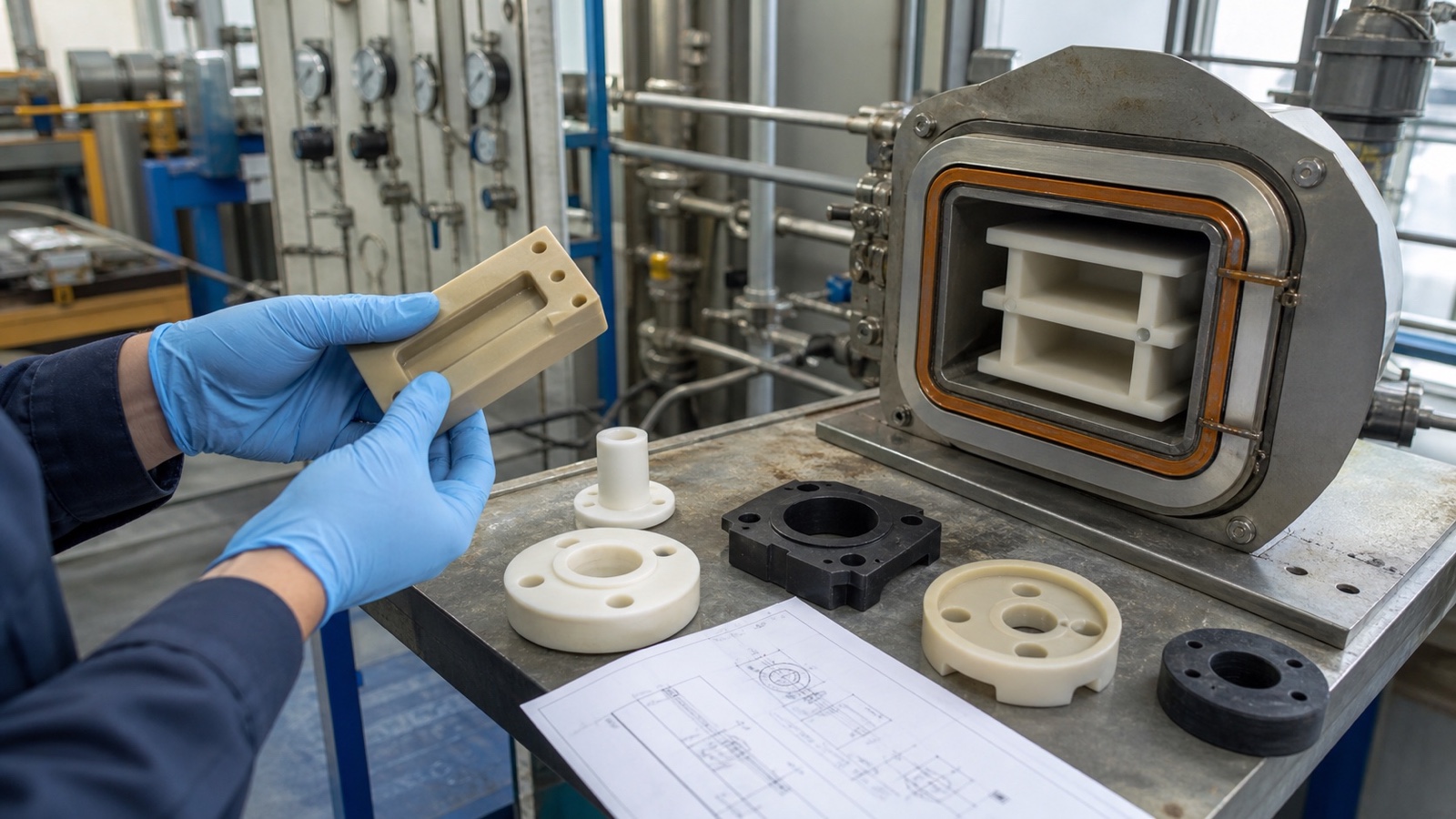
Polybenzimidazole (PBI)
PBI sits at the very top of the thermal pyramid. Unusually for a plastic, it has no true melting point at all — it holds together like a thermoset and only begins to degrade at extreme temperatures, with a glass transition around 427°C and continuous service capability up to roughly 310°C. It retains stiffness and compressive strength where virtually every other polymer has already surrendered.
The trade-offs are significant. PBI is one of the most expensive engineering plastics available, stock shapes are limited, and the material is extremely hard and sometimes abrasive on cutting tools. In our experience it demands sharp tooling, light cuts, and careful fixturing to machine without chipping or internal stress. We reserve it for applications where nothing cheaper survives — semiconductor test sockets, aerospace sealing components, and high-temperature insulators.
Vespel® (Polyimide)
Vespel®, DuPont’s polyimide, is another material that never truly melts — parts are machined from stock shapes produced through a proprietary high-pressure process. Continuous service temperatures reach approximately 288°C, and the material’s defining strength is dimensional stability that is essentially non-negotiable: very low creep, low thermal expansion for a plastic, and consistent performance from cryogenic conditions up to high heat.
That combination makes it a fixture in aerospace bushings, thrust washers, valve seats, and seals where a few hundredths of a millimeter of drift would cause leakage or seizure. From a machining standpoint, Vespel® is predictable and cuts cleanly, which is precisely why designers trust it for the parts they cannot afford to re-make.
Torlon® (PAI)
Torlon® polyamide-imide (PAI) offers perhaps the best balance in the ultra-high-temperature class: a glass transition around 275°C, HDT near 274°C, and continuous service up to roughly 250°C, combined with outstanding strength, stiffness, and wear resistance at temperature. It is a favorite for reciprocating compressor rings, high-temperature bearings, rotation and wear components, and seals in hot, loaded service.
One process point matters greatly: PAI stock typically reaches its full mechanical properties after a post-cure cycle following machining. If your supplier skips or mishandles this step, the part will underperform its data sheet. When we quote PAI parts, the post-cure and inspection plan is part of the quotation, not an afterthought.
PEEK (Polyetheretherketone)
PEEK melts at approximately 343°C and is rated for continuous service around 250°C to 260°C — and it has become the industry standard for high-performance engineering not because it is the hottest material, but because it pairs that thermal stability with excellent chemical resistance, low moisture absorption, good fatigue performance, and genuine machinability at production volumes. Glass- and carbon-fiber-filled grades push HDT dramatically higher for structural parts under load.
Its range of grades — unfilled, bearing grades, medical-grade and sterilizable formulations — means one material family can serve a pump seal today and a surgical instrument component tomorrow. When a customer needs heat plus chemistry plus repeat production, PEEK is usually where the conversation starts.
Shop floor note
Across our CNC shop, PEEK is the most frequently requested high-temperature polymer we machine — it hits the best balance of heat resistance, chemical resistance, machinability, availability, and cost. We step up to PAI, polyimide, or PBI only when the application genuinely outgrows it.
Ultem® (Polyetherimide)
Ultem® (PEI) is an amorphous polymer, so it has no sharp melting point; its glass transition sits around 217°C, HDT is typically in the 200°C range, and continuous service reaches roughly 170°C. What it adds on top of heat resistance is inherent flame retardancy with low smoke emission and strong dielectric strength, which is why it is so common in electrical housings, aircraft interior components, and medical sterilization trays.
It also machines beautifully and costs meaningfully less than PEEK. For parts that need high heat for an electrical or aerospace context — but not the full 250°C class — Ultem® is often the smartest specification on the drawing.
Comparative Analysis: Material Properties at a Glance
The table below lines up the five heavyweights on the metrics that actually drive part survival. Treat the figures as typical, room-condition values for unfilled base grades — exact data varies by grade and filler, so always confirm against the resin data sheet for your specific part.
| Material | Melting Point (typ.) | HDT @ 1.8 MPa (typ.) | Continuous Service (typ.) | Common Applications |
|---|---|---|---|---|
| PBI | No true melt; degrades only at extreme temperature | ~405°C | Up to ~310°C | Semiconductor test sockets, aerospace seals, extreme insulators |
| Vespel® (PI) | No true melt; Tg ~360°C | ~360°C | Up to ~288°C | Aerospace bushings, thrust washers, valve seats |
| Torlon® (PAI) | No true melt; Tg ~275°C | ~274°C | Up to ~250°C | Compressor rings, high-temp bearings, wear parts |
| PEEK | ~343°C | ~152°C unfilled; far higher in filled grades | ~250–260°C | Pump and seal components, medical and semiconductor parts |
| Ultem® (PEI) | Amorphous; Tg ~217°C | ~200–210°C | Up to ~170°C | Electrical housings, aircraft interiors, sterilization trays |
Notice the pattern: the higher the thermal capability, the higher the price tag and the harder the material is on your machining budget. Before you specify the hottest option, weigh the trade-offs below.
Higher material cost
PBI and polyimide stock can cost many times more per kilogram than PEEK, and premium materials amplify the cost of every scrapped blank. Specify them only where the temperature profile genuinely demands them.
Increased tool wear
The hardest, most heat-stable plastics are abrasive and unforgiving. Expect faster tool wear, more frequent tool changes, and longer machining times than with commodity or mid-tier engineering plastics.
Stock availability
PEEK and Ultem® are broadly available in rods, plates, and tubes worldwide. PBI and certain polyimide and PAI grades have a narrower supply base, which can extend lead times for special shapes and sizes.
Fit beats peak numbers
A material rated far beyond your operating temperature adds cost without adding life. Match HDT and CST to your real thermal duty cycle, including excursions, and let the numbers — not the headline melting point — decide.
Factors to Consider When Selecting High-Heat Plastics
Machinability
The plastics that survive the most heat are usually the hardest to cut. PBI, polyimide, and PAI require specialized tooling — sharp carbide at minimum, and the right geometries for each grade — plus disciplined speeds and feeds. Cut them like nylon and you will burn the surface, generate internal stress, and chase dimensional rejects for the rest of the batch. Ask your machining partner directly how they handle these grades; the answer tells you a lot about the parts you will receive.
Dimensional Stability
Plastics expand and contract far more than metals with temperature. A tolerance that measures perfectly at 20°C in the inspection room may drift out of spec at 180°C on the machine. For precision work in thermal cycling, specify tolerances at operating temperature, consider glass- or carbon-filled grades where the application allows, and insist that the stock be stress-relieved before final machining so residual stress does not move the part after it leaves the shop.
Chemical Compatibility
High heat resistance is often, but not always, paired with chemical resistance. PEEK, for example, shrugs off a very wide range of chemicals, which is why it dominates pumps and fluid handling. Other high-temperature polymers have specific weak spots — certain strong acids, bases, or steam environments can attack grades that otherwise look unbeatable on a thermal data sheet. Always validate both dimensions: temperature and the media it operates in.
Budgetary Constraints
Most “high-heat” requests we receive are solved perfectly by PEEK — it delivers roughly 250°C-class continuous service with excellent chemistry and predictable machining costs. PBI and polyimide earn their premium only at the top of the thermal range, in low volumes, where failure is more expensive than the material. A practical strategy we often recommend: prototype in PEEK or Ultem®, test against your real thermal profile, and upgrade to PAI, polyimide, or PBI only if the test data demands it.
Budget tip
Do not pay a PBI price for a PEEK problem. Send us the operating temperature, load, and media — we will tell you honestly which polymer is the most economical one that still survives, because we machine all of them.
FAQ: Common Questions About High-Temperature Plastics
What is the best plastic for CNC machining in high-heat environments?
For the widest range of demanding applications, PEEK is the versatile leader. It combines roughly 250–260°C continuous service, strong chemical resistance, low moisture absorption, and proven machinability for prototypes through repeat production. Above that range — or in extreme wear-at-temperature service — we step up to Torlon® (PAI), Vespel® (PI), or PBI.
What plastics have the highest melting points?
Polybenzimidazole (PBI) and polyimide (Vespel®) top the list — interestingly, neither has a conventional melting point at all. They are so thermally stable that they do not melt before degrading, behaving more like thermosets. This is exactly what makes them suitable for continuous service approaching 300°C.
Will 100 degrees melt standard plastics?
At 100°F (~38°C), essentially all engineering plastics are fine. At 100°C, the picture changes: commodity plastics like ABS soften near this range, PLA is already past its glass transition, and HDPE is approaching its melt zone — parts will warp or creep even if nothing visibly melts. High-temperature plastics such as PEEK, PAI, PEI, and PTFE handle 100°C with enormous margin. The practical failure at this level is loss of stiffness, not melting.
What plastic can withstand 300 degrees?
For continuous service at 300°C, specify PBI first, polyimide (Vespel®) second, and consider PAI for loaded wear applications. PEEK can survive brief excursions toward 300°C — its melting point is ~343°C — but it is rated for continuous duty around 250–260°C, so for permanent 300°C exposure it is the wrong long-term answer. For anything in this class, confirm the exact grade and duration with your material supplier before release.
Best Practices for CNC Machining High-Performance Polymers
Material choice is half the battle. The other half is how the part is cut. These are the three practices we treat as non-negotiable when machining high-temperature polymers:
Use sharp carbide tooling and controlled cutting parameters
Dull or inappropriate tools smear polymer instead of shearing it, pushing friction heat into the part and building internal stress. Sharp carbide with conservative feeds keeps the heat in the chip, not in your tolerances.
Select coolant deliberately for the material
Coolant maintains part temperature and protects tolerances during long cuts — but not every polymer welcomes every fluid. We match the coolant or air-blast strategy to each grade to avoid absorption, swelling, or stress cracking while holding dimensions.
Stress-relieve billets before final machining
High-performance stock carries residual stress from its own manufacturing. Rough-machining first, then stress-relieving (annealing) the blank before the final finishing passes lets the material settle so the finished part holds its tolerance.
Why it matters
We have seen parts measure perfectly on the day they ship and drift out of tolerance days later — almost always because a billet was finish-machined in one operation without stress relief. For high-performance polymers, the annealing schedule is as important as the CNC program.
Conclusion
The highest melting point plastic for CNC machining is PBI — but the right plastic for your part is the one whose HDT and continuous service temperature match your real thermal duty cycle, at a cost your project can absorb. PEEK covers the vast majority of demanding high-heat applications with the best overall balance. Torlon® (PAI) adds strength and wear life near 250°C. Vespel® and PBI take over where dimensional stability at extreme temperature is non-negotiable, and Ultem® wins on value when flame retardancy and dielectric strength matter more than peak heat.
My strongest advice, after years of reviewing drawings at PlasticCNCPro: bring the application, not just the material name. Operating temperature and duration, mechanical load, chemical media, tolerance at temperature, and annual quantity together determine the correct polymer — and the honest answer is frequently more economical than the obvious one.
If you have a drawing, a 3D model, or even just a thermal problem, send it to us. We will review the design, confirm material suitability, and return a clear quotation and production recommendation — from prototype to repeat production, shipped worldwide from our factory in Dongguan, China.
Next step
Ready to specify the right high-temperature plastic for your part?
Share your drawing, 3D file, material requirement, quantity, and tolerance — our engineers will get back to you with material guidance and a quotation.
Request a Machining QuoteContact PlasticCNCPro
Discuss Your High-Temperature Plastic Part
PlasticCNCPro is a precision CNC machining partner in Dongguan, China, specializing in custom plastic and engineering polymer parts — including PEEK, PAI, PEI, PI, and PBI grades — for prototyping, low-volume production, and repeat manufacturing. Send your requirements and we will recommend the most suitable material for your application.
Contact Information
- info@plasticcncpro.com
-
29 Fuxing Road, Dongguan City, Guangdong Province, China