
PC vs PMMA Acrylic: Which Transparent Plastic Is Better?
If you’ve ever searched for a clear plastic for a custom part, you’ve probably asked the same question: “Which transparent plastic should I use for my project?” It’s one of the most common material selection dilemmas we hear from engineers, purchasing managers, and product developers. On one side stands polycarbonate (PC), the tough, impact-absorbing workhorse. On the other sits PMMA acrylic (often known as Plexiglas or Lucite), the crystal-clear, glass-like favorite for displays and optics.
Both are excellent transparent engineering plastics, but they’re not interchangeable. The right choice depends on optical clarity, impact strength, heat tolerance, machinability, cost, and your application’s real-world demands. In this guide, I’ll break down PC vs PMMA acrylic across all these dimensions, so you can make an informed decision — whether you’re machining prototype parts, designing enclosures, or selecting material for high-volume production.
As a manufacturer of precision CNC-machined plastic components, I’ve worked with both materials on thousands of projects. Let me walk you through the trade-offs, because the honest answer is that neither material is “better” — only more suitable for a given set of requirements.
What Are PC and PMMA? Material Overview
Before we compare performance, let’s make sure we’re speaking the same language. Both PC and PMMA are thermoplastic polymers, but they have distinctly different molecular structures and personalities.
What Is Polycarbonate (PC)?
- Polycarbonate is an amorphous thermoplastic known for extreme impact resistance — often quoted as about 250 times stronger than glass and roughly 30 times stronger than acrylic.
- Common trade names include Lexan and Makrolon. It typically appears slightly less crystal-clear than acrylic and can yellow over time when exposed to UV light.
- PC offers inherent flame-retardant properties and excellent electrical insulation, making it a staple in electronics and safety equipment.
- It’s tough, ductile, and absorbs energy without shattering.
What Is PMMA (Acrylic)?
- PMMA (polymethyl methacrylate) is a lightweight, glass-like thermoplastic with exceptional optical clarity — offering up to 92–93% light transmission, the highest of any transparent plastic.
- Common trade names include Plexiglas, Lucite, and Perspex. It has outstanding UV stability and resists yellowing for decades outdoors.
- However, acrylic is brittle. It has lower impact resistance than PC and can crack or shatter on sharp impact.
- It also has a harder surface, which makes it more scratch-resistant than PC.
Key Differences at a Glance
Here’s a quick-reference comparison table that summarizes the main differences between the two materials. This should answer the frequently asked question: “What are the key differences between PC and PMMA plastic?”
| Property | PMMA (Acrylic) | PC (Polycarbonate) |
| --- | --- | --- |
| Optical clarity (light transmission) | 92–93% | 88–90% |
| Impact resistance | Moderate (stronger than glass, but brittle) | Very high (up to 30x PMMA) |
| Heat resistance (continuous) | ~70–80°C | ~120°C |
| UV resistance | Excellent | Poor without coatings/additives |
| Chemical resistance | Good against weak acids/alkalis; poor with solvents | Poor against solvents, oils, and fuels |
| Scratch resistance | Better (harder surface) | Worse (softer surface) |
| Machinability (CNC, laser) | Excellent, clean cuts | Fair; prone to melting and gumming |
| Cost per pound (ballpark) | $1.50–2.50 | $2.50–4.00 |
| Typical applications | Signage, displays, lenses, aquariums | Safety glass, machine guards, headlamps, enclosures |
In short: PC wins on strength and heat. PMMA wins on clarity, UV stability, cost, and scratch resistance. There’s no universal winner — only the material that fits your application best.
Optical Clarity: Which Plastic Is More Transparent?
If your part is a display case, lens, light guide, or signage panel, optical clarity is probably your first requirement. So, which is more clear, acrylic or polycarbonate?
The answer is unambiguously acrylic (PMMA). At a standard 3 mm thickness, PMMA transmits about 92–93% of visible light, while polycarbonate transmits 88–90%. That difference doesn’t sound huge on paper, but side by side, acrylic looks noticeably clearer and less hazy.
Polycarbonate’s lower clarity comes from higher light scattering within its molecular structure. It also tends to yellow over time when exposed to UV radiation, which degrades both its transparency and aesthetic appeal outdoors. PMMA, on the other hand, is naturally UV stable and will remain water-clear for years.
Can PMMA be transparent? Absolutely — it’s the most transparent plastic available, and that’s why it’s used for optical fibers, light pipes, and LED covers. It can also be tinted, dyed, or coated for specific optical effects while retaining its clarity.
For most applications that demand true glass-like transparency, PMMA is the go-to. Polycarbonate’s clarity is “good enough” for many practical uses, but it’s not the material I’d recommend for museum display cases or high-end retail lighting.
One caveat: both materials can be polished to an optical-grade finish. CNC-machined acrylic edges polish beautifully with flame or mechanical polishing, while polycarbonate edges are more difficult to finish and often require specialized polishing techniques. If your part needs visible edges, that’s a practical consideration for your machining partner.
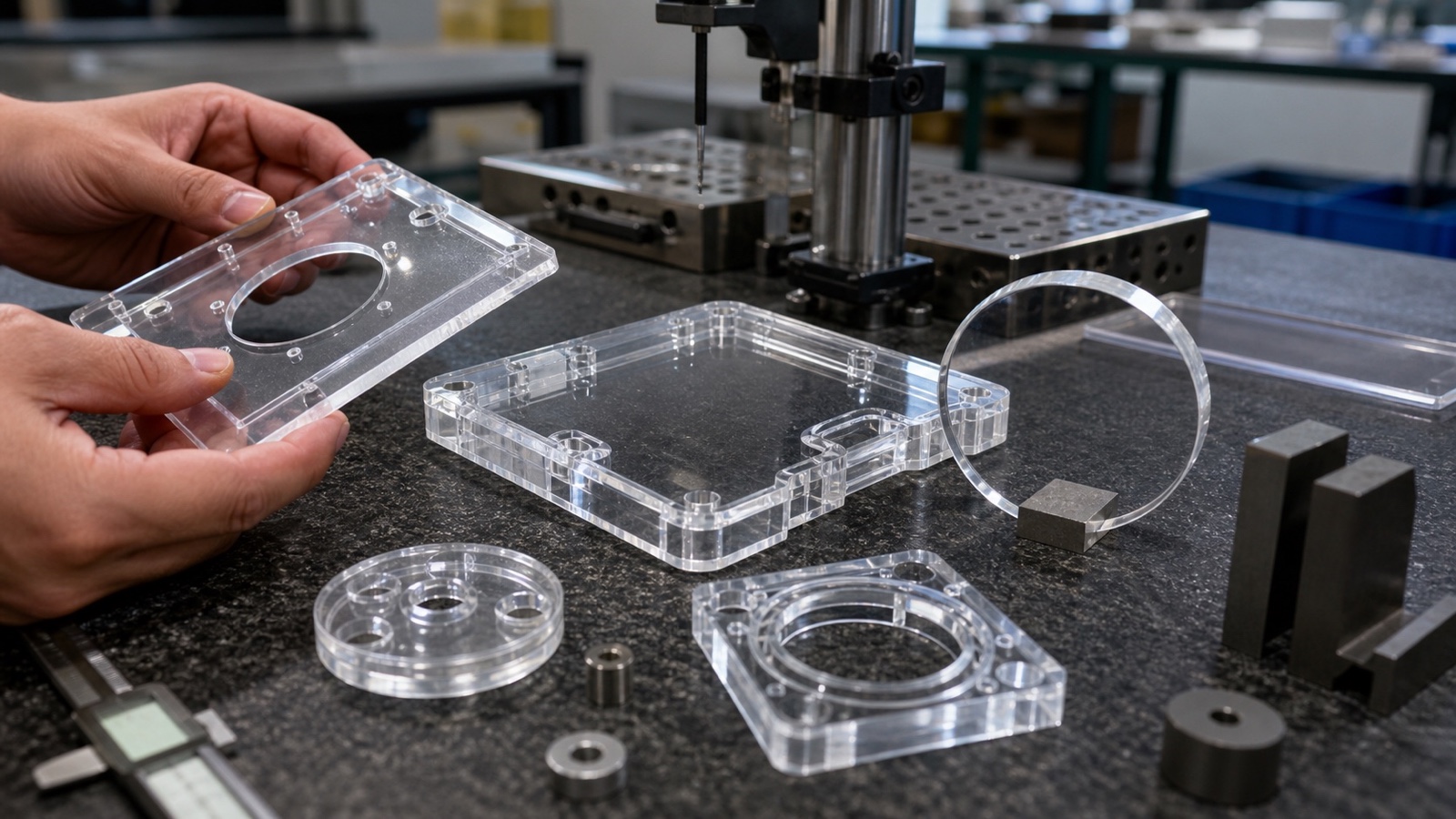
Impact Resistance and Strength: Which Transparent Plastic Is the Strongest?
This is the question that gets answered differently depending on who you ask — but from a mechanical engineering standpoint, there’s no contest. Polycarbonate is the strongest transparent plastic by a wide margin. Its impact resistance is up to 30 times greater than acrylic and roughly 250 times greater than glass.
What does that mean in practice? A polycarbonate sheet can absorb a hammer blow without breaking; it flexes, bends, and absorbs energy. Acrylic, by contrast, will crack or shatter under similar impact. Acrylic is still stronger than standard glass, but it’s brittle in the way glass is brittle — a sharp impact at a weak point can cause catastrophic failure.
Let’s look at the qualitative difference:
- PC deforms. It bends, dents, and absorbs impact energy. This makes it ideal for safety glazing, machine guards, riot shields, and helmet visors.
- PMMA cracks. It transmits impact energy poorly and is susceptible to stress concentrations, so a stiff blow creates fractures. This is fine for static, low-impact environments, but not for high-risk applications.
However, impact resistance isn’t the same as surface hardness. PMMA has a harder surface than PC, meaning it’s more scratch-resistant and holds its optical finish better. Polycarbonate, despite being tougher, scratches easily — which is why many PC-based products use hard coatings to protect the surface.
So which transparent plastic is the strongest? If “strongest” means resistance to breaking under impact, the winner is polycarbonate. If “strongest” means resistance to surface damage and deformation under load, acrylic holds its own due to its higher stiffness and hardness. For most engineers, impact resistance is the primary safety criterion — and that means PC.
Heat Resistance and Temperature Tolerance
Heat changes everything. When we select materials for parts that will sit near motors, electronics, or hot automotive interiors, thermal performance is a key differentiator between PC and PMMA.
Here are the critical numbers:
- PC glass transition temperature (Tg): ~147°C
- PC continuous service temperature: ~120°C
- PMMA Tg: ~105°C
- PMMA maximum continuous service temperature: ~70–80°C
What does this mean practically? PC can handle sustained heat that would soften or warp acrylic. If your part is an electrical enclosure housing transformers, an automotive interior component, or a medical device that undergoes steam sterilization, PC is the safer choice. PMMA should be kept away from heat sources — it can deform, warp, or take on stress when exposed to temperatures above its service range.
That said, PMMA has a lower coefficient of thermal expansion than PC. That means at moderate temperatures, acrylic holds its dimensional stability better. Polycarbonate expands more as temperature rises, which can be a problem for tight-tolerance assemblies and multi-material parts. Design allowances for expansion are essential when working with PC.
In terms of flammability, both materials are slow-burning, but PC has better inherent flame resistance. PMMA burns with a clean flame and decomposes into CO2 and H2O (which is why it’s sometimes used as a more “benign” burning plastic), but PC’s self-extinguishing characteristics make it preferred for electrical and safety-critical applications.
Machinability, Fabrication, and Manufacturing Options
At PlasticCNCPro, we machine both materials every day. The machining behavior difference is something every engineer should understand before designing parts.
CNC Machining and Laser Cutting
This is where the two materials diverge sharply. PMMA is a dream to CNC machine. It cuts cleanly, holds tight tolerances, and produces smooth, polished edges with the right tooling. It’s also one of the easiest plastics to laser-cut; the beam vaporizes the material cleanly, leaving a slightly frosted edge that can be flame-polished to crystal clarity.
PC is more difficult. It’s soft and gummy, so it tends to melt and re-weld around cutting tools, especially if feeds and speeds aren’t optimized. Laser cutting PC produces messy, discolored edges with significant charring. You can do it, but it requires low-power and slow speeds — and the result is rarely beautiful.
For CNC machining, I recommend the following:
- PMMA: Use sharp carbide tooling, moderate spindle speeds (8,000–12,000 RPM for smaller tools), and coolant or compressed air to evacuate chips. Watch for stress cracking if the material is pre-stressed or the tool is dull.
- PC: Use polished-flute tooling to reduce friction, lower cutting speeds, and plenty of coolant to prevent heat buildup. The main risk is stress whitening at cut lines, which can weaken the part aesthetically and structurally.
One advantage of PC is that it’s less prone to chipping and edge breakage during drilling. PMMA’s crispness means it’s easy to create clean edges, but it also means you need to control tool exit to avoid blowout.
Injection Molding
Both materials are widely injection molded, but their behavior differs.
- PMMA has lower viscosity and fills thin-wall molds more easily. However, it requires careful temperature control to prevent crazing (micro-cracks) and can be sensitive to trapped moisture.
- PC requires high-pressure molding machines and rigorous pre-drying. If the pellets absorb moisture, hydrolysis will occur during melting, leading to molecular degradation and reduced strength.
Molding cycle times differ too: PMMA generally cycles faster, whereas PC’s higher melt temperature extends cooling time. Shrinkage also matters: PMMA shrinks about 0.4–2.1% depending on processing, while PC shrinks around 0.5–0.7% and is more predictable.
Thermoforming and Other Methods
PMMA thermoforms easily at relatively low heat, which is why it’s popular for skylights, bathtubs, and display bubbles. PC also thermoforms, but it requires higher temperatures and more careful handling to avoid stress fractures.
For bonding, both materials can be solvent-cemented, but with different requirements:
- PMMA bonds beautifully with methylene chloride or acrylic solvent cement, creating a weld-like joint.
- PC requires specialized solvent cements to avoid crazing at the bond line. Many engineers prefer mechanical fastening or adhesive bonding for PC to prevent solvent damage.
Secondary operations also differ. PMMA can be flame-polished, chemically polished, or mechanically polished to optical clarity. PC edges are best left as-molded or mechanically polished — flame polishing would burn the material.
Chemical and UV Resistance
If your part will be outdoors or exposed to chemicals, this section matters more than almost anything else.
PMMA has excellent UV resistance. It doesn’t yellow or degrade after years of direct sunlight, which is why outdoor signage, skylights, and architectural glazing are overwhelmingly acrylic. It’s also resistant to weak acids, alkalis, and hydrocarbon-based mild chemicals.
PC is vulnerable to UV degradation. Without UV absorbers or protective coatings, it yellows quickly and can become brittle. Even UV-stabilized grades (like Lexan UV) perform worse than acrylic over a decade-plus outdoor lifetime. If you absolutely need PC for outdoor impact protection, specify a coated or UV-stabilized grade — and set expectations accordingly.
Chemical resistance is another differentiator. PC has poor resistance to solvents, oils, and fuels. Even gasoline vapors can cause stress cracking in PC. Many of our customers are surprised to learn that a polycarbonate machine guard in a fluid-handling environment should be avoided unless the chemical exposure is well-characterized. PMMA does better, but it also has solvent sensitivity — handle cleaning products carefully.
Real-world examples:
- Outdoor signage → PMMA wins on longevity.
- Glazing for bus shelters in sunny regions → PMMA is the standard.
- Security glazing that must survive vandalism and UV exposure → you need coated impact-resistant PC, or a laminated composite.
Cost Comparison: PMMA vs. Polycarbonate
Is polycarbonate worth the higher cost? That depends entirely on your application and risk tolerance.
In raw material terms, PMMA is roughly 20–40% cheaper than PC. Depending on grade and volume, expect PMMA resin around $1.50–2.50 per pound and PC around $2.50–4.00 per pound. For sheet and plate stock, similar ratios apply.
Processing costs also add up:
- PMMA is easier to machine and mold, which reduces cycle time and tool wear. Its lower processing temperature cuts energy costs.
- PC’s higher processing temperature and need for pre-drying consume more energy and require more robust tooling.
But total lifecycle cost is the real question. If you’re building a safety shield that could be struck by debris, PC’s durability may prevent costly downtime or failures — and that offsets its higher upfront price many times over. Conversely, if you’re making highly polished display stands or disposable lab fixtures, PMMA’s lower cost is hard to beat.
For transparent panels and glazing, sheet pricing can vary significantly. We always recommend requesting quotes for the exact grade, thickness, and quantity you need — not just comparing list prices.
Pros and Cons Summary
Let me condense the trade-offs into a quick-reference format.
PMMA (Acrylic) — Pros and Cons
Pros:
- Superior optical clarity (up to 93% light transmission)
- Excellent UV resistance — won’t yellow outdoors
- Scratch-resistant surface
- Stiff and dimensionally stable
- Easy to machine, laser-cut, and polish
- Low cost compared to PC
- Recyclable
Cons:
- Brittle — can crack or shatter under impact
- Lower impact resistance
- Lower heat tolerance (max ~80°C continuous)
- Can crack under stress or stress concentration
- Prone to crazing with certain solvents
PC (Polycarbonate) — Pros and Cons
Pros:
- Unmatched impact resistance (30x PMMA)
- High heat tolerance (up to ~120°C continuous)
- Flame-resistant and self-extinguishing
- Good electrical insulation
- Formable into complex shapes
- Can be transparent or tinted
Cons:
- Lower optical clarity and yellowing over time with UV exposure
- Prone to scratching (needs hard coating)
- Susceptible to solvent stress-cracking
- More expensive than PMMA
- Requires UV protection for outdoor use
Applications: Where to Use PMMA vs. PC
Now let’s talk real-world usage. Here’s where you’ll find each material, and why.
Common PMMA Applications
- Retail signage and point-of-purchase displays
- Aquarium and tank glazing (thick acrylic is used in public aquariums)
- Museum display cases and protective covers
- Architectural lighting panels and skylights
- Car taillight lenses and light covers
- Decorative and designer products
- Light pipes, optical waveguides, and LED covers — thanks to 92% light transmission
PMMA dominates where clarity is the primary performance requirement. If you need a see-through part that maintains optical transparency over time, acrylic is almost always the first recommendation.
Common PC Applications
- Bullet-resistant glazing and security windows
- Safety goggles, face shields, and riot shields
- Helmets and protective sports equipment
- Machine guards and safety enclosures
- Greenhouse panels and roofing
- Automotive headlamp lenses
- Electrical enclosures and connector housings
- Infant cups, reusable water bottles (with BPA-free grades), and medical devices
PC is the go-to for anything that must survive physical abuse, high temperatures, or flame exposure.
Industry-Specific Use Cases
- Automotive: PMMA for taillights and aesthetic glazing; PC for headlamp lenses, instrument clusters, and internal components exposed to heat.
- Construction: PMMA for noise barriers, architectural glazing, and decorative panels; PC for impact-resistant roofing and security glazing.
- Medical: PC for surgical instruments, sterilization trays, and medical device housings; PMMA for intraocular lenses, dental appliances, and implantable devices.
- Electronics: PC for mobile and laptop housings, connectors, and battery covers; PMMA for display covers and transparent electronics panels.
Finishing Options and Aesthetic Considerations
If your part will be seen, touched, or handled, finishing matters.
For PMMA, flame polishing is the classic technique — a quick pass with a hydrogen-oxygen flame melts the surface just enough to produce a glass-clear edge. Chemical polishing (vapor polishing with solvent) and mechanical polishing are also highly effective. This is why CNC-machined acrylic parts can look like cast glass.
For PC, edge finishing is trickier. Diamond-polishing is possible, but many PC parts are designed with as-molded or as-machined surfaces to avoid introducing haze. If optical clarity isn’t critical, a matte or textured finish can hide scratches.
Both materials accept painting, screen printing, and UV coatings. For PC, anti-scratch hard coatings are almost essential for anything exposed to handling or an outdoor environment. For PMMA, a UV-cured hard coat can also enhance scratch resistance, though acrylic already performs better in this regard.
You can also create frosted or matte textures on both materials via sandblasting or by specifying a textured mold surface in injection molding. This can help diffuse light or hide fingerprints on consumer-facing parts.
Alternative Transparent Plastics to Consider
Sometimes PC and PMMA aren’t the right answer at all. If you’re struggling with the trade-off between clarity and toughness, consider these alternatives.
PETG (Glycol-Modified PET)
PETG is a middle ground between PC and PMMA. It’s tougher than acrylic, clearer than polycarbonate, and much easier to thermoform than both. It also has good chemical resistance and is widely used in:
- Retail displays and protective cases
- Medical packaging and lab equipment
- 3D printing filaments
PETG doesn’t yellow as readily as PC, but it’s not quite as UV-stable as acrylic. It’s a fantastic choice for indoor applications where you need more impact strength than PMMA but less cost than PC.
Clear ABS and Other Options
- Transparent ABS offers moderate clarity at a lower cost, but it’s not in the same optical league as PMMA or PC. It’s more of a structural material with translucency.
- Styrene-acrylonitrile (SAN) is another clear option for internal parts, providing decent rigidity and clarity at a low price point.
- Trivex is a specialty material used in eyewear and optical applications, offering excellent clarity and impact resistance — but at a premium cost.
- Glass remains the reference point for maximum scratch resistance and optical performance, but it’s heavy, brittle, and difficult to machine.
Here’s a quick comparison of PC vs. PMMA vs. PETG:
| Property | PMMA | PC | PETG |
| --- | --- | --- | --- |
| Clarity | Excellent | Good | Good/very good |
| Impact resistance | Moderate | Excellent | Good |
| Heat resistance | Moderate | High | Moderate |
| UV resistance | Excellent | Poor | Moderate |
| Machinability | Excellent | Fair | Good |
| Cost | Low | High | Moderate |
How to Choose Between PC and PMMA (Decision-Making Guide)
Alright, let’s synthesize everything into a practical decision framework. These are the questions I ask my customers — and you should ask yourself — before specifying a transparent plastic.
Assess Your Impact and Durability Requirements
- Will the part be dropped, struck, or exposed to vibration? Choose PC. It absorbs energy and won’t shatter.
- Is the part static, handled gently, or used indoors? PMMA is sufficient and more cost-effective.
Evaluate Optical and Aesthetic Needs
- Is maximum clarity and UV stability non-negotiable? Choose PMMA for display cases, lenses, and signage.
- Is slight haze acceptable, and does strength matter more? Choose PC.
Consider Operating Temperature
- Will the application exceed 80°C continuously? PC is the safer choice.
- For room-temperature indoor use, PMMA’s heat performance is adequate.
Balance Budget vs. Performance
- Use PMMA when cost is the primary constraint and impact risk is low.
- Invest in PC when failure is costly — safety, security, warranty — and toughness delivers lifecycle savings.
Factor in Manufacturing Constraints
- For CNC machining with tight tolerances, PMMA machines cleanly and predictably. PC requires more machining expertise to avoid melting and stress whitening.
- For injection molding high volumes, evaluate gate design, drying requirements, and cycle-time trade-offs with your molder.
Simple decision checklist:
- Needs to be crystal clear? → PMMA
- Needs to survive a 6-foot drop? → PC
- Will it live outdoors? → PMMA (unless impact is critical, then coated PC)
- Will it see heat above 80°C? → PC
- Is cost the #1 constraint? → PMMA
- Does it need to meet flammability standards? → PC
- Are you laser-cutting? → PMMA
- Are you thermoforming complex shapes? → PETG (often easier)
If you’re still unsure, email us your drawing and application details. We’ll recommend the right material based on your specific operating conditions — that’s part of the engineering support we provide at PlasticCNCPro.
Frequently Asked Questions (FAQ)
Here are direct answers to the questions buyers ask us most often.
Which transparent plastic is the strongest?
Polycarbonate is the strongest transparent plastic, with impact resistance up to ~30 times that of PMMA and ~250 times that of glass. It bends and absorbs impact energy rather than shattering.
Which is more clear, acrylic or polycarbonate?
Acrylic (PMMA) is more optically clear, transmitting about 92–93% of visible light versus polycarbonate’s 88–90%. Acrylic is the best choice for crystal-clear applications like display cases and lenses.
Can PMMA be transparent?
Yes — PMMA is inherently transparent. It has the highest visible light transmission of all transparent plastics and can be tinted, dyed, or coated for various optical effects while retaining clarity.
What are the key differences between PC and PMMA plastic?
In short: PC wins on impact strength, heat resistance, and flame resistance. PMMA wins on optical clarity, UV stability, scratch resistance, and cost. You choose based on which property your application needs most.
Does polycarbonate yellow in sunlight?
Yes, without UV stabilizers or protective coatings, polycarbonate yellows and degrades outdoors. PMMA remains clear for decades in direct sunlight, making it the better outdoor transparent plastic.
Can you laser-cut polycarbonate and acrylic?
PMMA laser-cuts cleanly and is one of the easiest plastics to laser-cut. Polycarbonate tends to melt and char at the cut edge, so it requires lower power and slower speeds — and the result is often not as clean.
---
Let’s Machine Your Transparent Plastic Parts
At PlasticCNCPro, we manufacture precision CNC-machined components from PC, PMMA, PETG, and many other transparent and engineering plastics. Whether you need a UV-stable acrylic cover for outdoor equipment, a high-impact polycarbonate machine guard, or a custom prototype for optical testing, we can help you select the right material and machine it to your exact specifications.
Send us your 2D drawing, 3D model, material requirement, quantity, tolerance, and application details. We’ll review the design, recommend the best plastic, and provide a clear quotation with production recommendations. From prototypes to repeat production runs, we’re your manufacturing partner for transparent plastic parts — from Dongguan to the world.
RFQ Support
Send Your Drawing for a Quote
Share your 2D drawing, 3D model, material, quantity, tolerance, surface finish, and application details. Our team will review manufacturability and reply with a practical quotation.
Email: info@plasticcncpro.com
Address: 29 Fuxing Road, Dongguan City, Guangdong Province, China