
Industrial materials guide
PVC vs CPVC for Industrial Applications: Key Differences and Selection Guide
PVC and CPVC can both provide economical, corrosion-resistant piping, but they are not interchangeable in every industrial system. We compare temperature limits, pressure behavior, chemical compatibility, dimensions, standards, service life, and practical selection factors.
The best choice is rarely based on material price alone. In our experience, temperature, fluid chemistry, pressure, joining method, regulatory requirements, and the cost of an unexpected shutdown should be evaluated together.
What Is PVC Pipe?
PVC, or polyvinyl chloride, is a thermoplastic made from polymerized vinyl chloride with additives selected for processing, stability, color, and performance. Rigid PVC is lightweight, electrically insulating, corrosion-resistant, and relatively easy to fabricate and join. It is widely used for fluid handling where operating temperatures remain within the material’s design range.
Industrial PVC pipe is commonly supplied in nominal pipe sizes with Schedule 40 or Schedule 80 wall constructions. Schedule 80 has a thicker wall than Schedule 40 in the same nominal size, which generally supports higher pressure capability and greater mechanical robustness, although the actual rating depends on diameter, temperature, compound, fittings, and manufacturer data.
Where PVC is strong
PVC offers a practical balance of cost, corrosion resistance, low weight, and installation efficiency for many ambient-temperature water, drainage, chemical, and process-fluid systems.
What limits PVC
Its pressure capacity decreases as temperature rises, and compatibility must be checked for concentrated chemicals, organic solvents, hydrocarbons, and fluids containing additives or contaminants.
What Is CPVC Pipe?
CPVC is chlorinated polyvinyl chloride. Additional chlorine is introduced into the PVC polymer structure, changing its thermal behavior and influencing its chemical performance. CPVC retains many of PVC’s useful characteristics while providing a higher temperature capability for properly designed systems.
CPVC is therefore selected for applications where ordinary PVC may be too close to its upper temperature limit, such as heated water, selected chemical process lines, and industrial systems that experience warm operating conditions. The higher temperature range does not make CPVC universally resistant to every chemical or suitable for every pressure duty; the specific grade and manufacturer’s compatibility chart still control the decision.
Engineering note
PVC and CPVC solvent cements, primers, fittings, and joining procedures are not automatically interchangeable. We recommend treating the pipe, fitting, cement, and installation standard as one qualified system.
PVC vs CPVC: Key Differences at a Glance
The table below is a design-level comparison, not a substitute for the pressure tables, chemical charts, and code requirements for a particular product. Published ratings vary by pipe size, wall thickness, temperature, compound, joining method, and manufacturer.
| Property | PVC | CPVC | Selection implication |
|---|---|---|---|
| Typical maximum service temperature | Often rated around 140°F / 60°C for pressure applications | Often rated around 200°F / 93°C for pressure applications | Confirm the exact product rating and temperature derating curve. |
| Pressure performance | Strong at ambient temperatures; rating declines as temperature increases | Retains useful pressure capability at higher temperatures, but also requires derating | Use manufacturer pressure-temperature data, not the material name alone. |
| Chemical resistance | Good for many acids, bases, salts, and aqueous chemicals | Often broader at elevated temperatures, with important chemical-specific exceptions | Check concentration, temperature, exposure time, and stress conditions. |
| Sizing standards | Commonly NPS Schedule 40/80; CTS products also exist | Commonly NPS Schedule 40/80 and CTS systems, depending on application | Nominal size does not guarantee matching outside diameter. |
| Relative material cost | Usually the more economical option where its rating is sufficient | Typically carries a higher material cost because of formulation and temperature capability | Compare total installed and lifecycle cost, not pipe price alone. |
Temperature and Pressure Ratings
Temperature is one of the clearest dividing lines in the PVC versus CPVC decision. Many rigid PVC pressure products are designed for service up to approximately 140°F (60°C), while many CPVC pressure products are designed for service up to approximately 200°F (93°C). These are common reference values, not universal guarantees. A specific product may have a different rating, and non-pressure drainage products must be assessed differently.
Pressure capability falls as operating temperature increases because thermoplastic stiffness and strength change with heat. For example, a pipe with a strong ambient-temperature pressure rating may need a substantial reduction at a warm process temperature. We use the manufacturer’s pressure-temperature curve for the exact pipe and fitting system, then check surge, vacuum, support spacing, thermal expansion, and pump conditions.
Design checkpoint
Do not select Schedule 80 simply because it “looks stronger.” A correct design combines the pipe’s pressure rating at operating temperature with fitting ratings, joining details, support conditions, and transient loads.
Chemical Resistance Comparison
Both PVC and CPVC resist many inorganic chemicals better than metals that can corrode in wet service. Their performance is commonly favorable with many dilute acids, alkalis, salts, and aqueous solutions. However, chemical resistance is not a simple “yes or no” property. Concentration, fluid temperature, pressure, exposure duration, mechanical stress, and the presence of solvents can change the result.
In chemical processing, PVC may be suitable for selected ambient-temperature acid or salt solutions, water treatment chemicals, and low-temperature transfer lines. CPVC may be preferred when the same general chemistry is handled at a higher temperature or when the product-specific compatibility chart shows a broader operating window. Neither material should be assumed safe for all hydrocarbons, aromatic solvents, ketones, chlorinated solvents, or aggressive organic mixtures.
Often favorable, subject to verification
Many aqueous acids, bases, salts, and water-treatment solutions can be compatible with PVC or CPVC when concentration and temperature remain within published limits.
Requires special caution
Organic solvents, certain hydrocarbons, concentrated reagents, and hot chemical mixtures may soften, swell, craze, or otherwise damage the material or joint.
Sizing Standards: NPS, CTS, Schedule 40 vs 80
NPS means nominal pipe size. It is a naming convention rather than a direct measurement of the pipe’s outside diameter. In an NPS Schedule 40 or Schedule 80 system, the outside diameter is associated with the nominal size while the wall thickness changes by schedule. The inside diameter therefore changes as wall thickness changes, affecting flow area and pressure performance.
CTS means copper tube size. CTS products use a different dimensional family and should not be connected to NPS products solely because the nominal size appears similar. A 3/4-inch CTS component and a 3/4-inch NPS component may have different outside diameters and require different fittings, clamps, and joining methods.
Schedule 40 is often chosen when pressure and mechanical demands are moderate and lower material usage is valuable. Schedule 80 is preferred when the system requires a higher pressure rating at the design temperature, greater wall protection, or improved resistance to handling and localized impact. In both cases, the pipe, fittings, valves, adapters, and joining products must belong to a compatible dimensional system.
Common Industrial Applications and Pipe Selection
There is no single pipe material that is commonly correct for every industrial application. Engineers typically choose among PVC, CPVC, PVDF, PTFE-lined systems, polypropylene, stainless steel, and other materials according to the fluid and operating envelope.
For chemical processing, PVC can serve selected ambient-temperature chemical transfer duties, drains, scrubber systems, and utility lines. CPVC becomes more attractive when the fluid is warm, when the system sees temperature cycling, or when the required chemical compatibility and code listing favor CPVC.
In water and wastewater treatment, PVC is common in many cold or moderate-temperature water, filtration, dosing, drainage, and process-support systems. CPVC is used where hot water or warmer chemical service exceeds the practical range of PVC. Manufacturing facilities may use either material for cooling water, rinse systems, plating-related services, and fluid-handling equipment, but each line still needs a fluid-specific review.
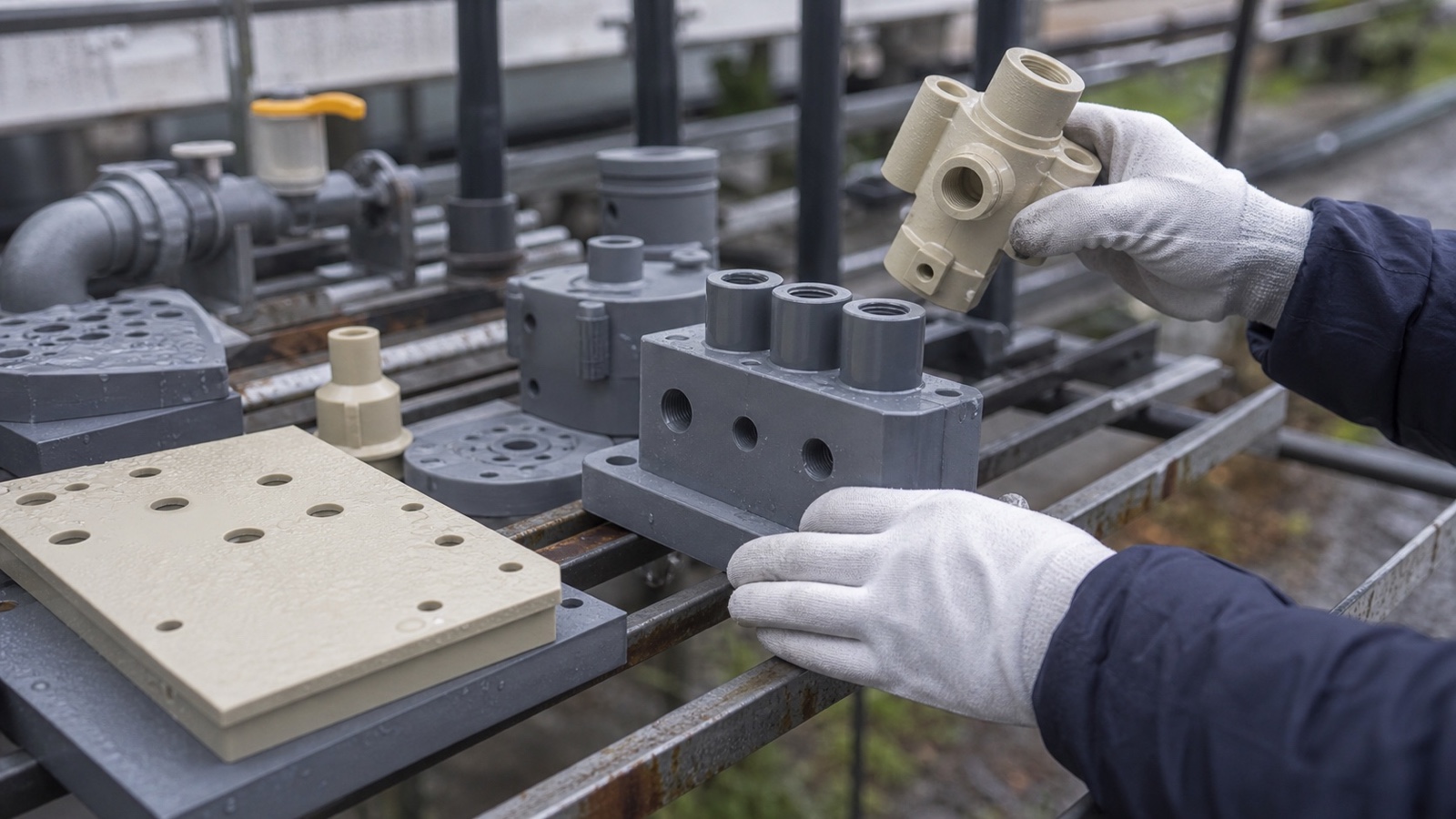
What type of pipe is commonly used in industrial applications?
PVC and CPVC are commonly used where corrosion resistance, low weight, and economical installation are important, but industrial piping is application-specific. The fluid, pressure, temperature, cleanliness requirement, joining method, and local code determine whether either plastic is appropriate.
Why Use CPVC Instead of PVC in Industrial Settings?
The direct answer is that CPVC provides a larger thermal operating window and may provide broader chemical compatibility for a defined process. That extra margin can be valuable when fluid temperatures are elevated, when a line experiences heat from nearby equipment, or when an industrial code or project specification calls for a CPVC system.
Higher temperature tolerance
CPVC is commonly specified for hot water and selected warm chemical services where PVC would require excessive derating or fall outside its published temperature limit.
Chemical compatibility at process temperature
A chemical that is compatible at room temperature may behave differently when heated. CPVC can be the better candidate when the manufacturer’s chart confirms compatibility at the actual concentration and temperature.
Code-driven or specification-driven selection
Some projects require a particular material, listing, standard, or fire and plumbing classification. In those cases, compliance can outweigh a lower initial PVC price.
Critical Safety Limitations and Best Practices
PVC and CPVC are pressure-rated thermoplastics, not universal substitutes for metal or specialty fluoropolymers. We would not approve a design based only on a nominal size and a material label. The complete operating envelope must be documented before installation.
Do not generalize the material
Neither PVC nor CPVC should be assumed suitable for compressed air or gas service, aggressive solvents, unverified hydrocarbon service, or any application outside the product’s listed pressure, temperature, and chemical limits. Use the applicable code and manufacturer approval for the exact service.
Verify the fluid and concentration
Identify every chemical, mixture component, concentration, temperature, cleaning agent, and occasional fluid—not only the normal process liquid.
Control thermal and mechanical loads
Account for temperature derating, pressure surges, thermal expansion, vibration, support spacing, external impact, and vacuum conditions.
Use the correct joining system
Follow the pipe and fitting manufacturer’s preparation, primer, solvent cement, cure time, and pressure-test instructions. Avoid mixing systems without documented compatibility.
Plan inspection and commissioning
Inspect for scratches, stress whitening, poor cuts, unsupported valves, misalignment, and incomplete cure before introducing process fluid.
Standards, Certifications, and Code Compliance
Standards help define dimensions, materials, performance tests, joining products, and acceptable applications. They do not eliminate the need for engineering review. The governing requirements may include local plumbing or mechanical codes, project specifications, pressure-vessel or process regulations, and the rules of the destination market.
Key ASTM Standards and NSF Certifications
Common references in North American PVC and CPVC piping include the following. Always confirm the current edition and the exact scope of the product being purchased.
| Reference | Typical relevance |
|---|---|
| ASTM D1784 | Rigid PVC and CPVC compound classification and material requirements. |
| ASTM D1785 | PVC plastic pipe, including Schedule 40, 80, and 120 product categories. |
| ASTM F441 | CPVC plastic pipe, including Schedule 40 and Schedule 80 categories. |
| ASTM D2466 / ASTM F439 | Common references for PVC and CPVC schedule-rated fittings, respectively. |
| NSF/ANSI 14 | Evaluation of plastic piping components and related systems for specified applications. |
| NSF/ANSI 61 | Health-effects requirements for components used in drinking-water system applications. |
NSF certification is not automatically required for every industrial fluid system. If the line carries process water, potable water, food-related fluids, or another regulated medium, verify the required listing for the complete component assembly, including pipe, fittings, valves, seals, and joining materials.
How Long Do PVC and CPVC Last in Industrial Use?
PVC and CPVC can provide long service in a properly designed and installed system, but a single universal service-life number would be misleading. Longevity depends on sustained temperature, pressure cycles, chemical exposure, ultraviolet exposure, installation quality, support, impact, and whether the material is continuously operating near its rating.
Service life is generally extended when the pipe is correctly supported, protected from impact and prolonged sunlight where required, kept within pressure-temperature limits, and exposed only to verified compatible fluids. It can be reduced by hot spots, repeated thermal cycling, pressure surges, unsupported heavy valves, poor solvent-cement joints, scratches, incompatible cleaning chemicals, or installation stress.
Factors that extend life
Correct derating, compatible fluids, proper support, controlled installation, protected routing, and documented inspection.
Factors that shorten life
Excess heat, chemical attack, surge, impact, sunlight exposure, joint errors, and operation beyond published limits.
How to Choose Between PVC and CPVC for Your Project
We recommend making the decision in a defined sequence rather than starting with the lowest pipe quotation. The following workflow helps purchasing, design, and operations teams reach the same conclusion.
Define the operating envelope
Record normal and maximum temperature, operating and surge pressure, vacuum exposure, flow rate, thermal cycling, and environmental conditions.
Identify every fluid contact
Check the process fluid, additives, cleaning chemicals, disinfectants, flushing fluids, and possible contamination against current compatibility data.
Select the dimensional system
Choose NPS or CTS, then choose the appropriate schedule and matching fittings, valves, adapters, supports, and joining products.
Check codes and documentation
Confirm required ASTM product standards, NSF or other listings, local code acceptance, test requirements, traceability, and project specifications.
Compare total cost and risk
Compare material, installation, maintenance, downtime exposure, replacement access, safety requirements, and the cost of changing material later.
Practical rule
Use PVC when its verified temperature, chemical, pressure, and code envelope comfortably covers the application. Move to CPVC when the higher temperature capability, compatibility window, or project requirement justifies it. If neither material provides sufficient margin, evaluate a different polymer or a lined metallic system.
FAQ
Is 3/4 CPVC the same as 3/4 PVC?
No. The “3/4” designation identifies a nominal size, but the actual dimensions depend on whether the product is NPS or CTS and on the applicable product standard. Even when PVC and CPVC components share a nominal designation, their temperature ratings, pressure ratings, material formulation, and joining instructions can differ. Confirm outside diameter, wall thickness, fitting series, and manufacturer compatibility before connecting them.
Can CPVC and PVC be used together in industrial systems?
They can sometimes be connected with an appropriately rated transition fitting or a documented joining method, but they should not be mixed casually. The connection must be dimensionally correct, chemically compatible, pressure-rated, and accepted by the relevant manufacturer and code. Do not assume that a PVC solvent cement or CPVC cement is suitable for every mixed-material joint.
Are PVC and CPVC safe for process water or other industrial fluids?
They can be safe when the exact pipe, fitting, seal, and joining system is rated for the fluid, temperature, pressure, and regulatory requirements. For process water, verify whether NSF/ANSI 61, NSF/ANSI 14, potable-water approval, food-contact requirements, or another listing applies. For industrial fluids, consult the manufacturer’s chemical-resistance data and review occasional cleaning or sanitizing chemicals as carefully as the normal fluid.
Talk with our engineering team
Need help selecting a plastic material or component?
At PlasticCNCPro, we support industrial equipment, fluid-handling, chemical-processing, automation, laboratory, and other B2B projects with custom CNC-machined plastic and engineering polymer parts. Send your drawing, CAD model, sample, quantity, tolerance, material requirement, and application details so we can review manufacturability and material suitability.