
PVDF vs. PP: Which Plastic Is Better for Chemical Tanks and Valves?
A practical comparison of chemical compatibility, thermal limits, mechanical creep, and total cost of ownership for fluid-handling design engineers and purchasing teams.
Table of Contents
"In severe chemical handling, specifying the wrong thermoplastic doesn't mean a slight drop in service life—it often causes sudden environmental stress cracking, ruined valve seats, hazardous leaks, and unscheduled shutdowns."
Engineering Perspective — PlasticCNCPro Application TeamUnderstanding the Critical Role of Material Selection
When we machine custom manifold blocks, ball valve bodies, tank flanges, and wet-bench fluid components at our Dongguan facility, the question we hear most often from design engineers is straightforward: Should we build this out of standard Polypropylene or step up to PVDF?
Industrial-grade chemical storage tanks, dosing manifolds, and control valves operate in harsh environments where stress cracking, thermal degradation, or leaching can trigger immediate OSHA, EPA, or cleanroom non-compliance. Selecting the right polymer requires balancing strict chemical and mechanical performance against practical budget constraints. A valve machined from an over-specified material inflates system capital cost by 300% to 500%, while an under-specified valve body can fail under thermal cycling within weeks.
Understanding the Materials: What Are PP and PVDF?
Both Polypropylene (PP) and Polyvinylidene Fluoride (PVDF) are semi-crystalline thermoplastics widely used throughout industrial fluid-handling systems, but their molecular backbones give them fundamentally distinct physical behaviors.
Polypropylene (PP / PPH): The Industrial Workhorse
Polypropylene is a hydrocarbon polyolefin ($[C_3H_6]_n$) renowned for its light weight, toughness, and broad base/acid compatibility. In tank and valve manufacturing, engineers typically specify Polypropylene Homopolymer (PPH), which exhibits higher stiffness and thermal resistance than copolymer variations. It is straightforward to mill, turn, weld, and bend, making it the most cost-effective solution for general-purpose industrial fluid handling.
PVDF (Polyvinylidene Fluoride): The High-Performance Fluoropolymer
PVDF ($[-CH_2-CF_2-]_n$), often referenced by brand names like Kynar®, is a specialty fluoropolymer engineered with alternating fluorine and hydrogen atoms along its carbon spine. The carbon-fluorine bond is exceptionally strong, conferring superior thermal stability, resistance to aggressive oxidizers, excellent dimensional stability during CNC machining, and an extremely low coefficient of surface friction.
Side-by-Side Comparison: Key Performance Metrics
Evaluating materials for pressure-bearing valves and containment vessels requires a clear breakdown of physical limits. Here is how PP and PVDF compare in day-to-day industrial service:
| Property / Metric | Polypropylene (PPH) | PVDF (Kynar®) | Engineering Takeaway |
|---|---|---|---|
| Continuous Temp Limit | Up to 82°C (180°F) | Up to 140°C–150°C (284°F–302°F) | PVDF operates safely in high-heat fluid loops. |
| Specific Gravity / Density | 0.90 – 0.92 g/cm³ | 1.76 – 1.78 g/cm³ | PP components are almost half the weight of PVDF. |
| Tensile Strength (Yield) | 30 – 38 MPa | 45 – 55 MPa | PVDF holds tighter tolerances under bolt loads. |
| Oxidizing Acid Resistance | Fair to Poor (Stress cracks) | Outstanding (Inert to halogens) | Avoid PP with concentrated nitric/sulfuric solutions. |
| UV & Flame Rating | UL 94 HB (Flammable) | UL 94 V-0 (Self-extinguishing) | PVDF is mandated in semiconductor plenum spaces. |
| Relative Raw Material Cost | Baseline (1x) | Approx. 4x – 6x of PP | PP dominates bulk chemical tank shell fabrication. |
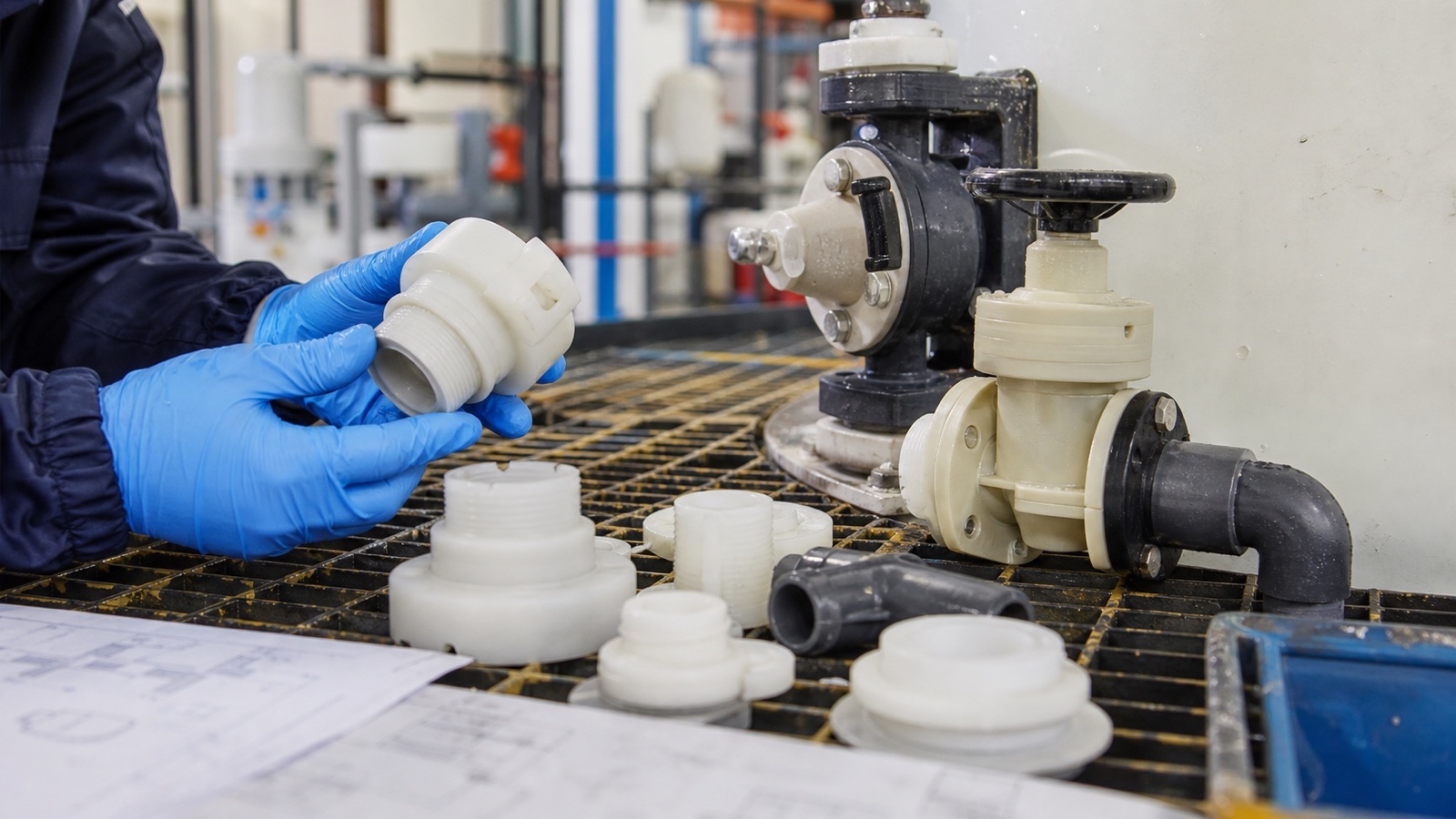
Precision CNC turned and milled fluid-handling parts produced at PlasticCNCPro from high-performance polymers.
Chemical Resistance Profiles
Polypropylene demonstrates outstanding chemical resistance against aqueous salts, mild alkalis, and dilute mineral acids such as hydrochloric acid (up to 37%) and non-oxidizing solutions. However, when exposed to strong oxidizing media—such as fuming nitric acid, 98% concentrated sulfuric acid, wet chlorine gas, or ozone—PP undergoes severe molecular chain scission. This embrittlement leads to micro-cracking and sudden catastrophic leakage.
PVDF, in contrast, remains virtually inert across aggressive oxidizing chemicals, halogens (chlorine, bromine), and strong mineral acids even at elevated temperatures. The primary blind spot for PVDF is high-concentration caustic solutions (such as 50% sodium hydroxide at hot temperatures) and strong polar solvents like acetone, MEK, and DMAc, which can attack the fluoropolymer matrix.
Thermal Performance Limits
Temperature is often the definitive criterion in process valve selection:
PP Thermal Profile
Continuous maximum service temperature sits around 82°C (180°F). Above 60°C, PP rapidly loses rigidity, resulting in severe derating of operating pressure for machined valve bodies and flanged connections.
PVDF Thermal Profile
Maintains high structural integrity and mechanical modulus up to 140°C–150°C (284°F–302°F). When line cleanouts, steam purge cycles, or exothermic dilution reactions occur, PVDF remains stable where PP softens and warps.
Mechanical Strength and Creep Resistance
For machined valves and pressurized tanks, long-term deformation under static mechanical load (creep) is critical. Bolted flanges on PP valves often require routine torque checks because PP undergoes noticeable cold flow over continuous load cycles. PVDF possesses roughly 40% higher tensile strength and a significantly higher flexural modulus than PP. This makes PVDF valve bodies, valve stems, and threaded port fittings far less prone to thread stripping, flange distortion, or creeping under continuous gasket seating loads.
Purity and Leaching Characteristics
In semiconductor wafer fabrication and pharmaceutical fluid lines, chemical purity is just as critical as chemical containment. Standard industrial Polypropylene resins contain processing stabilizers, plasticizers, and metallic catalyst residues (such as titanium or aluminum compounds from Ziegler-Natta catalysts) that can extract into ultrapure water (UPW) or aggressive etching chemicals.
High-purity grades of PVDF are polymerized without plasticizers, flame retardants, or UV stabilizers. The resulting machined component provides an ultra-smooth internal bore with minimal TOC (total organic carbon) and negligible trace metal extractables.
When to Choose Polypropylene (PP)
Polypropylene remains the go-to resin across thousands of fluid-handling projects for solid engineering reasons:
For massive 5,000 to 20,000-liter storage tanks and secondary containment systems, PVDF is economically impractical. PP delivers dependable corrosion resistance at a fraction of the raw material cost.
PP handles ambient-temperature plating lines, municipal water chlorination buffer tanks, pickling lines, and neutralized acid/base waste streams with zero operational risk.
PP cuts quickly with standard carbide tooling and features a broad, forgiving thermal welding window (hot gas welding, extrusion welding, and butt-fusion).
When to Choose PVDF (Kynar®)
Upgrading to PVDF becomes non-negotiable when operating boundaries exceed the safe physical envelope of polyolefins:
Critical Application Criterion
If your chemical stream involves ozone-enriched water, concentrated halogens (wet chlorine gas, bromine), concentrated nitric/hydrofluoric mixtures, or continuous service temperatures above 80°C, PVDF is the minimum safe baseline among rigid thermoplastics.
-
Semiconductor & Life Sciences Ultrapure Media
In UPW distribution loops, deionized water manifolds, and biotech processing systems, PVDF prevents contamination risks caused by plasticizer leachables and biofilm accumulation.
-
Flame Spread and Fire-Safe Plenum Environments
PVDF holds a UL 94 V-0 flame rating and meets stringent cleanroom fire-safety standards (FM 4910). Unlike PP, which melts and burns readily, PVDF self-extinguishes and emits minimal smoke.
-
High-Precision Valve Seats and Internal Components
When we CNC machine tight-tolerance ball valve seats, diaphragm weir bodies, or threaded metering needles, PVDF yields finer thread definition, minimal burring, and superior long-term dimensional retention.
Critical Considerations: Installation and Lifecycle Costs
Evaluating materials strictly by raw sheet or rod price per kilogram is a common procurement pitfall. The actual cost of a fluid-handling component must account for machinability, joining expertise, maintenance intervals, and process downtime risk.
Initial Investment vs. Total Cost of Ownership (TCO)
PVDF stock shapes cost roughly 4 to 6 times more than equivalent PP stock. However, in aggressive chemical environments where PP components fail in 8 to 14 months, the labor cost, plant downtime, fluid loss, and environmental cleanup quickly eclipse the upfront polymer cost difference. A precision-machined PVDF valve regularly delivers an operating lifespan of 5 to 10+ years without significant wear or creep.
Fabrication, Welding, and Machining Tolerances
From a CNC machining standpoint in our shop:
Machining Characteristics: Polypropylene is softer and prone to thermal distortion if tool feeds and chip evacuation are unoptimized. It tends to generate stringy chips and burrs on fine threads. PVDF is more rigid and chips cleanly, allowing us to hit tight valve seat tolerances (±0.025 mm) with smooth surface finishes ($Ra < 0.8\ \mu\text{m}$).
Joining and Welding: Polypropylene is forgiving to field weld with portable hot gas welders. PVDF requires strict infrared (IR), non-contact butt fusion, or cleanroom beadless welding technology to maintain joint purity and avoid thermal degradation of the fluoropolymer chains.
Risk Mitigation and Environmental Safety
For secondary chemical containment or exterior piping networks exposed to solar radiation, PVDF inherently resists UV degradation and atmospheric weathering without protective black carbon additives. PP tanks installed outdoors without carbon-black loading or UV inhibitors can experience severe surface chalking and embrittlement within 24 to 36 months.
Frequently Asked Questions
What are the main downsides of using PVDF?
The primary limitations are high raw material cost, nearly double the material density compared to PP (1.78 g/cm³ vs 0.91 g/cm³), and poor chemical compatibility with strong polar solvents (such as acetone, ethyl acetate, and MEK) or hot, high-concentration caustic solutions.
Which plastic is more chemically resistant overall?
PVDF offers significantly broader resistance against aggressive oxidizers, halogens, concentrated acids, and high temperatures. However, for ambient, non-oxidizing acids and strong alkaline solutions (such as sodium hydroxide), Polypropylene matches or outperforms PVDF at a fraction of the cost.
How can I confirm if PVDF is chemically compatible with my mixture?
Always review a comprehensive chemical resistance matrix that specifies both concentration percentage and exact continuous operating temperature. Trace contaminants (such as cleaning solvents or surfactant flushes) often trigger stress cracking in PP or chemical attack in PVDF. We frequently review 2D/3D component drawings alongside fluid chemistry specs to help customers choose the safest grade.
Can PP and PVDF be used for high-pressure industrial valves?
Yes, but pressure ratings depend directly on operating temperature, wall thickness, and reinforcement design. PVDF components maintain mechanical rigidity under elevated line pressure better than PP. For pressures exceeding 150 PSI (10 bar) at ambient temperatures, valve bodies require careful wall thickness verification and stress analysis.
Conclusion: Making the Final Decision
To simplify your design choice, use this practical rule of thumb:
Specify Polypropylene (PP) when fluid temperatures stay below 80°C, solutions are non-oxidizing (neutral salts, mild acids, caustic alkalis), equipment weight is a factor, or you need maximum budget economy on large storage tanks.
Upgrade to PVDF when handling concentrated oxidizers or halogens, operating at temperatures up to 140°C, maintaining ultrapure fluid streams without leachables, or requiring high-precision valve bodies with strict dimensional stability and fire retardancy.
At PlasticCNCPro, we machine custom PP, PVDF, PTFE, and PEEK fluid-handling components from prototype batches to repeat production runs. If you have an active valve, manifold, or tank component project, our engineering team can review your CAD models, tolerance callouts, and operating conditions to recommend the most reliable, cost-effective plastic.
Send Your Drawing or CAD File for Material Review
Share your 2D drawings, 3D step models, target resin requirements, and operational environment. Our application engineers will evaluate manufacturability, tolerances, and supply an actionable quotation.